
How to Price a Monthly Retainer for Your Service Business
By Noah Cohen, founder of revday · 5 min read
To price a monthly retainer, work out what one month costs you to deliver, including your own pay, then add your margin on top. Write down what the client gets each month, how fast you reply and what costs extra. Offer it first to a client who already books you often. This guide shows the sum with two made-up examples, a landscaper and a coach.
When does a retainer suit a service business?
A retainer suits work that repeats every month and that the client wants kept steady. Gardening, cleaning, bookkeeping, maintenance checks and coaching all fit. If every job is a different size, a fixed price per project works better.
For the client, a retainer means one known cost each month. For you, it means income you can plan around. The risk is that extra requests slowly fill the month, so the price and the limits need to be set together. The guide on how to price your services compares hourly, project and retainer pricing before you choose.
How do you work out the monthly price?
Add up what the month costs you to deliver, then add your margin on top. Include your own pay in the cost, because your time is part of what the client is buying. Round the result to a clean number.
The numbers below are examples made up to show the sum. They are not real clients.
A landscaper keeps a body corporate's grounds tidy each month:
12 hours of work at $45 an hour, which includes the landscaper's own pay: $540
Fuel, tools and dump fees: $100
Cost to deliver the month: $640
A 30% margin on top: $192
Price: $832, rounded to $830 a month
A coach works with one client each month:
Two one-hour calls, plus one hour of preparation and follow-up for each: 4 hours
Replying to messages: 2 hours
Notes and admin: 1 hour
7 hours at $80 an hour, which includes the coach's own pay: $560
Software and other costs: $40
Cost to deliver the month: $600
A 30% margin on top: $180
Price: $780 a month
The 30% is only for the examples. Your margin depends on how steady your work is and how much risk you carry, so use your own number.
What should a retainer include?
A retainer should say in plain words what the client gets, how quickly you reply, and what is not covered. Write these five things down before you offer it:
The work you do each month, with numbers, such as four visits or two calls.
How quickly you reply to messages, such as within one business day.
What is not included, and how it is priced.
The start date and the day of the month you invoice.
How either side ends the arrangement.
How do you stop extra requests filling the month?
Say yes to extra requests, at a separate price you have written down. The retainer covers what you listed, and anything beyond it is quoted on its own. That keeps the client happy and keeps the extra hours from coming out of your margin.
Price the extra work from your hourly cost plus the same margin. In the coach example, one extra hour is $80 plus 30%, which is $104. Tell the client the price before you start:
Hi [name], I can do that. It sits outside your monthly [service], so it would be [price]. Reply yes and I will fit it in this week.
How do you offer a retainer to an existing client?
Offer it to a client who already books you often, in a short message with the price, what is included and a start date. These clients already know your work, so there is little to explain.
Hi [name], you have booked me [every month / most months] for [service]. I can set it up as a monthly plan for [price]: [one line on what is included]. It starts on [date] and is billed on the [day] of each month. Would you like me to send the details?
Invoice at the start of the month, not the end. A deposit works the same way, with money in before the work starts, and why deposits change everything shows how to ask for one. The guide on how to get paid on time covers what happens after the invoice goes out.
A small saving for committing can work. Check first that the lower price still covers your costs and your margin.
What if a client wants to stop or pause?
Agree this before you start, and put it in writing. Set a notice period that gives you time to replace the income, such as one full billing cycle. Decide what happens to a month the client has already paid for.
A pause can keep a client you would otherwise lose. Allow one for a set number of months, then restart at the same price.
Review the price once a year. When your costs go up, tell the client in writing, and use how to raise your prices without losing clients for the message.
Where should you start?
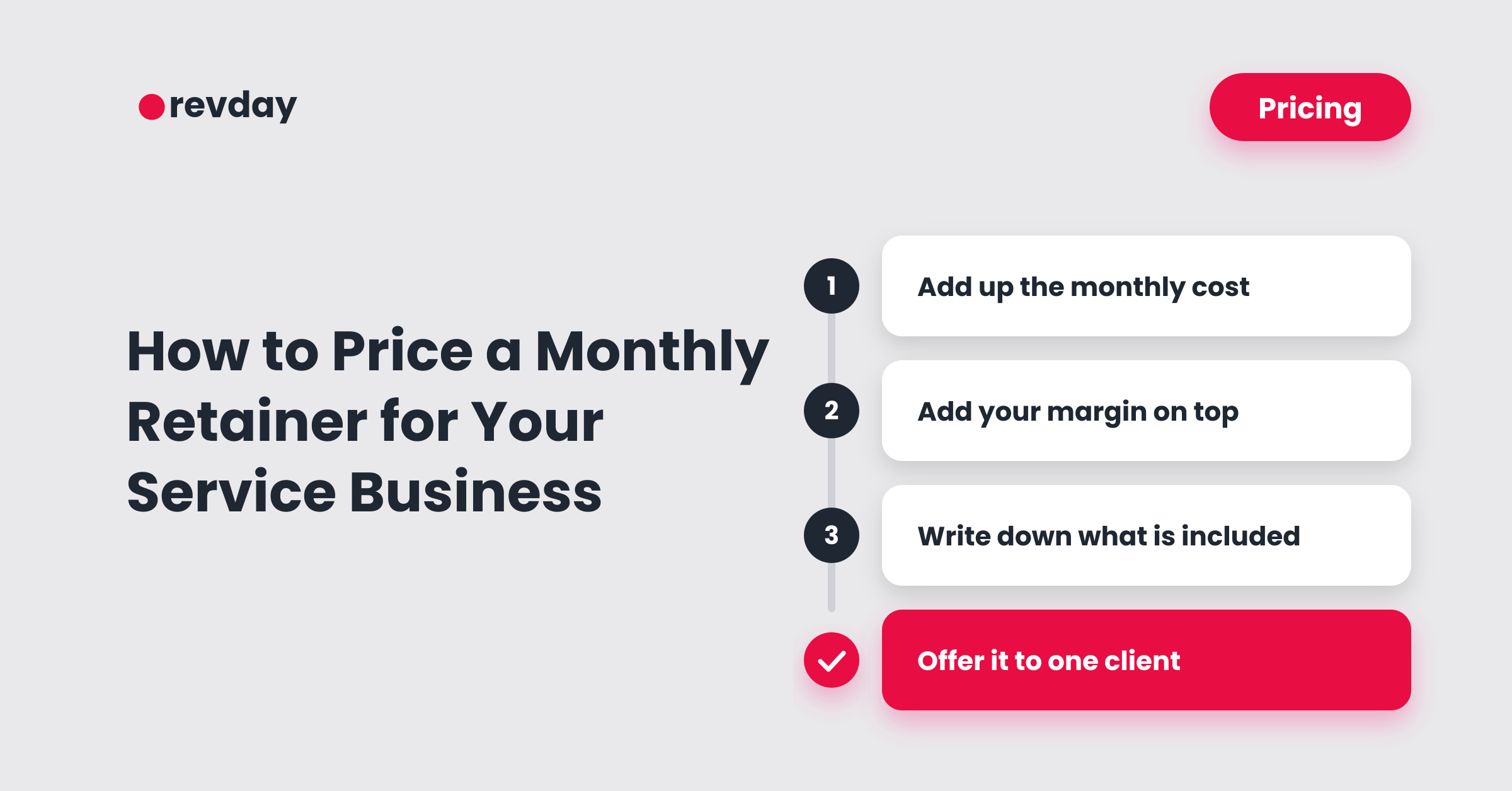
Start with your numbers, then take the steps in this order:
Add up what one month costs you to deliver, including your own pay.
Add your margin on top and round the price.
Write down what is included, how fast you reply and what costs extra.
Offer it to the client who books you most often.
After the first few months, compare the hours you planned with the hours you spent.
If you want help setting the number and building packages around it, the AIM programme does that with you over 12 weeks. You can also book a free clarity call.

