
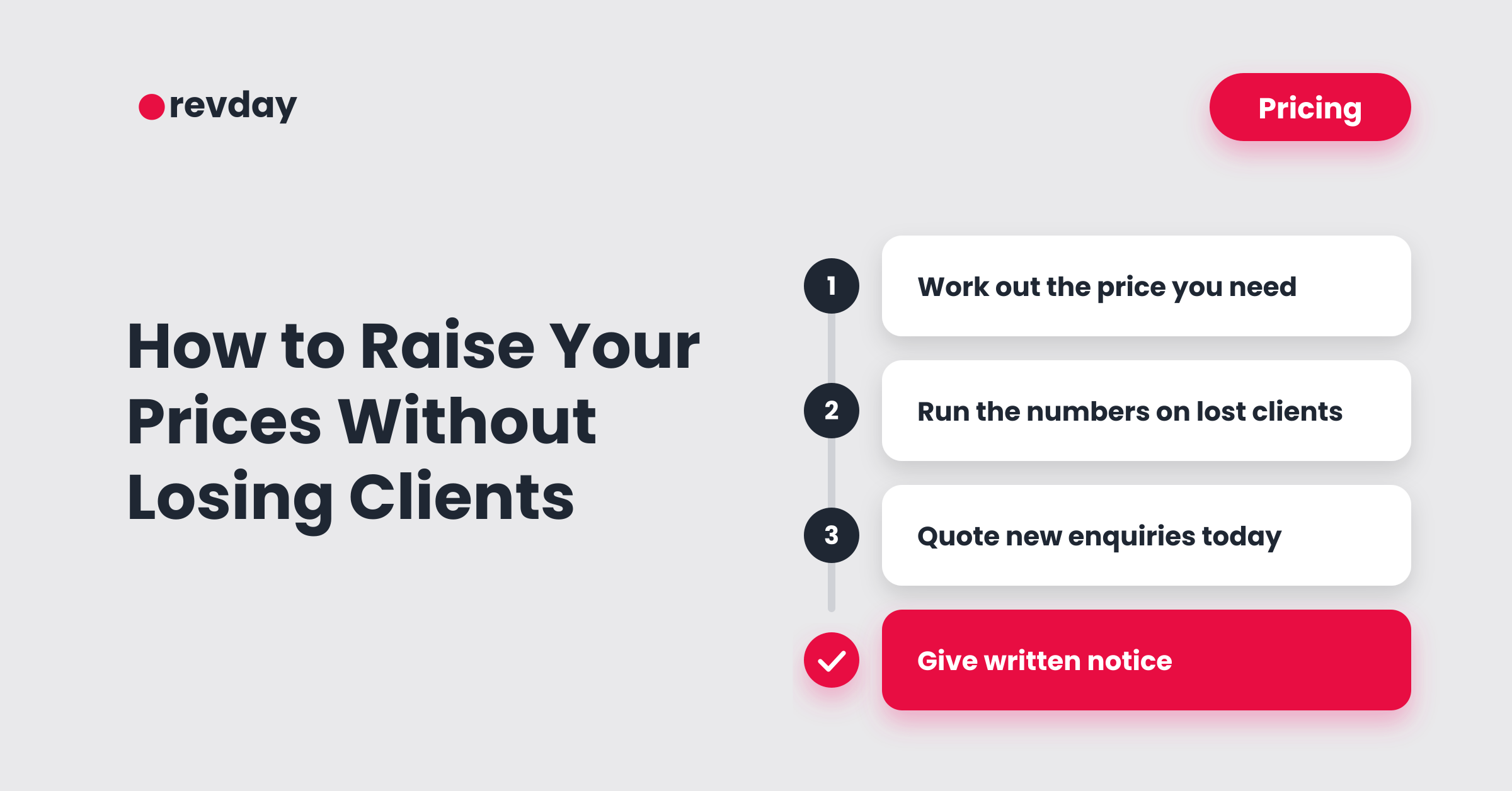
How to Raise Your Prices Without Losing Clients
By Noah Cohen, founder of revday · 6 min read
You can raise your prices without losing clients by working out the new price from your costs, charging it to every new enquiry straight away, and giving existing clients written notice with a start date. Keep the message short and let current bookings finish at the old price. Some clients may leave, so this guide shows how many you can afford to lose and what to say to the ones who push back.
How do you know it's time to raise your prices?
Your costs have gone up, or you have not changed your price in a year or more. Either one is enough. Insurance, fuel, software and your own skills all move, so a price set two years ago may no longer cover them.
Other signs point the same way. Almost every quote gets a quick yes with no questions. You are booked out, yet little is left after bills and tax. You give discounts without checking what they cost you. If several of these sound like you, your price is probably too low. The pricing guide, how to price your services, lists each sign and shows how to work out your break-even price.
How much should you raise your prices by?
Work out the number from your costs, not from a guess about what clients will accept. Add up what it costs you to deliver the job, add your margin, and the result is the price you need. The gap between that price and your current price is your increase.
No single percentage suits every business, because it depends on how steady your work is and how much risk you carry on each job. If the gap is large, you can move in two steps with a few months between them.
How many clients can you afford to lose?
Do the sum before you send anything. Say you have eight clients paying $200 a month, which is $1,600. You raise the price by 15% to $230. If one client leaves, seven clients pay $1,610, so your income is level and you have a client's worth of hours back.
That means you can lose about one client in eight after a 15% increase before your income drops. A bigger increase gives you more room and a smaller one gives you less, so run the sum with your own numbers.
Should new clients pay the new price straight away?
Yes. Quote the new price to every new enquiry from today. New clients have no old price in their heads, so there is nothing to explain. It also shows you how the new price lands before you tell anyone who already works with you.
How much notice should existing clients get?
Enough that no client finds the new price on an invoice. Give notice that covers at least one full billing cycle, and longer for a bigger increase. Check your agreement first, because some set a notice period you have to follow.
Put the start date in writing and let any booking already made finish at the old price.
What should a price increase message say?
Say what changes, when it changes and what stays the same. Leave out the apology and the cost breakdown. A long explanation invites an argument about each line, and a short message reads as a decision.
For a client who books job by job:
Hi [name], a quick heads up that from [date] my price for [service] will be [new price]. Anything booked before then stays at [old price]. If you would like to book your next one before [date], you can pick a time here: [link]. Thanks for your business.
For a client on a monthly fee:
Hi [name], from your billing date on [date], your monthly fee moves from [old price] to [new price]. What you get stays the same: [one line on what is included]. If you would like to talk it through, reply here or pick a time: [link].
Can you keep a client's old price if they pay upfront?
Yes, as a trade. For clients you want to keep, you can offer to hold their current price if they pay for the next 12 months upfront. You get the cash now and they get certainty. Say it plainly:
Hi [name], my prices are going up for new clients from [date] because my costs are going up. I am happy to keep yours the same if you pay upfront for the next 12 months. Let me know and I will send the invoice.
Check two things before you offer it. Your current price has to cover your costs with a margin for the whole 12 months, because you are locking it in while costs keep moving. And decide what happens to the unused months if a client stops partway, then put it in writing. If 12 months is too much to ask, a shorter period paid upfront still works.
What do you say when a client pushes back?
Ask what they are comparing the price with, then go back to what the price includes. If you give something, get something: a smaller scope or payment upfront in return, so the discount does not come only out of your margin. Decide before you send the message which clients, if any, get an exception, so you are not deciding under pressure.
A deposit helps here too. Why deposits change everything shows how to ask for one, and how to get paid on time covers what happens after the invoice goes out.
What if a client leaves?
Thank them for the work and tell them they are welcome back. Then check the sum from earlier. If your income is level or higher, the hours they leave behind are free for a client at the new price. If it is lower, review your costs and your list before the next increase.
Where should you start?
Start with your numbers, then take the steps in this order:
Work out the price you need from your costs.
Run the sum on how many clients you can afford to lose.
Quote the new price to every new enquiry from today.
Send written notice to existing clients, with a start date and the option to hold their price by paying upfront.
Let bookings already made finish at the old price.
If you want help setting the number and building an offer around it, the AIM programme does that with you over 12 weeks. You can also book a free clarity call.

