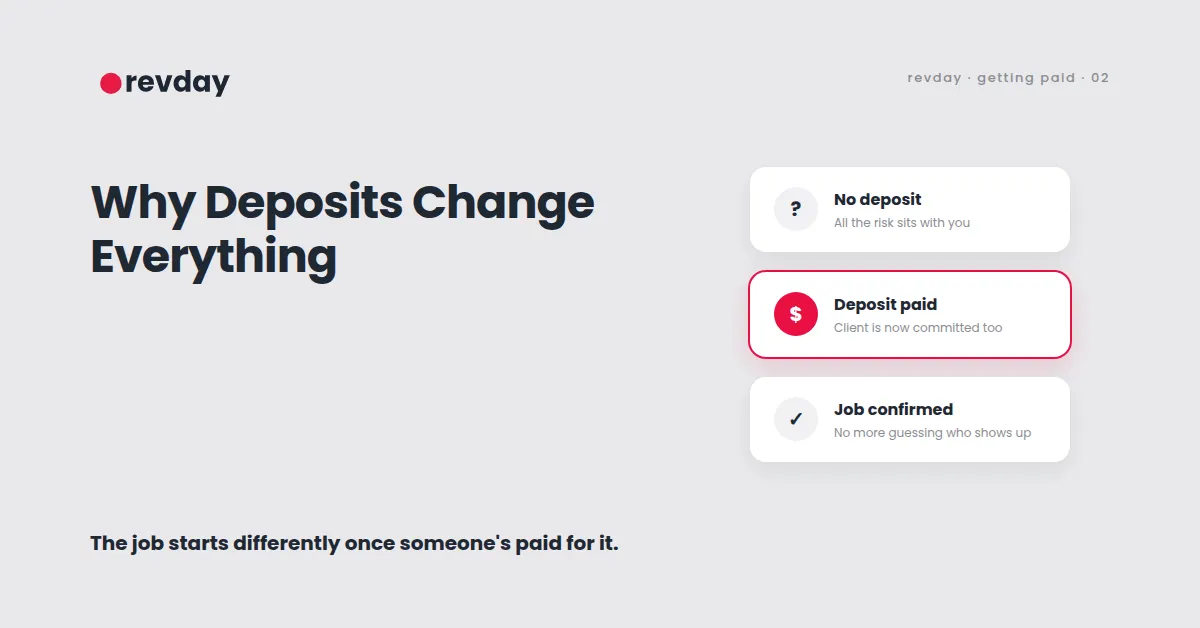
Why Deposits Change Everything for Your Business
A new client books you in. No deposit, nothing upfront, just a verbal yes and a date in the calendar. Three days before the job, they go quiet. Maybe they found someone cheaper. Maybe they never really committed in the first place. Either way, you've blocked out the time, turned away other enquiries, and now you've got nothing.
This happens constantly to service businesses that don't take a deposit, and almost never to the ones that do.
A deposit isn't a money grab. It's the moment a client moves from "thinking about it" to actually committed. Without one, you're carrying all the risk of someone changing their mind, and you won't find out until the day the job was supposed to happen. This is one piece of the bigger picture covered in how to get paid on time without chasing invoices.
What a deposit actually does
Most owners think of a deposit purely as cash flow protection, and it is that. But its bigger job is filtering.
A client willing to pay something upfront has already decided you're worth booking. A client who balks at the idea, or tries to negotiate it away, is telling you something important before you've spent a single hour on their job. That information is valuable, and it's free. You just have to ask the question.
Without a deposit, every enquiry looks the same on the surface. Serious clients and tyre kickers all sit in the same calendar slot, and you find out which is which the hard way, usually by getting stood up.
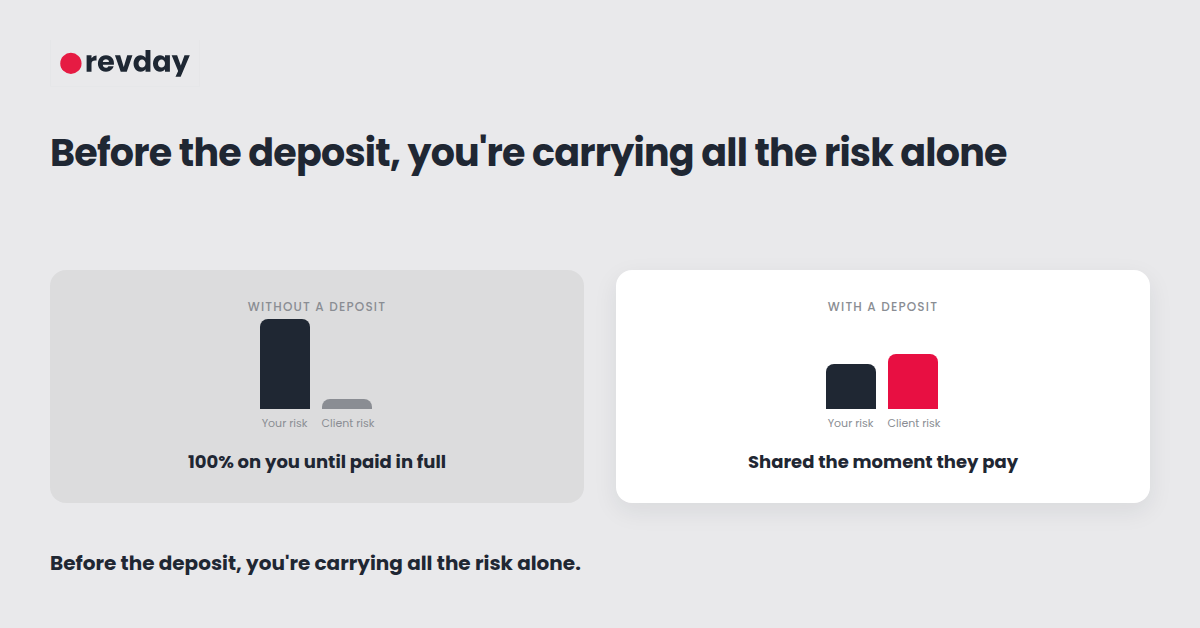
The risk sits with you until someone pays
Right now, if you don't take deposits, here's what's actually happening: you do the quoting, the planning, the back and forth, and you hold a time slot open, all before a single dollar changes hands. If the client cancels, disappears, or simply forgets, you've absorbed all of that cost and you have nothing to show for it.
A deposit flips who's carrying the risk. The moment it's paid, the client has something on the line too. They're not just hoping to remember the appointment, they've already made a financial commitment to it. That changes behaviour. People show up for things they've paid for.
How much to ask for
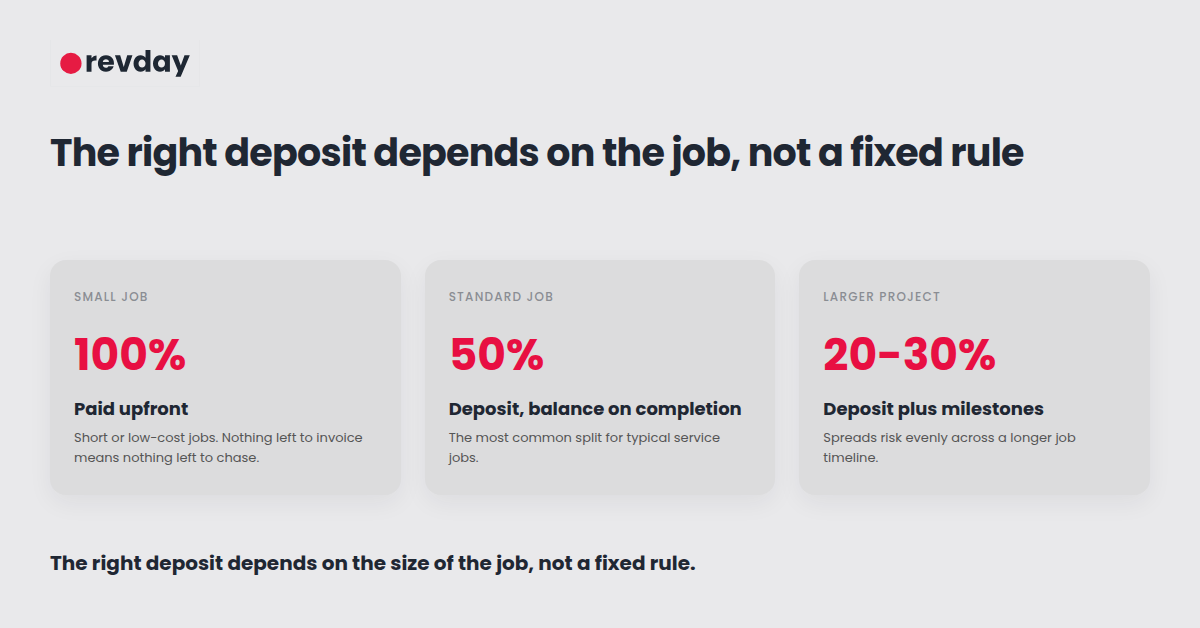
There's no single right number, but a few patterns work well depending on the job.
For smaller, shorter jobs, 50% upfront with the balance on completion is common and easy for clients to understand. For larger projects that run over weeks or months, a smaller deposit (often 20-30%) combined with milestone payments spreads the risk more evenly across the whole job rather than putting all the weight on day one.
For very short or low-cost services, taking full payment upfront often makes more sense than splitting it at all. If there's nothing left to invoice after the job, there's nothing left to chase either.
[INSERT IMAGE: spoke1-inline-2-deposit-by-job-type.png | Alt text: Three card graphic showing typical deposit percentages for small, medium, and large service jobs | Caption: The right deposit depends on the size of the job, not a fixed rule.]
The number matters less than the consistency. Pick a structure that fits your typical job size, then apply it the same way every time. The moment it becomes a case by case negotiation, you've turned a simple policy into an awkward conversation, which defeats the purpose.
What to say when you ask
The request itself doesn't need to be complicated or apologetic. Something direct works better than something soft: "To lock in your booking, I'll send through an invoice for the deposit, the balance is due once the job's finished." Said plainly, as a normal part of how you operate, it rarely gets pushback. This is often the same conversation covered in how to run a discovery call that converts, since the deposit ask usually comes right after.
If a client does push back on a standard deposit, that's useful information too. It's one of the clearest early signals that a relationship is going to be difficult before you've invested any real time.
Make it part of the process, not a one-off ask
The businesses that get the most value from deposits aren't the ones with the best negotiating skills. They're the ones where asking for a deposit isn't really an "ask" at all, it's just what happens after a booking is confirmed, every time, automatically. Late payments aren't a client problem. They're a business design problem, and the same logic applies before the work even starts: if collecting a deposit depends on you remembering to bring it up, it'll get skipped on your busiest weeks, which is exactly when you can least afford to skip it.
Once it's built into how bookings are confirmed, there's no decision to make and no awkward moment to get through. The client pays the deposit as part of locking in their spot, the same way they'd expect to pay a deposit for almost any other service they've booked in their life. The next piece worth sorting alongside this is what to include in a service agreement, even if you're solo.

