How to Run a Discovery Call That Converts
You got someone on a call. That is not nothing, most people never get this far.
But a discovery call is not a finish line. It is the moment everything either comes together or falls apart. And for most new service business owners, it falls apart, not because they are bad at what they do, but because no one ever showed them how to run the call.
This guide changes that.
What a Discovery Call Actually Is
A discovery call is not a pitch. It is not an interview. It is a structured conversation where both sides work out whether they are a good fit.
That framing matters. When you treat the call as a pitch, you spend the whole time trying to convince someone to hire you. When you treat it as a mutual evaluation, you ask better questions, listen more carefully, and end up with better clients.
The best discovery calls feel like a good conversation with a trusted advisor, not a sales presentation.
Why Most Discovery Calls Fail to Convert
Before getting into the structure, it helps to understand where things go wrong.
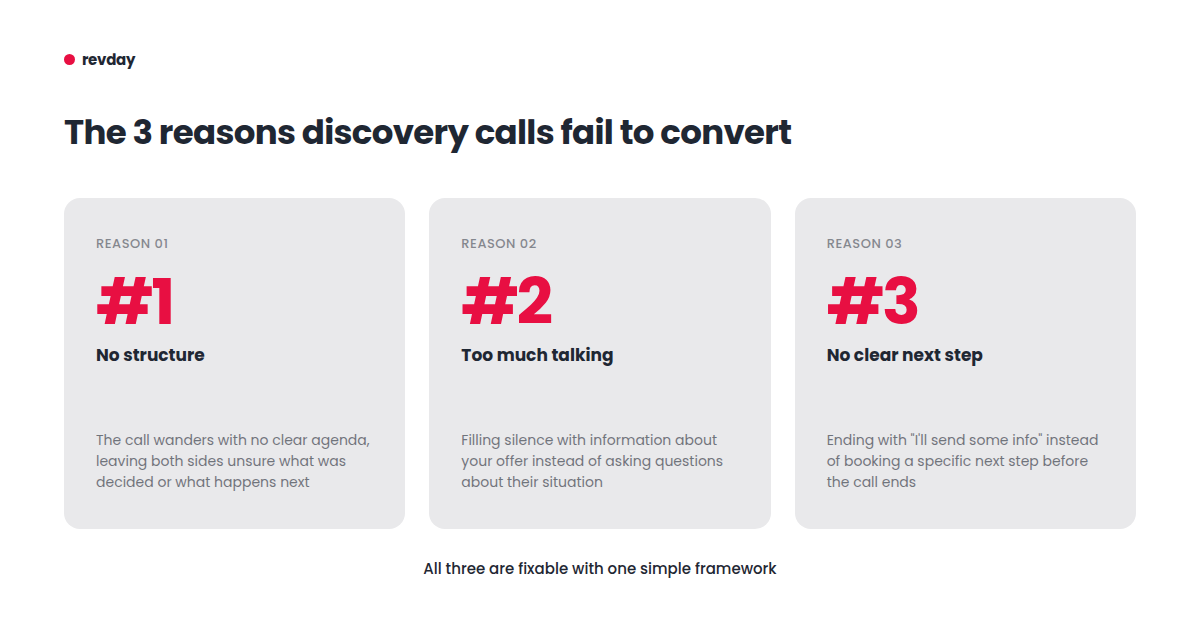
No structure. The call wanders. The prospect talks about their situation, you talk about your services, and by the end neither of you are sure what just happened.
Talking more than listening. Most people who are new to sales talk too much. They fill silence with information about their offer when they should be asking questions about the prospect's situation.
No clear next step. The call ends with vague phrases like "I'll send you some information" or "let me know if you want to move forward." No date, no deadline, no decision. These calls rarely convert.
The good news is that all three of these are fixable with a simple framework.
If getting calls is still the challenge before converting them, start with how to get clients for a new service business first.
The Discovery Call Structure That Works
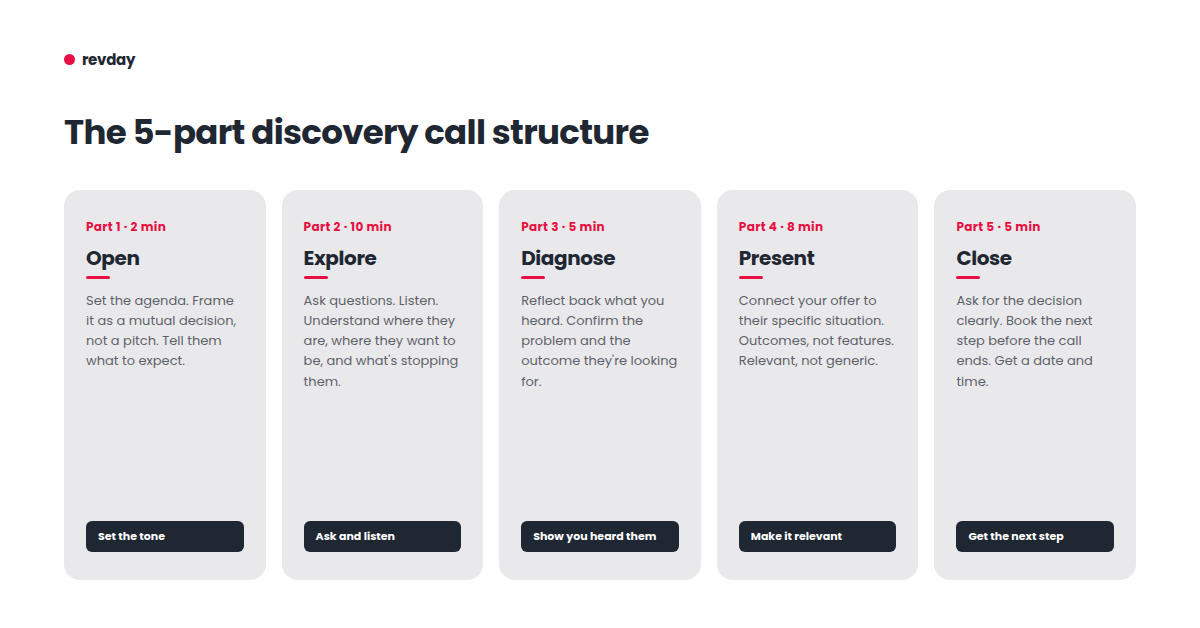
A discovery call has five parts. Each part has a job. When all five work together, conversion becomes natural, not forced.
Part 1: Open (2 minutes)
Set the agenda at the start. Not a long preamble, just a simple sentence.
"I've got about 30 minutes set aside. My plan is to ask you a few questions about where things are at in your business, tell you a bit about how we work, and then we can both decide together whether it makes sense to go further. Does that work?"
This does two things. It tells the prospect what to expect, and it frames the call as a mutual decision rather than a sales process. Both are important.
Part 2: Explore (10 minutes)
Ask questions. Listen. Take notes. This is the most important part of the call and the part most people skip.
You are trying to understand three things: where they are now, where they want to be, and what is stopping them from getting there.
Good questions for this section:
"Tell me a bit about where things are at in your business right now."
"What made you reach out at this point?"
"What have you already tried?"
"What does success look like for you in the next six months?"
Do not interrupt. Do not jump in with solutions. Just ask and listen.
Part 3: Diagnose (5 minutes)
Summarise what you heard back to them in your own words. This is not a trick, it is genuinely useful for both sides.
"So from what I'm hearing, the main challenge is [X], and you've already tried [Y], and what you really want is [Z]. Is that right?"
This shows you were listening. It also gives the prospect a chance to correct or refine what they told you. Often, hearing their situation reflected back helps them see it more clearly themselves.
Part 4: Present (8 minutes)
Only now do you talk about what you do. And you do it in the context of what they just told you, not as a generic overview of your services.
"Based on what you've shared, here's how I'd approach this..."
Connect every part of your offer to a specific problem they mentioned. Don't present features. Present outcomes that are relevant to their situation.
Part 5: Close (5 minutes)
Ask for the decision. Not aggressively, clearly.
"Based on what we've talked about, does this feel like a good fit for where you are right now?"
If yes, book the next step on the call. A follow-up session, a proposal review, an onboarding call, whatever is appropriate. Get a date and time before you hang up.
If they're not sure, ask what would need to be true for them to feel confident. This either surfaces a real objection you can address, or it tells you they are not a good fit right now.
Before the Call: What to Do in the 24 Hours Prior
The call itself is only part of the equation. What you do before the call matters just as much.
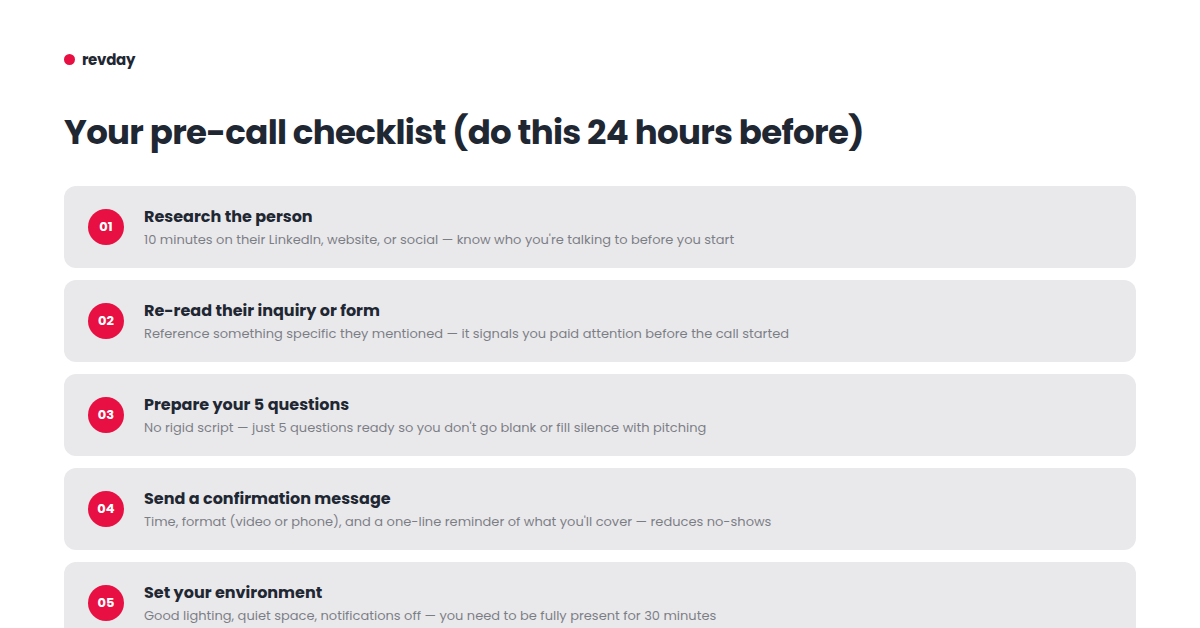
Research the person. Spend 10 minutes looking at their LinkedIn, their website, or their social media. Know who you are talking to before you start asking questions.
Review your notes from first contact. If they filled out a form or sent an inquiry, re-read it. Reference something specific they mentioned, it signals you paid attention.
Prepare your questions in advance. You don't need a rigid script, but have five questions ready that you know you want to ask. This stops you from going blank or filling silence with pitching.
Confirm the call. Send a brief confirmation message the day before. Include the time, the format (video call, phone), and a one-line reminder of what you'll be covering. This reduces no-shows significantly.
Set your environment. Good lighting, quiet space, no notifications. You need to be fully present for 30 minutes. That is all this requires.
If you are still working on who your ideal client is before this stage, the post on how to find your ideal client is worth reading first.
What to Do When They Say They Need to Think About It
"I need to think about it" is the most common response at the end of a discovery call. It is not a no. It is a signal that something is unresolved.
The right response is to gently find out what that thing is.
"Of course, completely understand. Just so I can be helpful, is there a specific part you want to think through, or is it more of a timing thing?"
Most of the time they will tell you. And most of the time, it is something you can address.
If it is genuinely timing, offer to follow up at a specific date. If it is a concern about fit or cost, address it directly and honestly. If they are not the right fit, say so, it saves both of you time.
The full picture on why clients sometimes say no, even when the fit seems right, is covered in Why You're Not Getting Clients (The Real Reasons).
After the Call
Send a short follow-up message within two hours. Not a long proposal, just a brief note summarising what you discussed, what was agreed, and the next step.
Keep it to three short paragraphs. The follow-up serves as a record of the conversation and a soft confirmation of the next step. It also keeps momentum going while the call is fresh in their mind.
What Comes Next
Once your discovery call converts and a client signs on, the next question is how to grow beyond organic referrals and outreach. That is where paid advertising becomes relevant, but only once the right foundations are in place. We cover exactly when it makes sense to start in When to Start Running Ads for Your Business.
You Do Not Have to Figure This Out Alone
A great discovery call is a learnable skill. Like anything, it gets easier with practice, but the practice is a lot more productive when you have the right structure and someone in your corner to review what's working.
That is what revday is built for. We work alongside you, give you the platform to run your business, and make sure the conversations you're having are turning into clients.
This post is part of the revday Client Acquisition Series. Previous: How to Get Clients for a New Service Business Next: When to Start Running Ads for Your Business