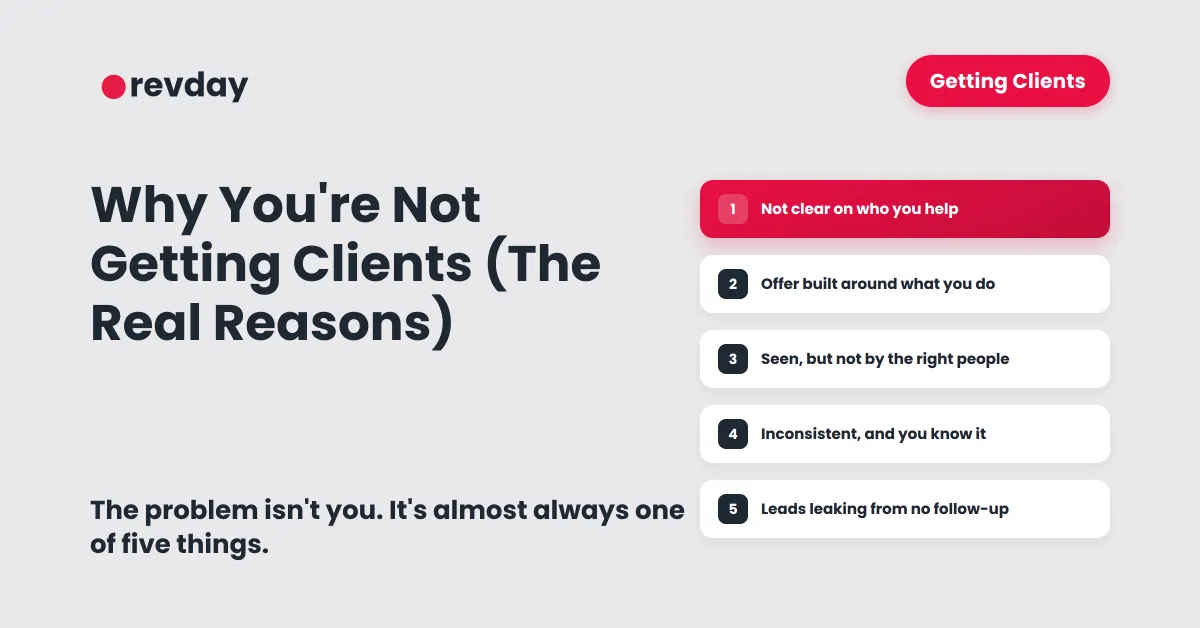
Why You're Not Getting Clients (The Real Reasons)
If you're doing the work, posting on LinkedIn, sending the messages, taking the calls, and the clients still aren't coming, you've probably already worked out it's not for lack of effort.
So you're left with the more uncomfortable question. Why.
There's a temptation, when you're four months into trying, to assume the problem is you. It usually isn't. The actual cause is almost always one of five things, and most of them are fixable inside a fortnight once you know which one you're dealing with.
This post walks through them. I'll be direct about each, give you something concrete to do about it, and tell you which one to look at first.
If you want the bigger picture of how getting clients actually works for service businesses, the pillar post on getting clients covers the full picture. Otherwise, here's what's probably going wrong.
Reason 1: You're not clear on who you actually help
This is the most common cause by a long way. I'd put it at roughly 60% of the cases I see.
The way it shows up: your messaging sounds reasonable in your own head, but when you say it out loud at a networking event, people nod politely and the conversation moves on. Your LinkedIn profile reads fine and gets no enquiries. Your cold emails are technically well-written and get no replies.
The cause is almost always that you're describing what you do in language that could fit fifty other businesses. "I help people grow their business." "I work with founders to scale." "I support service businesses with their marketing." None of those sentences make a real reader stop and think "this is for me."
The fix takes about half a day. Pick one specific kind of person at a specific stage with a specific problem, and rewrite your one-liner around them. "I help boutique consultants in their first year stop chasing clients and start signing them" does more work in fifteen words than three paragraphs of generalist copy ever will.
The pushback I hear most often is some version of "but I don't want to turn away the other types of clients I could help." Fair concern. Wrong logic. A specific message attracts the right person and doesn't actually repel the others. A generalist consultant might still hire someone whose tagline is about boutique consulting in the first year, especially if the underlying problem rings true. The reverse almost never happens. Vague messages don't pull in a wider audience. They just pull in nobody, very evenly.
Reason 2: Your offer is built around what you do, not what they get
People don't buy services. They buy outcomes.
If your website talks about your six-step methodology, your years of experience, and your collaborative approach, you're describing the drill. Your client wants the hole.
Look at how you describe what you sell. Count the sentences that are about you versus the sentences that are about the result the client gets. If the ratio is anywhere near even, you've got a problem. The healthy ratio is roughly one sentence about you for every four about them.
Easy fix: take your current service description and rewrite every sentence that starts with "I" or "we" so it starts with "you." If the sentence breaks when you do that, the sentence wasn't earning its place. Cut it.
A concrete example. Bad version: "I bring 12 years of operational consulting experience and a proven six-step methodology to help businesses optimise their workflows." Cuts to: "You'll stop running the business out of your inbox and start running it from a system you can hand to someone else." Same service, completely different reading experience.
There's a deeper version of this trap worth flagging. Some service businesses describe outcomes, but the outcomes they describe are still abstract. "Grow your business." "Scale your revenue." "Transform your marketing." Those are outcomes only in the loosest sense. They're closer to slogans. The outcomes that actually convert are concrete enough that a reader can picture them. "Stop checking emails on Sunday nights." "Get out of the bottleneck of every client decision." "Have a steady five new enquiries a month without posting on LinkedIn every day." Specific. Visible. Believable.
Reason 3: You're being seen, but not by the right people
There's a version of this problem where the marketing is technically working. Your posts get likes. Your profile gets viewed. Your content gets shared. And none of it produces clients.
That's an audience match problem, not a marketing problem. You're being seen by the wrong people, or by people at the wrong stage to buy what you sell.
The check takes ten minutes. Look at your last 20 LinkedIn post likers. Look at the last 30 people who engaged with your content. What percentage of them are actually your ideal client? If it's under 30%, the channel is producing reach but the wrong reach. You either need to change what you're posting, where you're posting it, or who you're connecting with.
The fix is rarely "post different content." Usually it's "connect with different people." Spend a week sending 100 connection requests to actual ideal clients (not other consultants in your space, which is what most people accidentally do) and the engagement quality changes dramatically.
Why this happens to almost everyone at some point: when you're starting out, the easiest people to connect with on LinkedIn are other people in your industry. They reply to your DMs because they understand what you do. They engage with your posts because they find them interesting. The platform shows you more of those people because of who you've connected with, and within six months your audience is mostly other service providers who will never hire you. It feels like progress and produces nothing.
The audit is uncomfortable but useful. Open your LinkedIn connections. Filter by your last 200. Count how many of them could realistically buy your service. If the answer is under 50, your audience is the issue, not your content.
Reason 4: You're inconsistent, and you know it
This is the reason most owners don't want to look at.
You posted twice last week. None this week because Tuesday was busy. You sent eight cold emails the first week of the month, then got distracted by a project and haven't sent any since. Your follow-ups are ad hoc when you remember.
Two months in, you look back and convince yourself you've been at it consistently. You haven't. You've been at it in bursts of two weeks at a time, with three-week gaps in between, and the channel never gets enough sustained pressure to start working.
Most service business channels need 90 days of consistent effort before they reliably produce clients. LinkedIn doesn't pay out in three weeks. Cold email doesn't pay out in two. Content takes longer than that. The owners who get to consistent clients aren't doing more clever things. They're doing the same thing every week for a year.
The fix isn't motivational. It's structural. Pick the smallest possible weekly commitment you can keep on your worst week (two posts, ten outreach messages, one Friday pipeline review) and keep that floor for 90 days before you decide whether the channel is working.
A way to test whether you've actually been consistent: open your sent folder, your LinkedIn activity, or whichever channel you've been working, and look at the last 12 weeks. Count the weeks where you did the activity. If it's under 9 out of 12, the channel didn't get a fair run, and any conclusion about whether it works is premature. Most owners who tell me a channel "didn't work" did the work for 4 of 12 weeks.
Reason 5: Your leads are leaking out the bottom of a bucket you didn't know was there
This one surprises people. Most service business owners I've seen who say "I can't get clients" actually have leads. They just don't know they have leads.
Someone replies positively to a LinkedIn message and asks for more info. The owner sends a long reply. The lead doesn't respond immediately. Three weeks later, the owner has forgotten the conversation existed. Repeat across seven similar exchanges in a year and that's seven potential clients who quietly evaporated, with no record they ever happened.
The cause is almost always that there's no central place to keep track of leads in motion. Some are in your inbox. Some are in your LinkedIn DMs. Some are in scribbled notes from a coffee meeting. None of them are in one list you actually look at every week.
This is the easiest fix on the page. Open a spreadsheet, or use the CRM you already pay for, and dump every active conversation into it. Add a single "next action" column. Look at it every Friday for 30 minutes. The first review usually surfaces three or four leads the owner had genuinely forgotten existed.
The reason this matters more than it sounds: most service businesses don't actually have a getting-clients problem at the top of their funnel. They have a not-following-up problem at the bottom. Plug that leak first and you'll often find you don't need new tactics, you need the leads you already had.
What to do this week
Read the five reasons above and pick one. Just one.
If you're not sure which, the order I'd suggest is: start with reason 5 (leaking pipeline), because it's the cheapest to fix and often surfaces clients you didn't know were there. Then reason 1 (clarity on who you help), because it makes everything else more efficient. The other three usually resolve themselves once those two are clear.
The trap to avoid is reading this post, agreeing with three of the reasons, deciding to fix all of them, and then doing none of them. Pick one. Do it this week. The others can wait.
And if the bigger question is what to focus on across the whole picture, the pillar post lays out the full strategy for getting clients.
Still not sure which one is yours?
If you've read the five reasons and you genuinely can't tell which one is biggest in your business, that's usually a signal you're earlier in the journey than you think. The Clarity Quiz takes about three minutes and tells you which of the three stages you're at (clarity, foundations, or scale) and what to focus on first.
Or have a look at the Clarity Hub at revday.io/tools, which has free tools (no signup needed) for working through specific bits of this.