How To Get Clients For Your Service Business
If you've spent the last two hours reading articles about getting clients and you're still no closer to having any, this post is for you.
I'll skip the part where I tell you to "build a brand" and "add value." You've read that. It didn't help. Most of what's written on this topic is filler from companies that have never actually run a service business, and you can usually feel that from the second paragraph.
Here's what I'll do instead. I'll walk you through the four things that actually move the needle when a service business is trying to get clients, in the order you should think about them. I'll be specific about numbers, timelines, and trade-offs. And I'll link out to deeper posts on each piece so you can go further on whichever bit applies to you.
Some of this you'll already know. Some of it might annoy you. Read it anyway.
If you already know roughly what's going wrong and you just want to diagnose the specific cause, here's a separate post on the five most common reasons clients aren't coming in. Otherwise, keep going.
Why this feels harder than it should
Most service business owners I talk to are convinced they have a marketing problem. They've tried LinkedIn. They've sent some cold emails. They've thought about running ads. Nothing has clicked, so the assumption is that they need a better tactic.
Usually that's wrong. The real issue sits one step earlier, in how clearly they can answer three questions a potential client is silently asking: who do you actually help, what do they get when they work with you, and why would they pay you now rather than wait.
If those answers are blurry, every channel you try will feel quiet. You'll switch from LinkedIn to email to content to referrals, and each one will feel like it almost works but doesn't. The temptation is to blame the channel. The actual cause is usually upstream.
I've seen this play out enough times to know the pattern. Owner gets four months in, has had 30 conversations and zero clients, decides cold outreach doesn't work, switches to content, gets six months further in, decides content doesn't work, goes back to outreach. By month 14 they've tried everything and concluded the market is broken. The market isn't broken. The message was never sharp enough to land in the first place.
Slow down for a week. Get the message right. Then pick up the tactics.
If you've been at this a while and want a closer diagnosis, the post on why clients aren't coming in breaks down the five most common reasons in plain English.
Get clear on who you actually help
There's a particular kind of stuck that comes from trying to help everyone. It feels like the safer bet (more potential clients to sell to) and produces the opposite result (nobody hears themselves in your message).
"Service-based business owners" isn't an audience. "Coaches, consultants, freelancers" isn't an audience either. Those are categories you'd use on a Census form. An audience is a specific kind of person at a specific stage with a specific problem they're losing sleep over.
Compare these two:
"I help small business owners with their marketing."
"I help boutique consultants in their first year stop chasing clients and start signing them."
The first one slides off a reader. The second one stops the right reader cold, because for ten seconds they think the writer might be reading their mind.
You don't need to niche so hard you become unhirable. You need to niche enough that the right person reads your headline and thinks "this is for me, and probably nobody else writes for me like this." That's the bar.
How specific is specific enough?
A test that works: if your description of who you help could be cut and pasted onto a competitor's site without anyone noticing, you're not specific enough yet. If it would feel weird on a competitor's site because it's clearly about a different person, you're getting close.
The two things that usually need to get sharper are stage and problem. Stage means how far along they are: first year, plateaued at five clients, scaling past ten. Problem means the specific pain, not the generic outcome. "Growth" isn't a problem. "Spending more time chasing clients than delivering for them" is a problem. The first won't make anyone read the second sentence. The second will.
Pick the channels you'll actually use
This is where the wheels come off most strategy advice. You'll find lists with 14 channels presented as if they're equivalent options. They aren't. And you can't run all 14, not properly, not while also doing the work you've already sold.
In my experience, the four channels that consistently produce clients for service businesses are referrals, LinkedIn, cold outreach, and content with SEO. Other things help (events, podcasts, partnerships, paid ads) but they sit on top of those four, not instead of them.
The job is to pick two. Not seven. Not five. Two channels you can run for ninety days without burning out.
Picking your two has nothing to do with what's trending and everything to do with three boring factors: what suits your temperament, what fits your stage, and what you can sustain on the worst week of the quarter when you're also trying to deliver client work and possibly being a parent.
Here's what each channel actually involves once you stop reading about it and start doing it.
Referrals
Referrals are the highest-converting source of new clients in service businesses by a long way. Someone referred to you arrives pre-trusted. Conversion rates are roughly three to five times what you'll get from cold leads.
The catch is that most owners completely fail to work this channel, and the failure is almost always the same. They ask once, vaguely, at the wrong time. "If you know anyone who needs my services, send them my way!" gets nothing because it's broad and easy to ignore.
What works is asking specific people for specific introductions in the moments when they're already happy with your work. Done properly, the right ask gets a yes more than half the time. The wrong ask gets a polite smile and silence forever.
Trade-off worth knowing: referrals are quick to produce the first few clients (your existing network can usually generate two or three within a couple of weeks) and then slow to compound from there. They're a great starting channel and a great long-term channel. They're a frustrating middle channel.
If your clients are other businesses, LinkedIn is the strongest channel currently available. The decision-makers are there. The platform still rewards organic posting (most platforms have stopped). The conversation-to-call rate is better than email by a meaningful margin.
That's the reality. The cliché version of LinkedIn (post seven times a week, run automated outreach, build a personal brand) is what gives the platform a bad name and what most people give up on after a fortnight. The actual playbook is much quieter.
It looks like this. A profile that does the selling for you when someone clicks through. Comments before posts, because the algorithm rewards comments and most people skip them. Outreach that reads like it was written by a human who actually looked at the recipient's profile. Two posts a week, not seven.
The trade-off is patience. LinkedIn rewards consistency in months, not weeks. Most owners post for three weeks, decide it isn't working, and stop. It does work. They didn't stay long enough.
Cold outreach
Outreach has the worst reputation and the most predictable results. If you can stomach the discomfort of writing personal, researched messages to people who didn't ask to hear from you, this channel will produce paying clients faster than almost anything else.
Realistic numbers for a service business doing this properly: 50 well-researched messages a week produces around 5 conversations, and 5 conversations produce around 1 to 2 clients a month once you're a few months into it. Volume isn't the lever that matters. Quality of the message is.
The trade-off is mostly emotional. Cold outreach is the most uncomfortable channel for most owners, especially anyone raised on the idea that good marketing means people come to you. That idea sounds nice. It's also keeping a lot of capable people broke.
Content and SEO
Writing useful content that ranks on Google is the hardest channel to do well and the most rewarding once it's working. Six to twelve months in for a new site is the realistic timeline before content starts producing meaningful inbound. If you need clients in the next 60 days, this isn't your channel.
It's worth investing in once you're past survival stage and have something to actually say. Before that, hours spent writing a blog are hours not spent talking to potential clients, and most owners get that ratio backwards.
The trade-off is obvious but worth saying out loud. Content compounds beautifully and pays nothing for the first six months. It's the right channel for year two and a slow death for year one.
How to actually pick your two
Score yourself on each of the four channels:
Referrals: do you have at least 15 past clients or contacts who'd vouch for you? If yes, this channel is on for you.
LinkedIn: are your clients other businesses, and can you write two short posts a week without it draining you? If yes, this channel is on for you.
Cold outreach: can you tolerate sending messages to people who didn't ask to hear from you, and do you have 30 to 60 minutes a day to do it properly? If yes, this channel is on for you.
Content with SEO: do you have at least six months of runway and the patience to write before anyone reads? If yes, this channel is on for you.
Pick the two strongest yeses. Stop trying to do the others until those two are humming.
Build something that runs, not something you have to remember
Almost every service business owner I've worked with goes through the same cycle in their first year or two. Hustle for a month, sign two clients, get busy delivering the work, stop marketing, finish the work, panic, start hustling again. Some months are brilliant. Some months are silent. The pattern feels like luck. It isn't.
The cause is simple. You're running one track at a time when you need to be running two.
Track one is delivery: the work you've already sold. Track two is pipeline: the work you're trying to sell. Most owners run them in alternation. They sell, then deliver, then sell again. The ones who get to consistent monthly income run them in parallel. Both tracks keep moving every week, even when you're full. Especially when you're full.
The pipeline track doesn't need to be complicated. It needs five stages and a habit of moving people through them on purpose.
Lead: someone you've identified as a potential fit. Not contacted yet.
Conversation: you've had at least one back-and-forth and they've responded. Door is open.
Proposal: you've sent something concrete. A quote, a scope, a clear next-step suggestion.
Close: they're deciding. You're following up at the right pace, not nagging.
Won or lost: signed and onboarded, or politely closed out and added to a list to revisit in 90 days.
Most service businesses don't lose deals at the close. They lose them between conversation and proposal. Someone gets interested, goes quiet for a week, the owner is too busy delivering to follow up, the lead cools off, and three weeks later it's gone. Multiply that small leak across a year and it's the difference between a stressful business and a stable one.
You don't need a CRM with 200 features to fix this. A list, a 30-minute review every Friday, and a habit of moving leads through the stages on purpose will do it. The reason most owners don't is because it sounds boring, and boring is exactly why it works.
Be realistic about how long this takes
One of the cruelest things about online advice on this topic is the timeline distortion. You'll see headlines promising your first five clients in 30 days. You'll see case studies of people going from zero to six figures in a quarter. Most of those stories leave out the inconvenient bit, which is usually that the person had an audience, prior business experience, or a network that's doing more work than the article admits.
Here are the actual numbers for a service business starting from scratch and working consistently.
First client: two weeks to two months. Most land somewhere in week three or four if they're doing outbound and using their existing network.
First three to five clients: month two to month four, if you're being consistent on two channels.
Stable monthly income from clients (predictable enough to plan from, not just lucky): six to twelve months for most service businesses. Faster if you have a strong network. Slower if you're going content-only from zero.
These ranges assume you're actually doing the work. Not researching it, not reading articles like this one, but spending five to ten hours a week on pipeline activities. If you're putting in two hours a week, double the timelines. If you're putting in one, you're not running a business yet, you're hoping.
The reason I'm being this blunt about timelines isn't to discourage you. It's to stop you quitting two weeks before it would have worked. Most people who fail at getting clients fail by quitting at week six, not by lacking talent. Week six is exactly when it starts to compound. That's the cruelest part of the timing.
From scattered to consistent
There's a moment in most service businesses where the question changes. It stops being "how do I get a client" and becomes "how do I make this consistent." That shift is the real game.
Consistent monthly clients aren't the result of better tactics. They're the result of running the same boring tactics for long enough that they compound. That's it. There's no secret tactic at the consistency stage that wasn't available at the scrappy stage.
What I see most often is owners abandoning a channel just before it would have worked. Three weeks of LinkedIn, decide it isn't working, switch to cold email. Three weeks of cold email, decide that isn't working, switch to content. Three weeks of content, back to LinkedIn. None of those channels gets a fair run, and none of them gets the chance to compound.
The owners who get to consistent clients aren't doing more clever things. They're doing the same boring things for longer. Same two channels. Same weekly rhythm. Same Friday pipeline review. For a year. Then two years. Compounding is invisible until suddenly it isn't, and by then they've quietly built something most of the people who started at the same time as them have given up on.
The short version
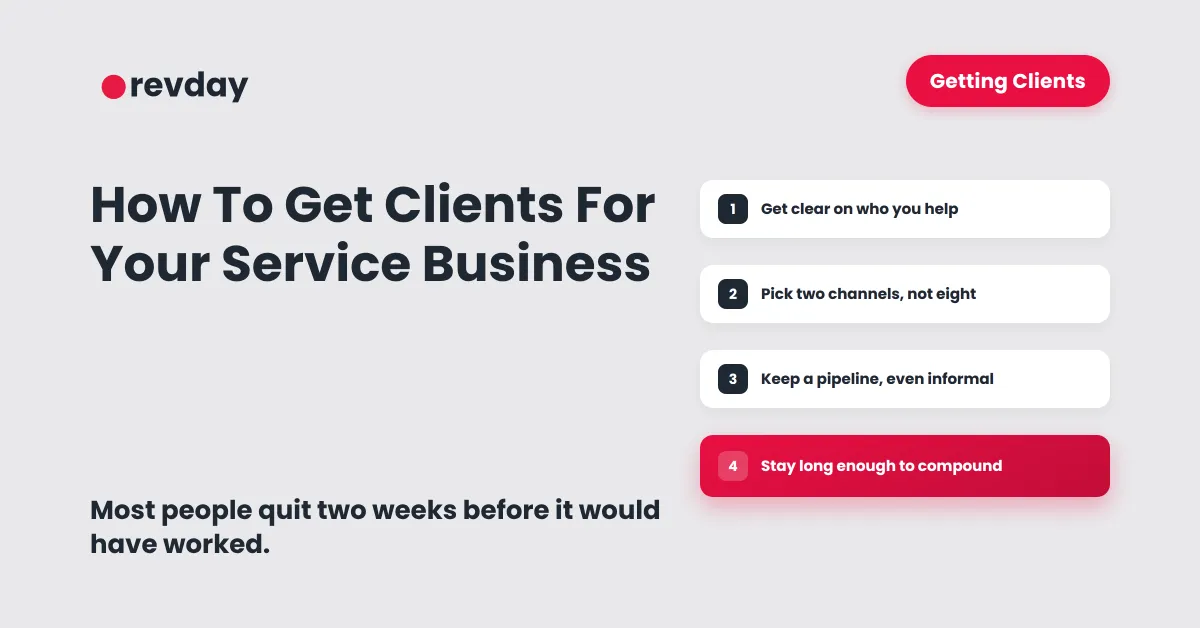
Strip everything else away and getting clients comes down to four things.
Get clear on who you help, what they get, and why now. Vague messages produce vague results.
Pick two channels you can actually run for ninety days. Stop dabbling in eight.
Keep a pipeline so the leads you're already getting don't quietly leak away while you're delivering.
Stay long enough for compounding to do the heavy lifting. Most people quit at the wrong moment, and the right moment is usually two weeks after the moment they quit.
That's the whole picture. Everything else, the tactics, the scripts, the channel-specific deep dives I've linked to throughout this post, is detail underneath those four things.
Now, the part most posts skip.
If you've read this far, you probably already knew most of what I just wrote. Knowing it isn't the hard part. The hard part is doing it, alone, while also figuring out the strategy, building the website, writing the messages, having the conversations, delivering the work, and somehow finding time to think clearly about any of it. That's the gap most service businesses get stuck in.
That's the gap revday is built to fill. We're not a course. We're not a software tool you log in to and figure out alone. We're an all-in-one platform combined with real human support. Done-with-you building, 1:1 coaching, 24/7 help when you're stuck, and the strategy to know what to focus on next. Whether you're starting (AIM), building foundations (BLAST), or scaling out of the bottleneck (CSA), the difference is having someone in it with you instead of in your head about it.
The platform makes it possible. The support makes it real.
Where to start
If you've read this and you're not sure whether your problem is clarity (AIM stage), foundations (BLAST stage), or scale (CSA stage), the Clarity Quiz takes about three minutes and tells you exactly which stage you're at and what to work on next.
Or if you'd rather poke around first, the Clarity Hub at revday.io/tools has a handful of free tools (no signup needed) for working through specific bits of this.