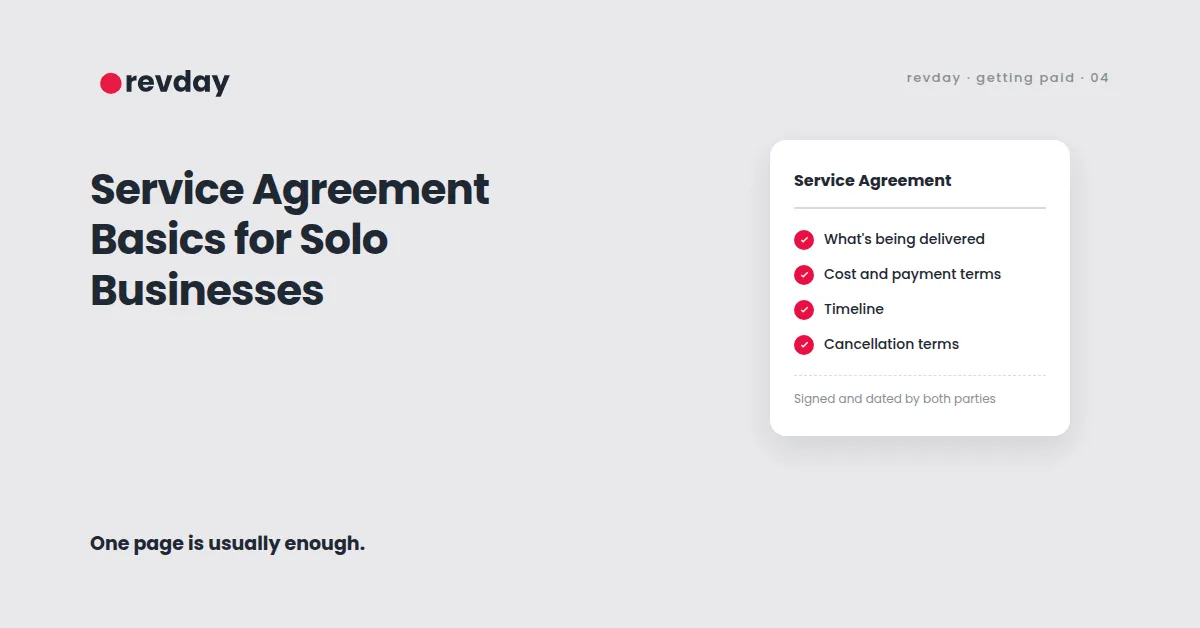
Service Agreement Basics for Solo Business Owners
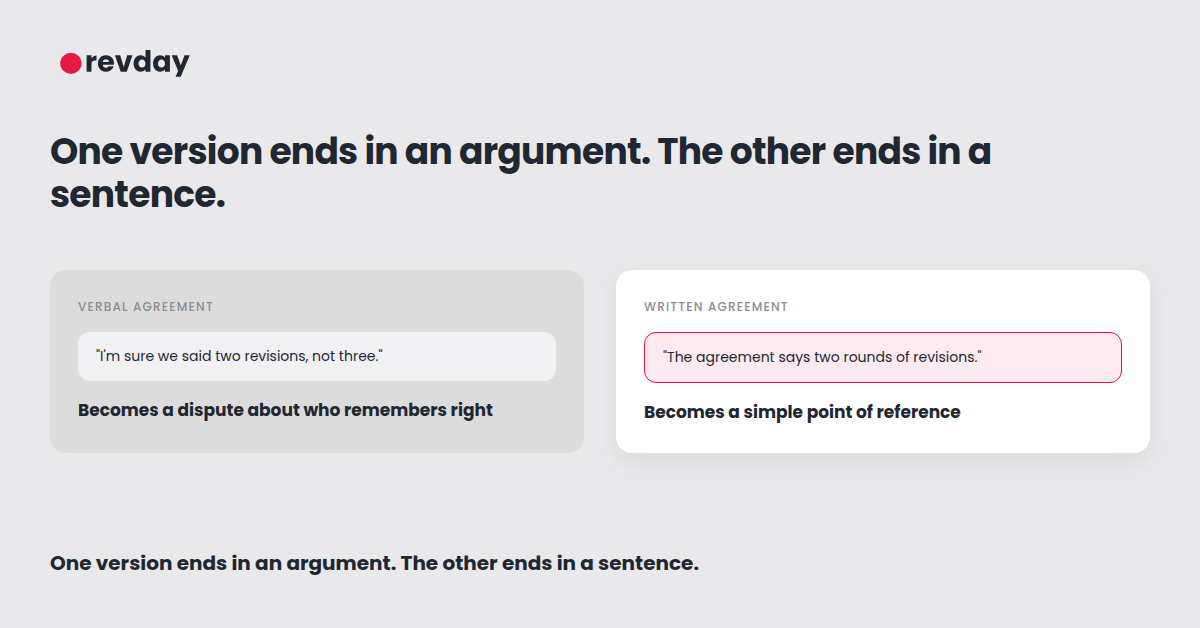
A client says the job includes three rounds of revisions. You remember two. Neither of you wrote it down, so neither of you is wrong, you just both walked away from the same conversation with a different version of it.
This is how most disputes start. Not from bad faith, just from two people relying on memory for something that should have been written down once and referred back to.
A service agreement fixes this, and it doesn't need to look like a legal document to do the job. Most solo service businesses need one page, not a twenty page contract drafted by a lawyer. The point isn't legal armour, it's a shared, written record of what was actually agreed. It's the piece that ties together everything else in getting paid on time, including the deposit you've already agreed on.
Why "we talked about it" isn't enough
A verbal agreement works fine when everything goes smoothly. It falls apart the moment something doesn't, which is exactly when you need it most.
When a client disputes the scope, the price, or the timeline, and there's nothing in writing, the conversation becomes about who remembers correctly rather than what to do next. That's a worse conversation to have than the one where you simply point back to the agreement both of you signed.
The five things every solo agreement needs
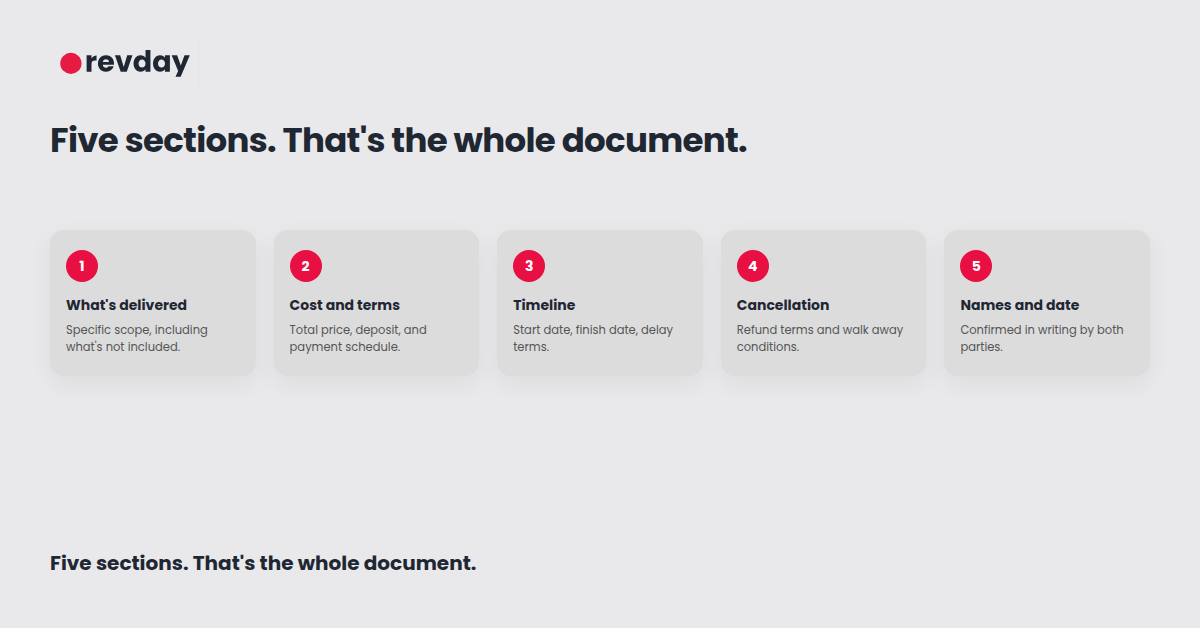
You don't need every clause a corporate lawyer would include. You need five things, stated clearly, in plain language.
What's being delivered. A specific description of the work, and just as importantly, what's not included. Vague scope is where most disputes start.
What it costs and when it's due. The total price, the deposit amount if there is one, and the payment schedule. This is where the deposit and payment terms from your booking process get written down properly rather than just mentioned in passing. It also pairs naturally with having the 4 offers every service business should have clearly defined before you're writing this section.
Timeline. When the work starts, when it's expected to finish, and what happens if either side causes a delay.
What happens if it's cancelled. Whether the deposit is refundable, and under what circumstances either party can walk away.
Both names and a signature. Even a typed name and a date counts as agreement when it's been sent and confirmed in writing, it doesn't need to be a wet signature on paper. Once this is in place alongside automated invoice reminders, there's a written reference for both the work and the payment terms.
You don't need a lawyer for this
For most solo service businesses, a lawyer-drafted contract is overkill for the size and complexity of the work. A clear one page agreement, written in plain English and reused for every client, does the job for the vast majority of situations.
Save the lawyer for the genuinely complex jobs, the ones with significant scope, large amounts of money, or unusual terms. For a standard job, a consistent, well-written template you send to every client achieves almost everything a longer contract would, without making a simple booking feel like signing a mortgage.
Make it part of the booking, not a separate step
The agreement works best when it's not something you have to remember to send. If it's built into how every job gets confirmed, the client sees it as a normal part of booking with you, the same way they'd expect to receive a quote or a deposit invoice. This is exactly the kind of step that belongs inside a proper client onboarding process, not bolted on afterwards.
This is the same principle behind getting paid on time. The things that protect your business shouldn't depend on you remembering to do them under pressure. They should be part of how the business runs by default.

