
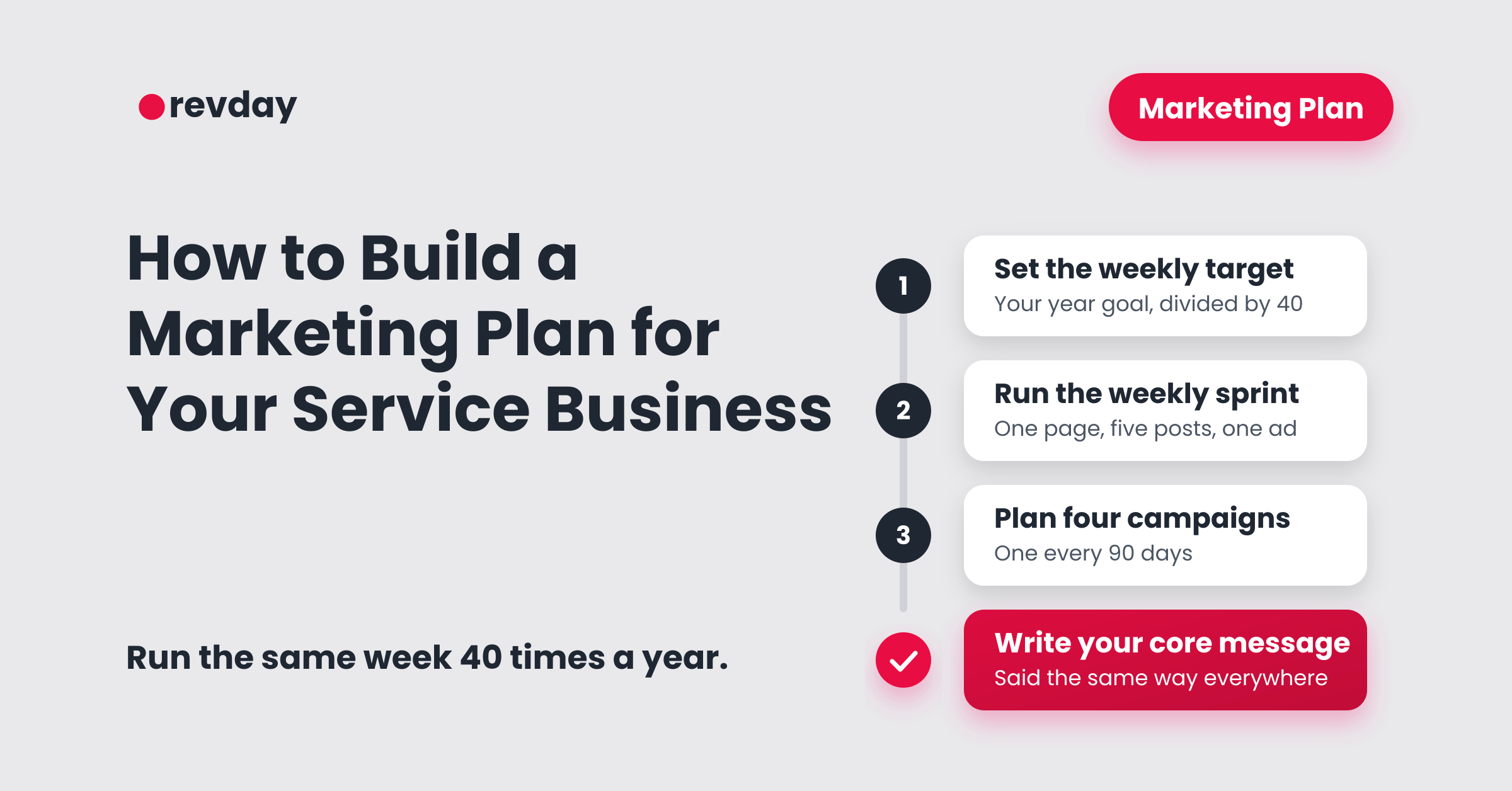
How to Build a Marketing Plan for Your Service Business: The 40-4-1 System
By Noah Cohen, founder of revday · 6 min read
A marketing plan for a service business needs three parts. A weekly routine you repeat 40 times a year. Four campaigns a year that bring back people who haven't bought yet. And one core message you say the same way everywhere. I call it the 40-4-1 System, and this guide walks through how to fill it in, using a $100,000 year as the example.
What is the 40-4-1 System?
It is a marketing plan built on repetition: 40 weekly sprints, 4 quarterly campaigns and 1 core message.
40 Weekly Sprints. One landing page, five daily posts and one ad, all pointing to the same page. You run this exact week 40 times a year.
4 Quarterly Campaigns. Every 90 days you do something special that brings back the people who haven't bought yet.
1 Core Message. The message you become known for, said the same way everywhere.
If your marketing has felt like a series of random acts, this gives it a shape. For the thinking behind it, see how to build a foundational marketing system. For where clients come from in the first place, see how to get clients for your service business.
Step 1: How much does one week need to make?
Divide what you want to make this year by 40 active weeks. That is your weekly target.
Here is the example. You want to make $100,000 this year and you charge $5,000 per sale.
$100,000 across 40 weeks is $2,500 a week.
At $5,000 a sale, that is 20 sales a year, or about one sale every two weeks.
Work backwards from there and you get the week's numbers: about 14 people raising a hand, 2.5 enquiry calls, 2 pitches and a sale every second week. These are example numbers. Swap in your own price and your own results as you learn them.
If the weekly target looks bigger than the hours you can deliver, check your price before you change your marketing. How to price your services shows how.
Step 2: What goes in a weekly sprint?
One landing page, five posts and one ad. Every one of them sends people to the same page and the same next step.
The landing page. It has an offer name, a headline and one next step, such as booking a call, taking an assessment or joining a webinar.
Five posts, Monday to Friday. Give each day a job:
Monday: Problem. Name a problem your clients have.
Tuesday: Mistake. Describe a mistake you see.
Wednesday: Story. Tell a story from your work.
Thursday: Tip. Share one useful tip.
Friday: Invite. Invite people to take the next step on your page.
A short video of 3 to 7 minutes works for each post. Start with three problems your clients have, and you have your first three topics.
One ad. A hook and an audience, pointing to the same landing page.
Then you run the same week again. That repetition is the plan.
How do you know your weekly sprint is working?
Count your reps. REPS is how I track a week: Raised hands, Enquiry calls, Pitches, Signed.
Raised hands: someone shows interest.
Enquiry calls: they book a call.
Pitches: they hear your offer.
Signed: they become a client.
Write the four numbers down every week and compare them to your target. In the $100,000 example, a good week is about 14 raised hands, 2.5 enquiry calls, 2 pitches and a signed client every second week. If one number falls short, you know which part of the week to fix.
Step 3: What are the four campaigns?
Every 90 days, run one campaign. A campaign is how you reach the people who haven't bought yet.
Here is why. Run ads, get 100 leads and sell to 2, and you have 98 people who haven't bought yet. Some of them needed a different angle, a deadline or a reason that fits the moment.
In the example, 40 weeks at about 14 raised hands comes to about 556 people. Twenty sign. That leaves about 536 who haven't bought yet, and they are the pool for your four campaigns.
Give each quarter one campaign type:
Seasonal. Tie the campaign to a moment in the calendar, such as end of financial year, a holiday offer or back to school.
Special event. Run your own event, or sponsor an existing industry event and be the main sponsor.
Launch. Launch something new: a service, a service tier, a cohort or a fresh offer.
Topical. Ride a hot topic or new technology in your industry, and be early to it.
For each campaign, write down a name, the dates, a revenue goal, the offer or event, the message and who it is for.
Suppose 2% of those 536 people come back. That is about 11 extra sales, or roughly $53,000 at $5,000 a sale. The 2% is an example. Use your own result once you have one.
Step 4: What is a core message?
A core message is the one idea you want people to tie to your name. It has two parts: a short, memorable name that people repeat back to you, and a one-line statement of the idea.
Start with your best guess today. It grows from what you hear on calls and from the questions your audience asks, so sharpen it through the year.
Then say it the same way everywhere: in your weekly posts, your campaigns and your conversations. The core message feeds back into your weekly sprint with a sharper message, and the loop runs again.
What does a year look like on one page?
A year has 52 weeks. In the 40-4-1 System, 40 are sprint weeks, 4 are campaign weeks and the rest are breaks. Put the whole year on one page: your target, your weekly sprint, your four campaigns and your core message. Print it and keep it where you work.
Where should you start?
Start with Step 1 and Step 2. Work out one week's target, then write the landing page and your first five posts. Run that week, count your reps, and run it again. Add the campaigns and the core message as the year builds.
If you want help setting it up, revday builds this with you and coaches you through it. Book a free clarity call and we will plan your weekly sprint, your four campaigns and your core message together.

