The Infrastructure That Lets Your Business Run Without You
When most people hear "infrastructure," they think servers, cloud uptime, network reliability. That's not what's actually breaking in a five-to-fifteen-client service business. The infrastructure that matters here is much simpler, and much more personal: can the business keep functioning for a week if you genuinely can't be reached?
For most owners at this stage, the honest answer is no. Not because anything is technically broken, but because the things that keep the business running only work because you're the one running them.
The test that reveals the gap
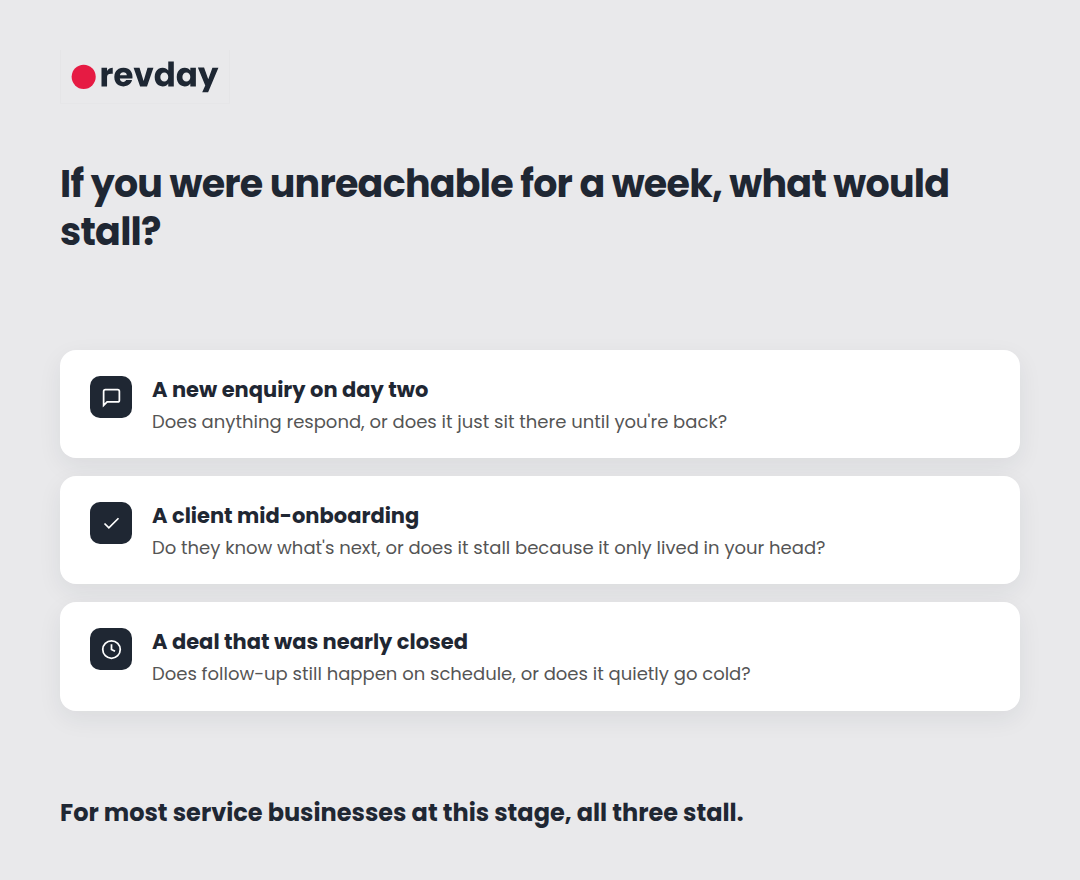
Imagine you genuinely couldn't be reached for a week. Not checking your phone between meetings, actually gone. What happens to a new enquiry that comes in on day two? Does anything respond, or does it just sit there until you're back?
What happens to a client mid-onboarding? Do they know what's supposed to happen next, or does the process stall because the next step only exists in your head? What happens to a deal that was nearly closed? Does the follow-up still happen on schedule, or does it quietly go cold because nobody else knew it was due?
For most service businesses at this stage, all three stall. Not because the business lacks tools, most have a CRM, a calendar, an inbox, but because none of it is actually set up to keep moving without a person actively driving it. The tools exist. The infrastructure, the part that makes them work without you, doesn't.
The three pieces that actually matter
Real infrastructure at this stage isn't about bigger or more expensive tools. It's about three specific things being properly built, not just installed.
A CRM that holds the truth, not just contact details. Most CRMs get set up once, used loosely, and slowly drift out of date because updating it feels like admin instead of useful. The fix isn't a better tool, it's setting the CRM up properly from the start so it reflects what's actually happening with every lead and client, not what was true three weeks ago. A CRM that's accurate is the difference between someone else being able to pick up a deal mid-conversation, and a deal quietly dying because nobody else knew it existed.
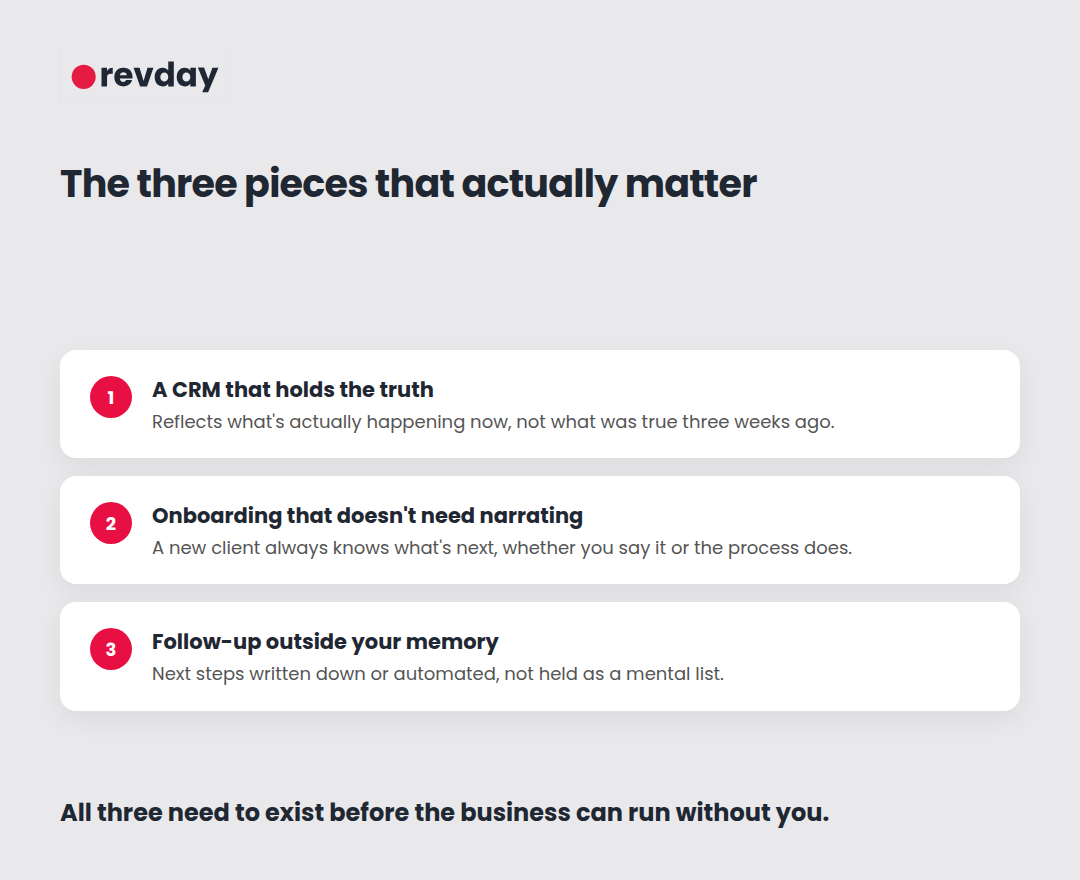
An onboarding sequence that doesn't need you to narrate it. If a new client's first two weeks depend on you personally explaining what happens next at every step, onboarding is a bottleneck dressed up as good service. A proper onboarding process means a new client always knows what's coming next, whether you're the one telling them or the process is.
Follow-up and next steps that exist outside your memory. This connects directly to building a sales process that doesn't depend on you, but it extends past sales into delivery too. Whatever's supposed to happen next for any client or lead should be written down or automated somewhere, not held entirely in your head as a mental list you're managing alongside everything else.
Why this gets skipped
Infrastructure work is unglamorous. Fixing your CRM setup or writing down your onboarding steps doesn't feel like growth the way landing a new client does, so it's the thing that gets pushed to "later" indefinitely, even as the business gets busier and the cost of not having it compounds.
The irony is that infrastructure is what actually makes growth possible past this point. Positioning and sales process determine who you're talking to and how those conversations go, but infrastructure determines whether any of it keeps working when you're not the one personally holding it together. You can have perfect positioning and a flawless sales process and still be capped, because the operational backbone underneath both of them only functions when you're actively present.
What it actually looks like once it's there
A business with real infrastructure doesn't feel dramatically different day to day. That's the point. Enquiries still get a response. Onboarding still moves forward. Follow-up still happens. The difference only becomes visible in the moments it used to fall apart: a busy week, a sick day, an actual holiday. Those become non-events instead of small crises.
That's the real test of whether you've stopped being the bottleneck: not how the business runs when you're fully present and on top of everything, but what happens to it on the one week you're not.

