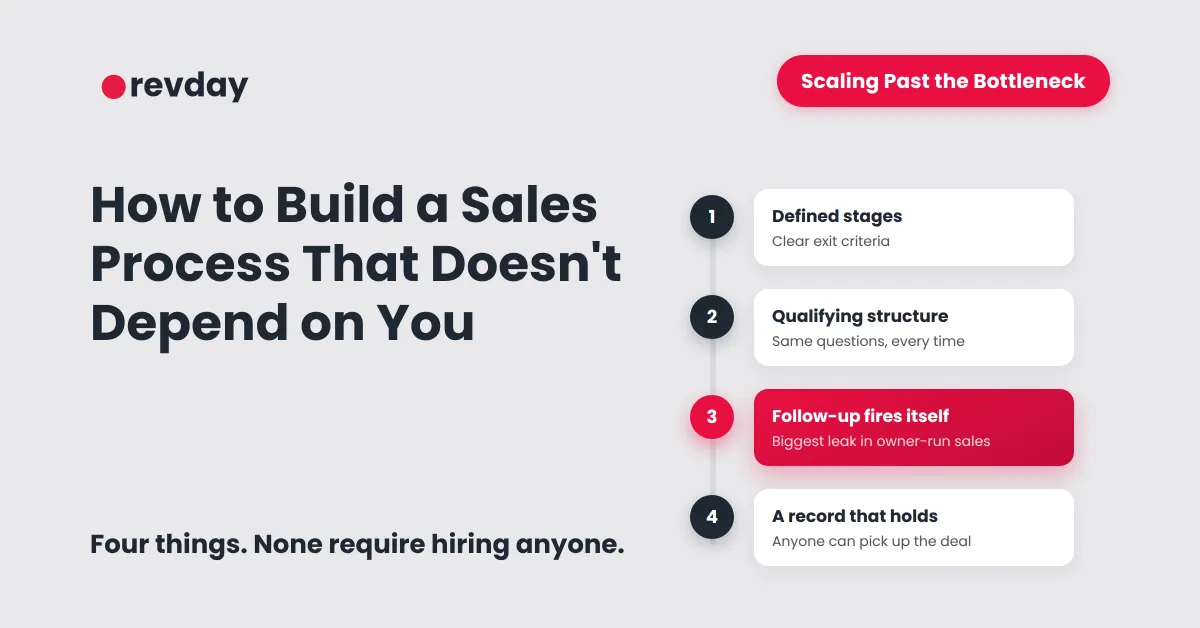
How to Build a Sales Process That Doesn't Depend on You
Most advice on building a sales process assumes you're hiring salespeople and need something to hand them. Document the stages, train the team, watch close rates stabilise. That's genuinely good advice if you're hiring. It's almost useless if you're not.
If it's still just you running sales, the goal isn't handing the process to someone else. It's making sure the process doesn't live entirely in your head, so it keeps working even when you're flat out, on a call with someone else, or simply having an off week.
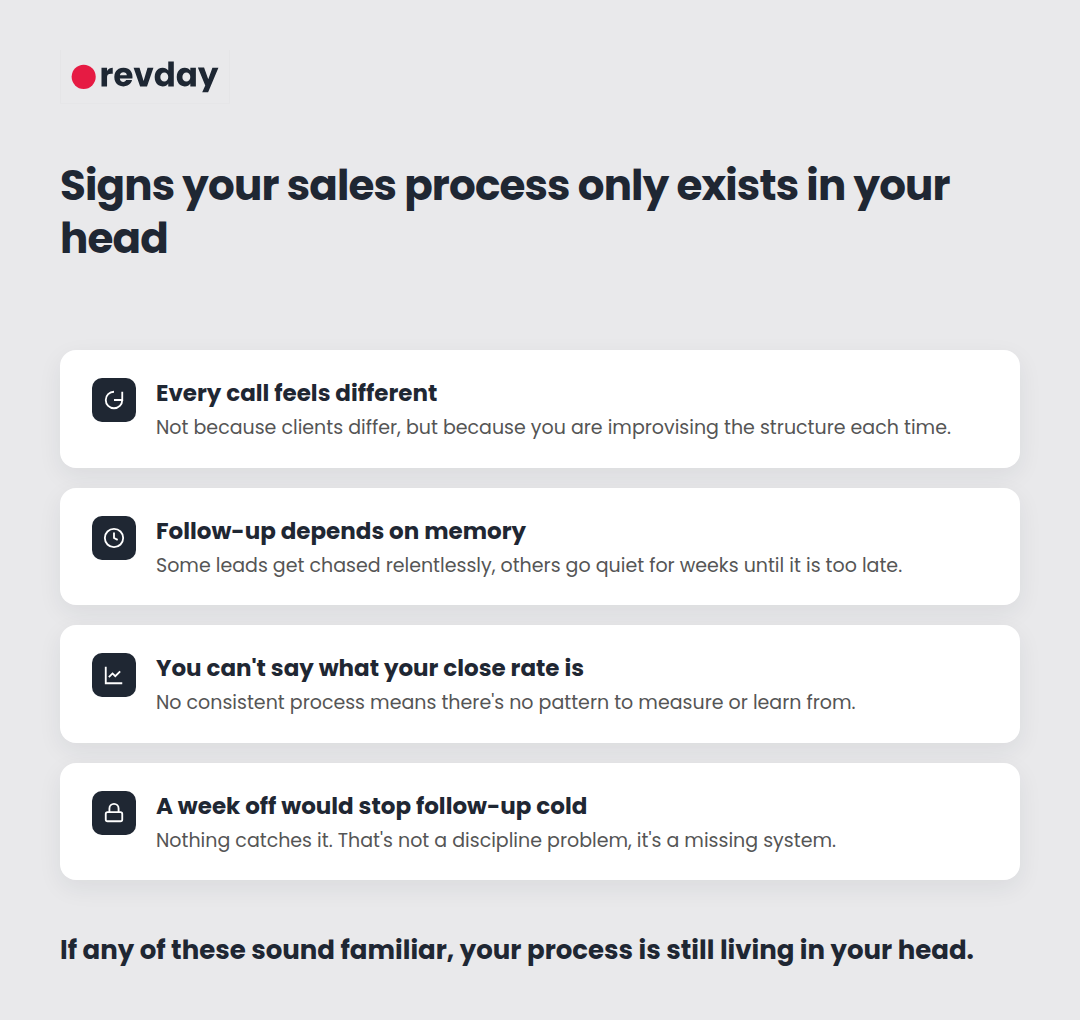
How to tell your process only exists in your head
A few signs make this easy to spot. Every sales call feels slightly different, not because every client is different, which is normal, but because you're improvising the structure each time rather than running a known sequence. Sales conversations become exhausting in a specific way: not because selling is hard, but because you're rebuilding the wheel on every call instead of just driving it.
Follow-up depends on whether you remembered. Some leads get chased relentlessly because they happened to be top of mind. Others go quiet for two weeks because something else came up, and by the time you think of them again, they've gone with someone else.
You can't say with any confidence what your actual close rate is, or where deals tend to fall over, because there's no consistent process to measure against. Every deal is its own story, which means there's no pattern to learn from.
And the clearest sign of all: if you took a week off with no notice, follow-up would simply stop. Nothing would catch it. That's not a discipline problem. That's a missing system.
The four parts of a process that holds without you
A sales process that survives your absence needs four things in place, and none of them require hiring anyone.
Defined stages with clear exit criteria. Every lead should be in one of a small number of known stages, new enquiry, qualified, call booked, proposal sent, won or lost, and there should be a clear, specific reason a lead moves from one stage to the next. Without this, "where things are" is just a feeling, not a fact. Automating pipeline updates based on what a lead actually does removes the guesswork about which stage someone is really in.
A qualifying structure that runs the same way every time. The questions you ask on a first call shouldn't change based on your mood or how rushed you are. Knowing exactly who you're looking for means you can build two or three consistent qualifying questions that work whether you're sharp that day or running on four hours of sleep.
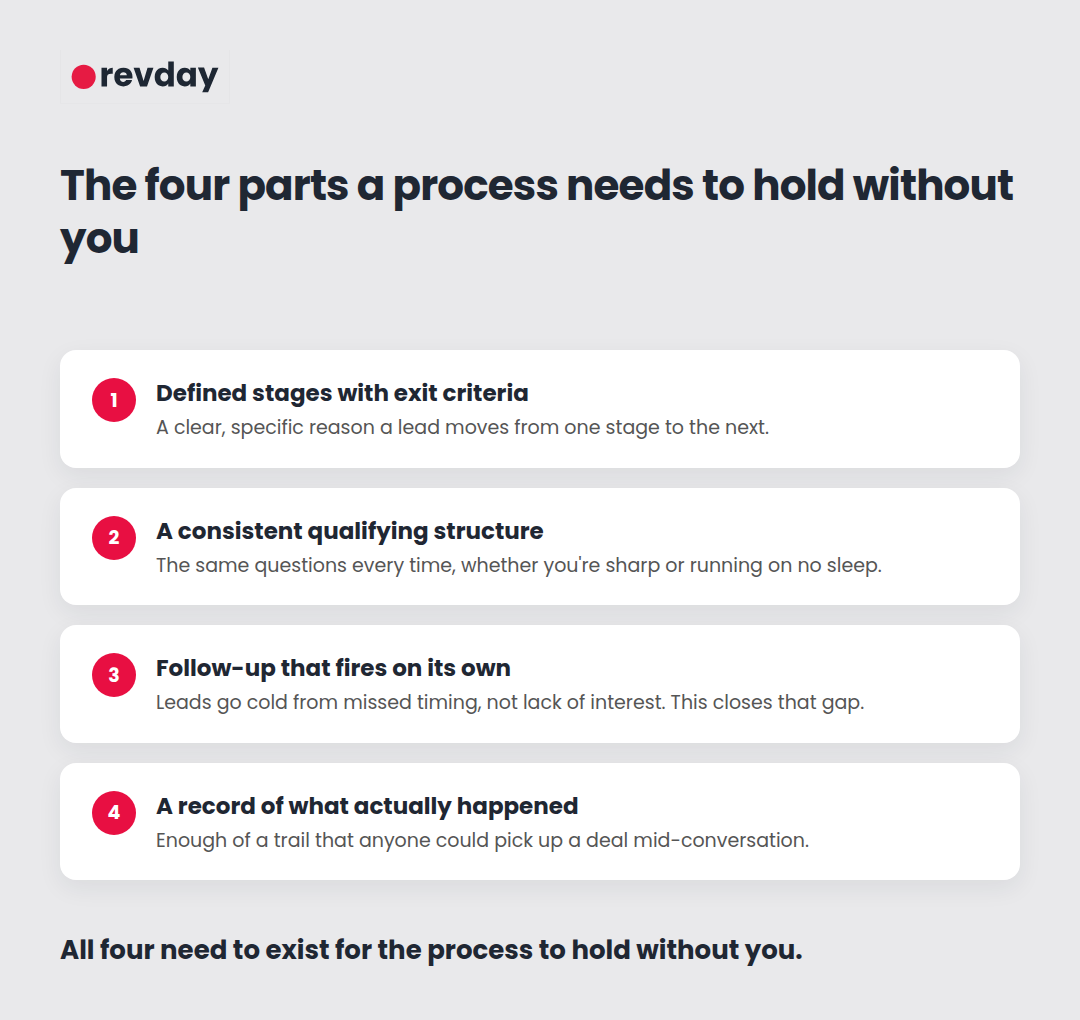
Follow-up that fires on its own. This is the single biggest leak in most owner-run sales processes. Leads don't disappear because they weren't interested, they disappear because nobody followed up at the right moment. A follow-up process that runs without manual chasing means a lead never goes cold just because you got busy.
A record of what actually happened. Not detailed notes for their own sake, but enough of a trail that you, or anyone else, could pick up any deal mid-conversation and know exactly where it stands and what was already said. This is what makes the difference between a process and a memory test.
What changes once this is in place
The honest version of this is that none of it is exciting work. Defining stages, writing down qualifying questions, setting up follow-up that fires automatically, none of that feels like growth in the moment. It feels like admin.
But it's the admin that decides whether a slow week, a sick day, or a genuinely busy stretch costs you deals or doesn't. A process that exists outside your head keeps working on the days you're not at your best, which is most of what separates a business that can actually grow from one that's permanently capped at whatever you can personally hold together.
This is one piece of the larger shift away from being the bottleneck in your own business. Positioning and infrastructure matter too, but sales process is usually where the cracks show first, because it's the part of the business that's hardest to fake your way through when you're stretched thin.

