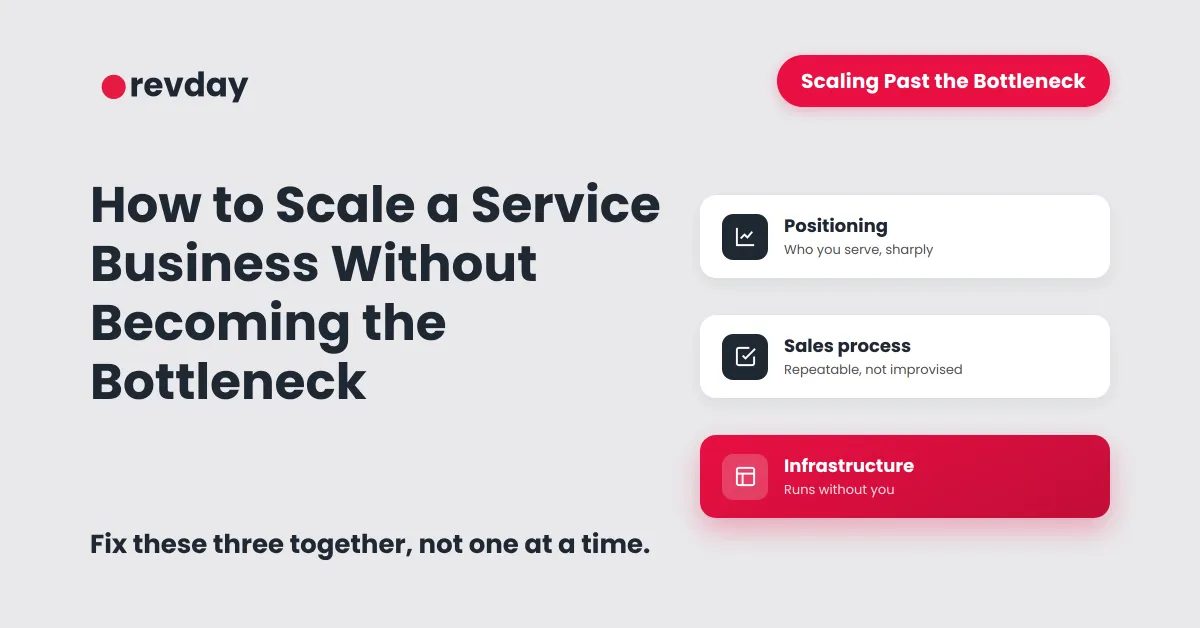
How to Scale a Service Business Without Becoming the Bottleneck
Somewhere between your fifth client and your fifteenth, something changes. You're not new anymore. You know what you're doing. But you're also busier than you've ever been, and the business doesn't feel like it's actually growing, it feels like it's just adding more of you to every part of the process.
That's not a sign you're doing it wrong. It's a sign you've outgrown the setup that got you here. The systems that worked when you had five clients won't work at twenty, and pretending they will is how good businesses plateau.
What actually breaks as you grow
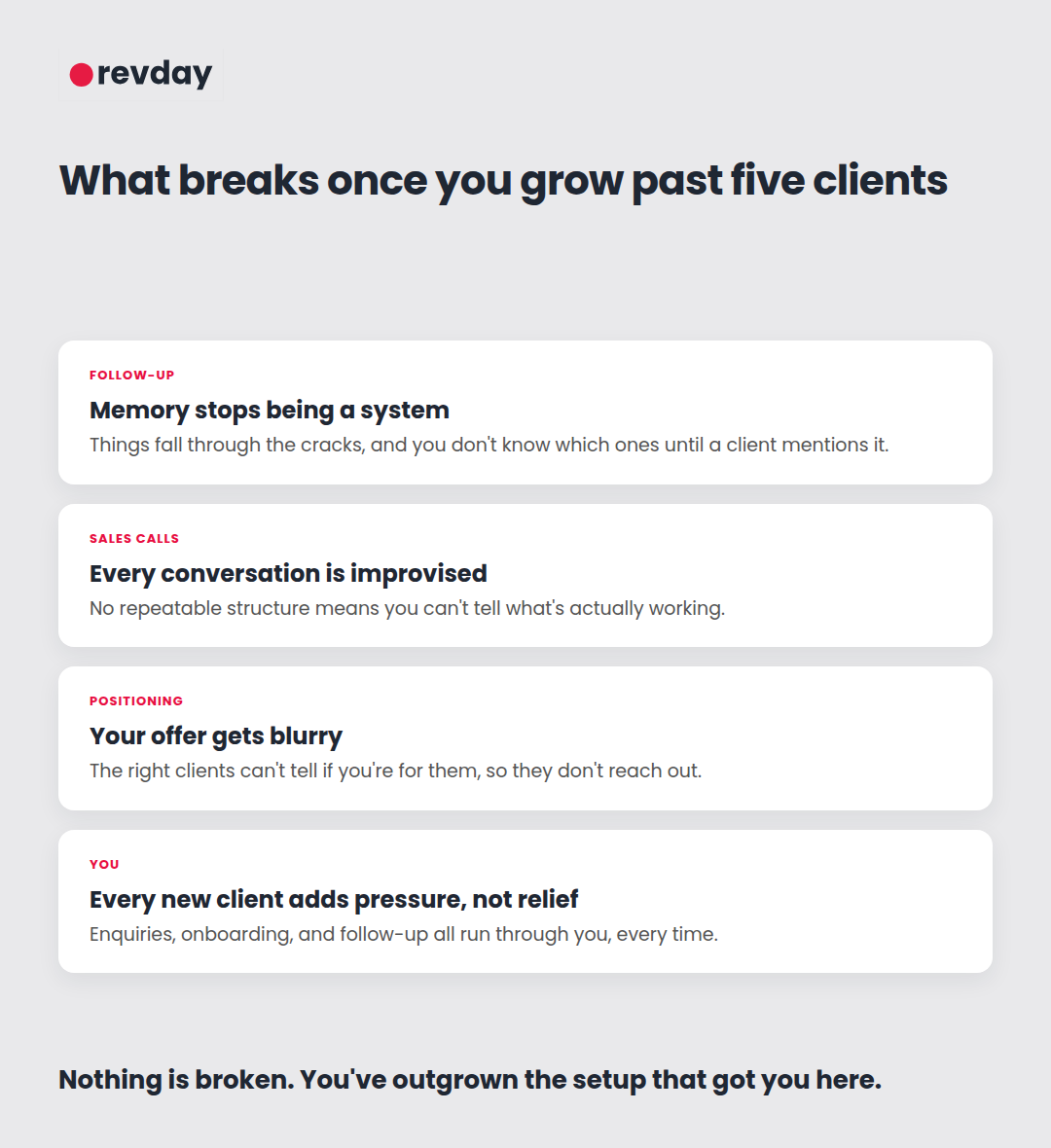
At five clients, memory works. You remember who you spoke to, what they needed, and when to follow up. At twelve or fifteen, memory stops being a system. Things fall through the cracks, and the frustrating part is you don't always know which ones until a client mentions it weeks later.
Sales conversations start to drift too. Every call becomes improvised because there was never a repeatable structure to begin with. Some go well. Some don't. You can't tell what's actually working because nothing was ever consistent enough to compare.
Positioning gets blurry around the same time. Early on you said yes to almost anyone, because you needed the clients. By client ten, you're still saying yes to things that aren't quite right, and the people who would be perfect for you can't tell if you're for them, so they don't reach out.
And underneath all of it sits the real issue: you're the one holding the business together. Every enquiry, every onboarding, every follow-up runs through you, which means every new client adds pressure instead of revenue. You're working more hours, but the income isn't growing the same way the hours are. That gap is not a motivation problem. It's an infrastructure problem.
The three things that actually fix it
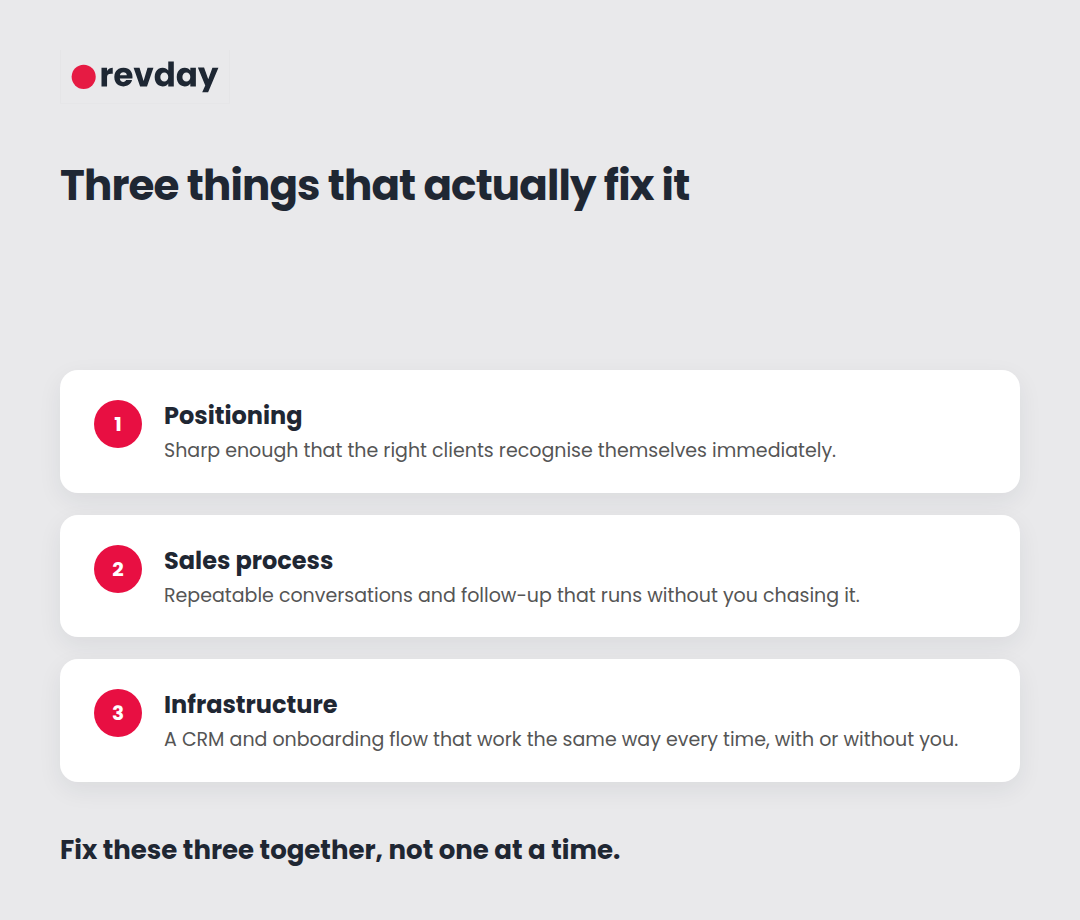
Scaling a service business without burning out comes down to three areas, and they need to be fixed together, not one at a time.
Positioning. Who you serve and why needs to be sharp enough that the right clients recognise themselves immediately. A blurry offer means more enquiries that go nowhere and more time spent qualifying people who were never going to be a fit. Knowing exactly who your ideal client is isn't a nice-to-have at this stage, it's what stops the wrong leads from clogging the pipeline in the first place.
Sales process. A repeatable conversation structure means you can identify what's working and fix what isn't, instead of every call being a fresh improvisation. This also means follow-up that doesn't depend on you remembering to do it. Automated pipeline updates and a follow-up process that runs without you chasing it turn a sales process that lives in your head into one that runs whether you're thinking about it or not.
Infrastructure. This is the operational backbone: a CRM that's actually set up properly for how your business runs, not just installed and ignored, and an onboarding process that doesn't require you to personally walk every new client through the same steps every time.
Why this stage is different from starting out
When you're starting out, the goal is momentum. Get clients, get experience, figure out what you're actually good at and who wants it. That stage rewards hustle, because hustle is what gets the first ten clients in the door.
This stage rewards something different: structure that holds without you pushing on it constantly. Working harder is not the fix here. You're already working hard, that's evident in the fact you have a business with real clients and real revenue. What's missing isn't effort. It's the systems that let that effort compound instead of just repeating itself every week.
This is also why generic scaling advice built for $3M agencies with twenty staff doesn't translate well to a solo or near-solo service business. You don't need an org chart or a hiring pipeline yet. You need your existing business to stop depending entirely on you being available, switched on, and remembering everything, all the time.
What this actually looks like once it's fixed
A business that's scaled properly doesn't feel frantic. Leads get a consistent first response without you doing it manually. Sales conversations follow a structure you've tested and refined, so you know what's working. Onboarding happens the same way every time, whether you're available that day or not. And when you take a week off, the business doesn't grind to a halt waiting for you to come back.
None of that happens by accident, and none of it happens by simply trying harder with the same setup. It happens by fixing positioning, sales process, and infrastructure together, deliberately, in that order.

