
Sales is in your head: stop selling and start defining the path
Sales feels hard for many business owners because they think their job is to convince someone. That’s usually where things go wrong. Good sales isn’t about convincing people. It’s about helping someone understand what’s actually going on in their situation and what the next sensible step might be. When you stop trying to “sell” and start helping someone see the path forward, the pressure disappears and the conversation becomes much more natural.
Why sales feels uncomfortable for many business owners
A lot of founders feel strange about sales.
Not because they can’t talk to people. Usually it’s because they don’t like the idea of pushing someone into something.
So when a sales conversation happens, they either:
talk too much
explain too many details
lower the price too quickly
or avoid following up
The issue usually isn’t skill. It’s how sales is framed in their head. If sales means pressure or persuasion, it’s always going to feel uncomfortable.
The real job of sales
The real job of sales is much simpler.
You are helping someone understand where they are now and what the next step should be.
That usually means helping them see three things clearly.
Their current situation
What is actually happening right now?
Why did they start looking for help in the first place?
Most people come into a conversation with a vague idea of the problem. Part of the conversation is simply making that clearer.
The real problem
The first problem people describe is often not the real one.
Someone might say they need more leads. But once you dig a bit deeper, the issue might be something else entirely.
Maybe enquiries are not followed up properly.
Maybe there’s no clear next step after someone shows interest.
Maybe the sales conversation itself is unclear.
The next logical step
Once the real issue becomes clear, the next step is usually obvious.
You’re not forcing a decision.
You’re simply pointing to the most sensible move from here.
Why buyers resist being “sold to”
People don’t like feeling pushed.
The moment a conversation feels like someone is trying to force a decision, most buyers become cautious. They slow down and protect themselves.
But if the conversation focuses on understanding the situation and figuring out what should happen next, the dynamic changes.
It stops feeling like a pitch and starts feeling like a discussion.
What defining the path sounds like
When you define the path, the conversation sounds very different from a typical sales pitch.
You’re not listing features or trying to impress someone.
You’re simply helping them see what is actually happening.
Example
“You probably don’t need more leads right now. From what you’ve said, the bigger issue is that enquiries don’t have a clear next step.”
Another example
“It sounds like the problem isn’t marketing. It’s what happens after someone shows interest.”
Another example
“Before rebuilding everything, the first step should probably be fixing the follow-up process.”
Why this reframe changes sales completely
When you start thinking about sales this way, the conversation becomes much calmer.
You’re not trying to prove anything.
You’re simply helping someone understand their situation and what might help.
That takes a lot of pressure out of the conversation for both sides.
A simple structure for sales conversations
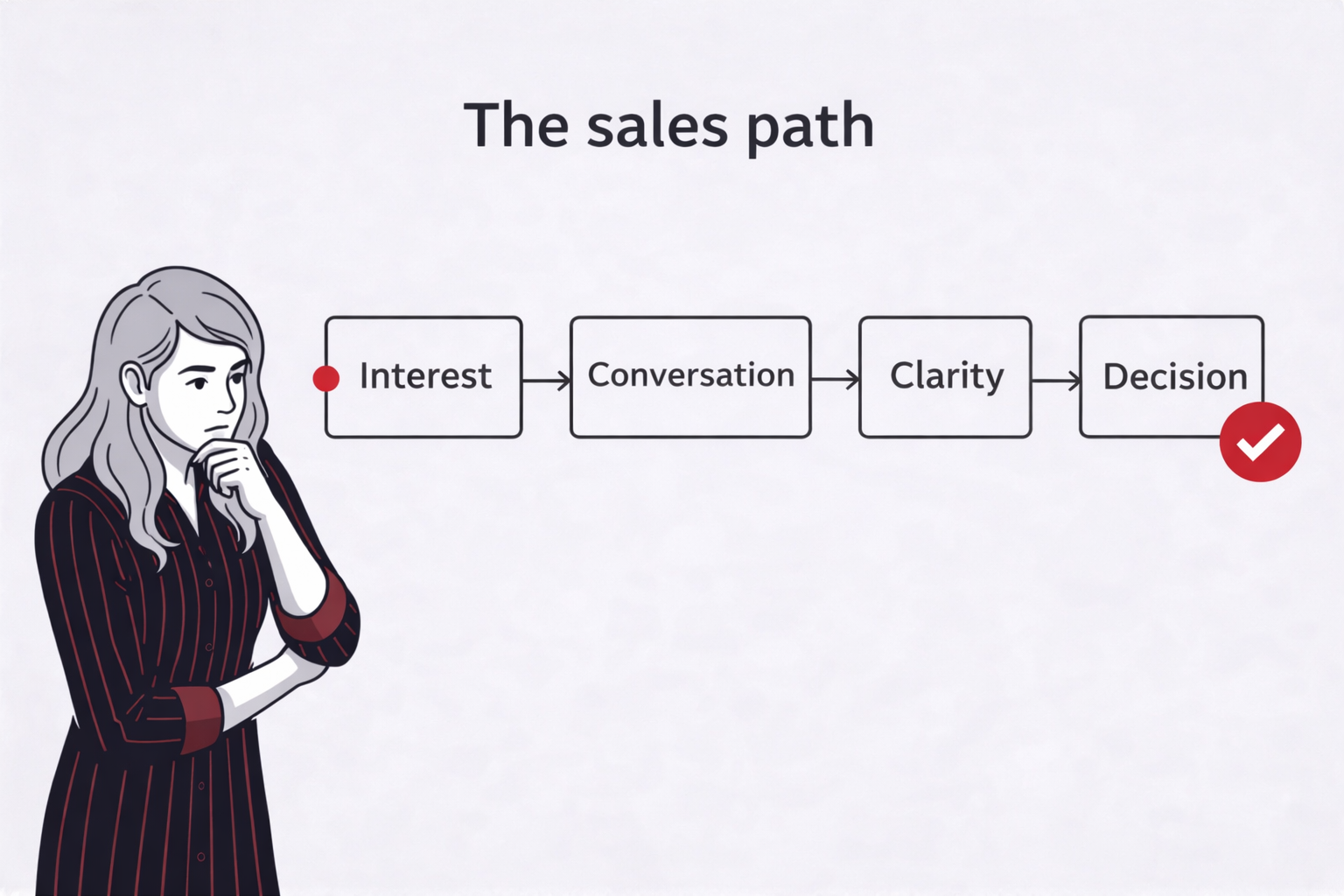
Most sales conversations for service businesses follow a simple flow.
Understand the situation
Ask questions and understand what is happening in the business right now.
Identify the friction
Find where things are getting stuck.
Maybe leads come in but nothing happens next.
Maybe conversations happen but decisions don’t.
Clarify the impact
Explain what that friction is costing.
Lost opportunities.
Slow growth.
Extra effort for the same results.
Define the path forward
Show what the simpler path might look like.
Not ten options. Just the most sensible next move.
Recommend the next step
From there, the next step becomes clear.
Sometimes that step involves working together. Sometimes it doesn’t.
Either way, the buyer understands what should happen next.
How revday thinks about sales
At revday we don’t think about sales as convincing people.
We think about it as helping someone see the structure of what is going on in their business.
Most businesses already have effort, tools, and opportunities.
What they often lack is a clear path between interest and action.
Sales is often just the process of making that path visible.
Frequently asked questions
Is sales mainly a mindset problem?
Mindset plays a big role.
If someone believes sales means pushing people, they will usually avoid it or handle it awkwardly.
If they see sales as helping someone understand the next step, the conversation becomes much easier.
What is consultative selling?
Consultative selling means understanding someone’s situation before recommending anything.
Instead of leading with a pitch, you start with questions and clarity.
How do you sell without being pushy?
Focus on the situation first.
Understand what is happening, identify the real problem, explain the impact, and then suggest the most sensible next step.
When things are clear, pressure isn’t necessary.