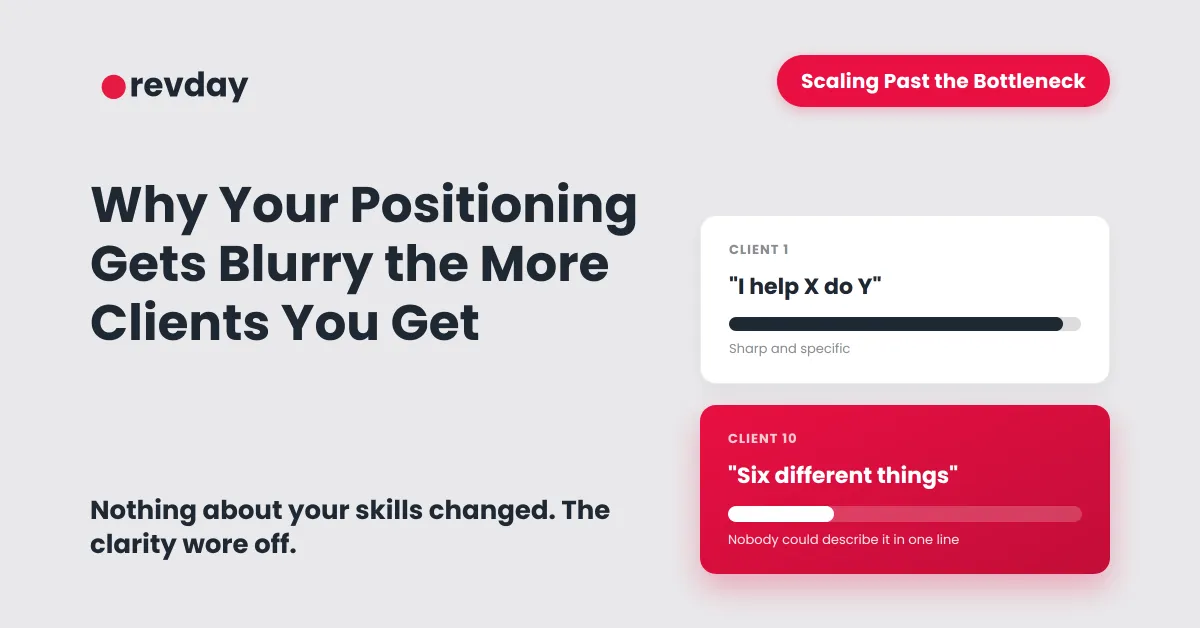
Why Your Positioning Gets Blurry the More Clients You Get
When you started, you probably knew exactly who you were for. You had to. With no clients and no track record, the only way to get the first few was to be specific about who you helped and what you fixed, because vague offers don't get picked when nobody knows you yet.
By client eight or ten, that clarity has usually softened, even though nothing about your skills changed. What changed is that somewhere along the way, the urgency that forced you to be sharp wore off, and you started saying yes more broadly than you used to.
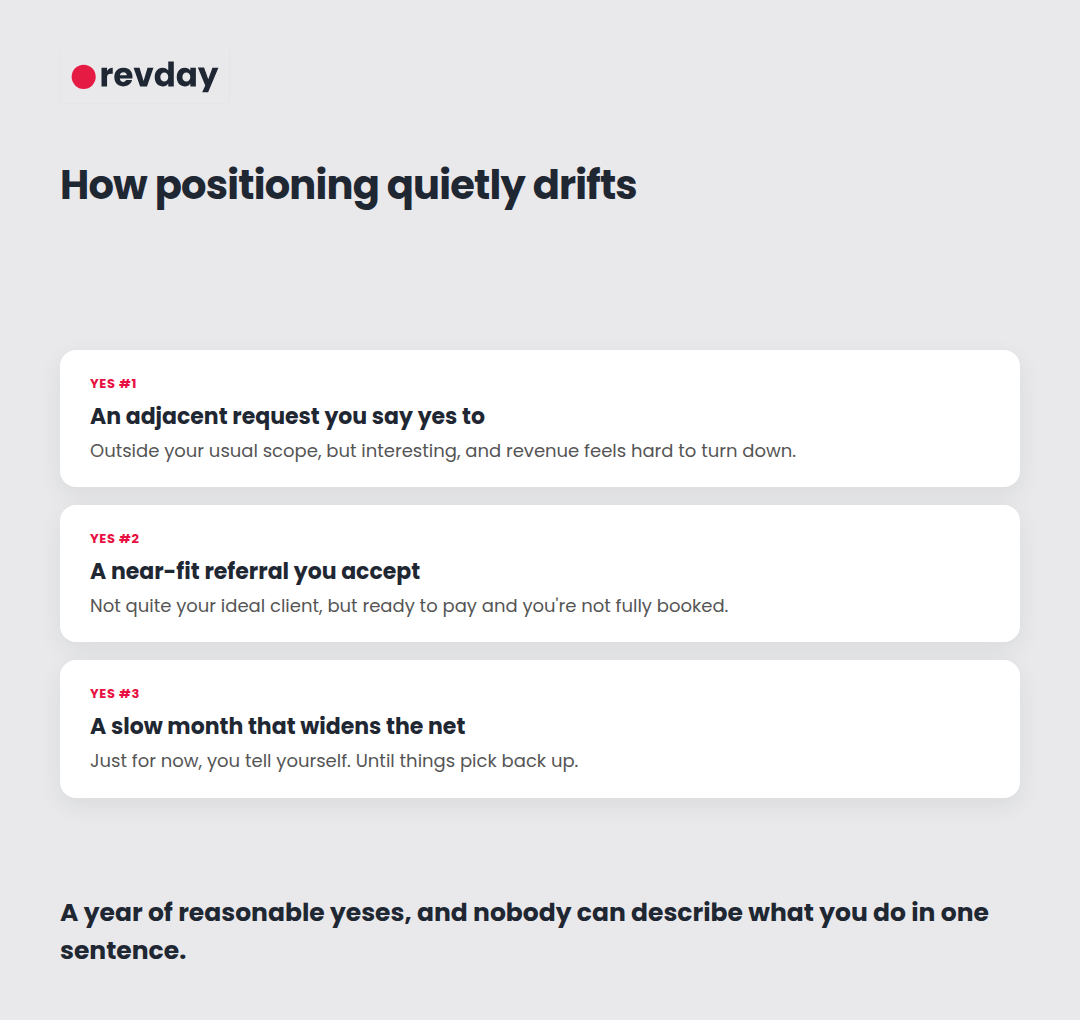
How positioning quietly drifts
It rarely happens as one decision. It happens as a series of individually reasonable ones.
A client outside your usual scope asks if you can also help with something adjacent. You can, so you say yes, partly because the work is genuinely interesting and partly because turning down revenue still feels uncomfortable this early on. A referral comes in for someone who isn't quite your ideal client, but they're ready to pay and you're not fully booked, so you take it. A slow month makes you quietly expand who you're willing to work with, just for now, you tell yourself, until things pick back up.
None of these decisions feels like a positioning problem in the moment. Each one feels like good business sense. But a clearly defined ideal client only works as a filter if it's actually being enforced, and every one of these small yeses quietly erodes it. A year in, the business that started by saying "I help X do Y" is now doing six different things for five different types of client, and nobody, including you, could describe it in one sentence anymore.
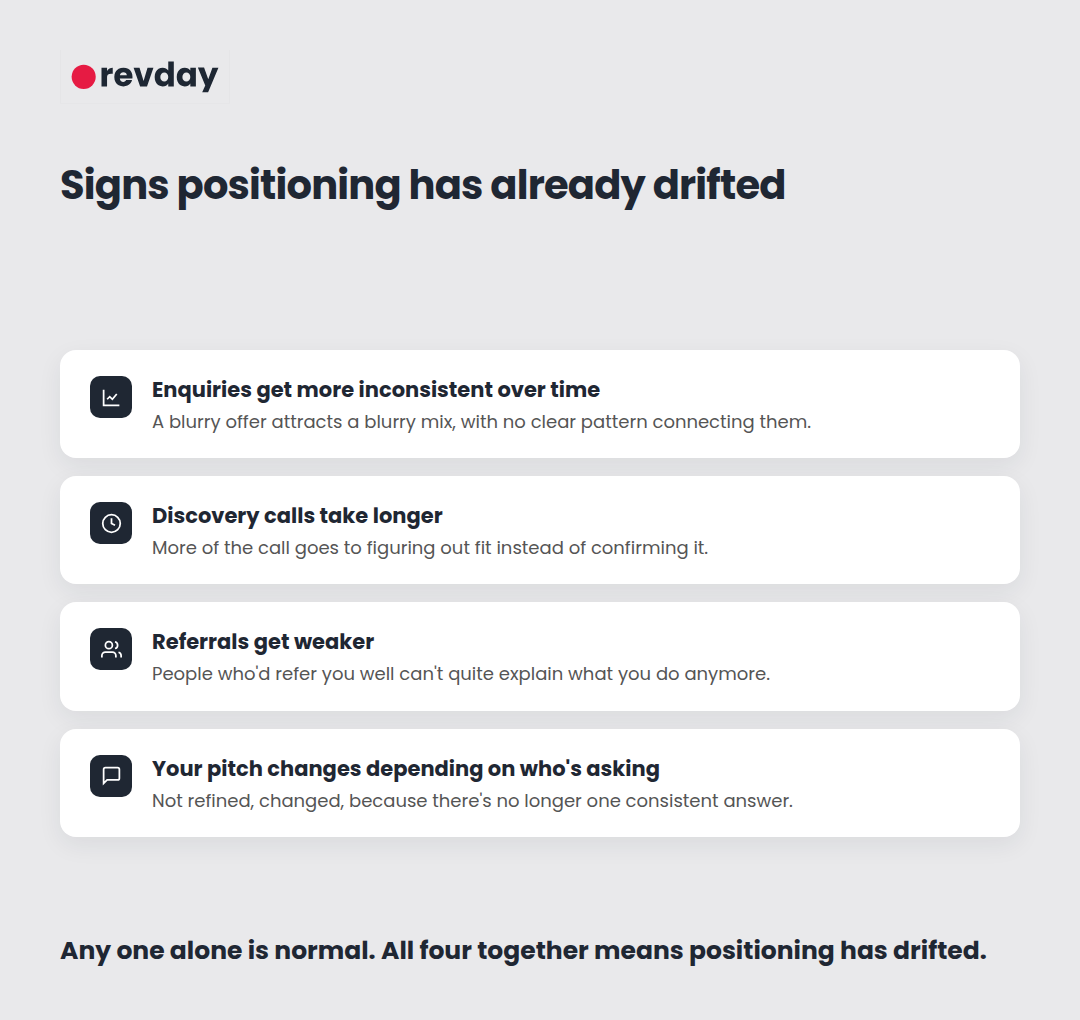
The signs positioning has already drifted
A few patterns show up consistently once this has happened, and they're easy to mistake for unrelated problems.
Enquiries get more inconsistent, not less, the longer you've been in business. You'd expect the opposite as you build a track record, but a blurry offer attracts a blurry mix of people, some perfect, some completely wrong, with no clear pattern connecting them.
Discovery calls take longer because more of the call is spent figuring out fit rather than confirming it. When positioning is sharp, the prospect mostly already knows if they're a fit before they book the call. When it's blurry, that work has to happen live, every time.
Referrals get weaker. The people who'd refer you well can't quite explain what you do anymore, because what you do has quietly become five things instead of one. They end up sending people who are an approximate fit instead of an exact one.
And the clearest sign: you find yourself adjusting your pitch depending on who's asking. Not refining it, changing it, because there's no longer one consistent answer to "what do you actually do."
Why this matters more at this stage, not less
Early on, broad positioning is a survival strategy. You don't have the luxury of turning down work, and saying yes to almost anything is how the first few clients happen at all.
Past five clients, that logic flips. You're no longer trying to prove the business can exist, you're trying to make it predictable. Sharp positioning is what makes a sales process repeatable in the first place, because a repeatable process needs a consistent type of conversation, and you can't have a consistent conversation with five completely different kinds of buyer. This is part of why building a sales process that doesn't depend on you tends to stall when positioning is still drifting underneath it. You can't make a process repeatable if the thing it's processing keeps changing shape.
Getting it back
Fixing drifted positioning doesn't mean starting over. It usually means looking honestly at the clients who were genuinely excellent fits, the ones who converted fastest, paid easily, and got the best results, and being willing to say no to everything that doesn't look like them, even when the no costs you short-term revenue.
That's a harder decision now than it was at the start, because now turning work away means turning away real, available money instead of hypothetical future money. But the businesses that get unstuck at this stage are usually the ones that make that trade deliberately, not the ones that keep saying yes to everything and wonder why growth still feels chaotic.
Positioning is one of the three things that actually fix the bottleneck, alongside sales process and infrastructure. None of them work in isolation, but positioning is usually the one quietly undermining the other two without getting blamed for it.

