The Foundational Systems Every Service Business Needs Before Scaling
After auditing dozens of service businesses, I see the exact same trap over and over: founders trying to 'scale' before they even have a floor to stand on. They sign up for complex CRM software, start running ads, and hire VA's, but their core offer and lead capture process are still completely messy. It's backwards. Before you try to pour gas on the fire, you have to build the engine. Here is the exact foundational setup we use at revday to stop the chaos.
A quick warning before we begin: If you do not have absolute clarity on your target audience, your core offer, and your messaging, stop reading this right now. Building systems for a bad offer just helps you lose clients faster. Go back to Stage 1: AIM and lock in your strategy first.
But if your message is dialed in, people are buying, and your day-to-day operations feel like you are holding together a house of cards with sticky notes and spreadsheets?
Welcome to Stage 2: BLAST. It is time to build your foundations.
The "Volume Trap": Why More Leads Will Break Your Business
Most founders operate under the delusion that their primary problem is a lack of leads. They think if they just ran more ads or posted more on LinkedIn, their revenue problems would disappear.
In reality, most service businesses are stuck in the Volume Trap. Their manual processes are so fragile that a sudden influx of 50 new clients wouldn't make them rich, it would completely break their business. Proposals would be missed, onboarding would become a disaster, and client results would plummet.
You cannot scale founder-led chaos. To grow cleanly, you must transition from relying on your own sheer effort to relying on structured, repeatable systems.
Take a recent consulting client we worked with. They were desperate to scale and wanted to spend thousands on new marketing. The problem? They were still manually emailing back and forth with every single inquiry just to find a time to chat. Leads were getting frustrated and ghosting them. We paused the marketing, spent one week connecting a simple, automated booking flow, and mapped out a clear 'Stage 2' entry offer. Their conversion rate doubled simply because we removed the foundational friction.
What Is a Foundational System? (Logic Over Effort)
In the service industry, a foundational system isn't a random collection of software subscriptions. It is a connected, logical sequence that moves a stranger to a buyer, and a buyer to a successful case study, with minimal friction.
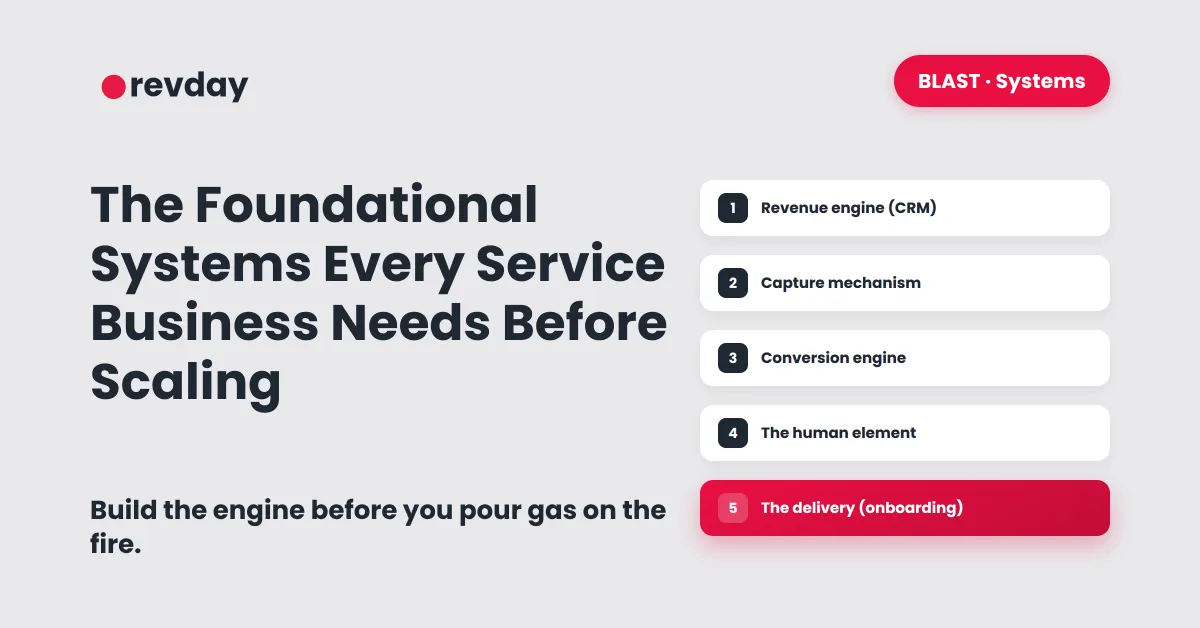
Here are the five non-negotiable systems you must have in place to stop dropping the ball and start scaling your revenue.
System 1: The Revenue Engine (CRM & Pipeline)
Your business does not need a digital address book; it needs a command centre. If you are tracking deals in a spreadsheet or relying on your inbox to remind you to follow up, you are bleeding money. A properly structured CRM visualises your exact sales pipeline, telling you exactly who to contact today and how much revenue is sitting in the "Proposal Sent" stage. Once your pipeline is visual, you can implement simple marketing automation to handle the manual follow-up for you.
The Deep Dive: How to Set Up a CRM for a Service Business (Before You Buy the Software)
System 2: The Capture Mechanism (Landing Pages & Lead Magnets)
Stop obsessing over your "website." A traditional 10-page website is a digital brochure full of distractions. When you are scaling, you need high-converting Landing Pages designed to do exactly one job: capture contact information in exchange for a high-value diagnostic tool or asset.
The Deep Dive: Why Your Lead Magnet Is Attracting the Wrong Clients
System 3: The Conversion Engine (Sales Process & Scripting)
Once the lead is captured and sitting in your CRM pipeline, how do you move them to a "Yes"? If your sales process changes every single time you jump on a Zoom call, your revenue will remain completely unpredictable. You need a structured, diagnostic sales framework that diagnoses the prospect's pain and logically positions your service as the only viable bridge.
The Deep Dive: How to Build an Initial Sales Process & Script
System 4: The Human Element (Sales Call Execution & Closing)
You can have the most automated pipeline and the best script in the world, but if you freeze up when a prospect says, "I need to think about it," the system fails. Landing high-value clients requires mastering the human element: managing your own psychology, maintaining authority, and handling objections with quiet confidence.
The Deep Dive: Sales Call Execution: How to Handle Pricing Objections
System 5: The Delivery (Client Onboarding)
The most critical moment in your client's journey is the 48 hours immediately after they pay your invoice. Most buyer's remorse (and subsequent churn) happens right here. Your onboarding process must be automated enough to be instantaneous, but personal enough to build immediate trust. Move them from "buying" to "working" seamlessly.
The Deep Dive: Client Onboarding Basics: Securing the First 30 Days
The BLAST Approach to Scaling
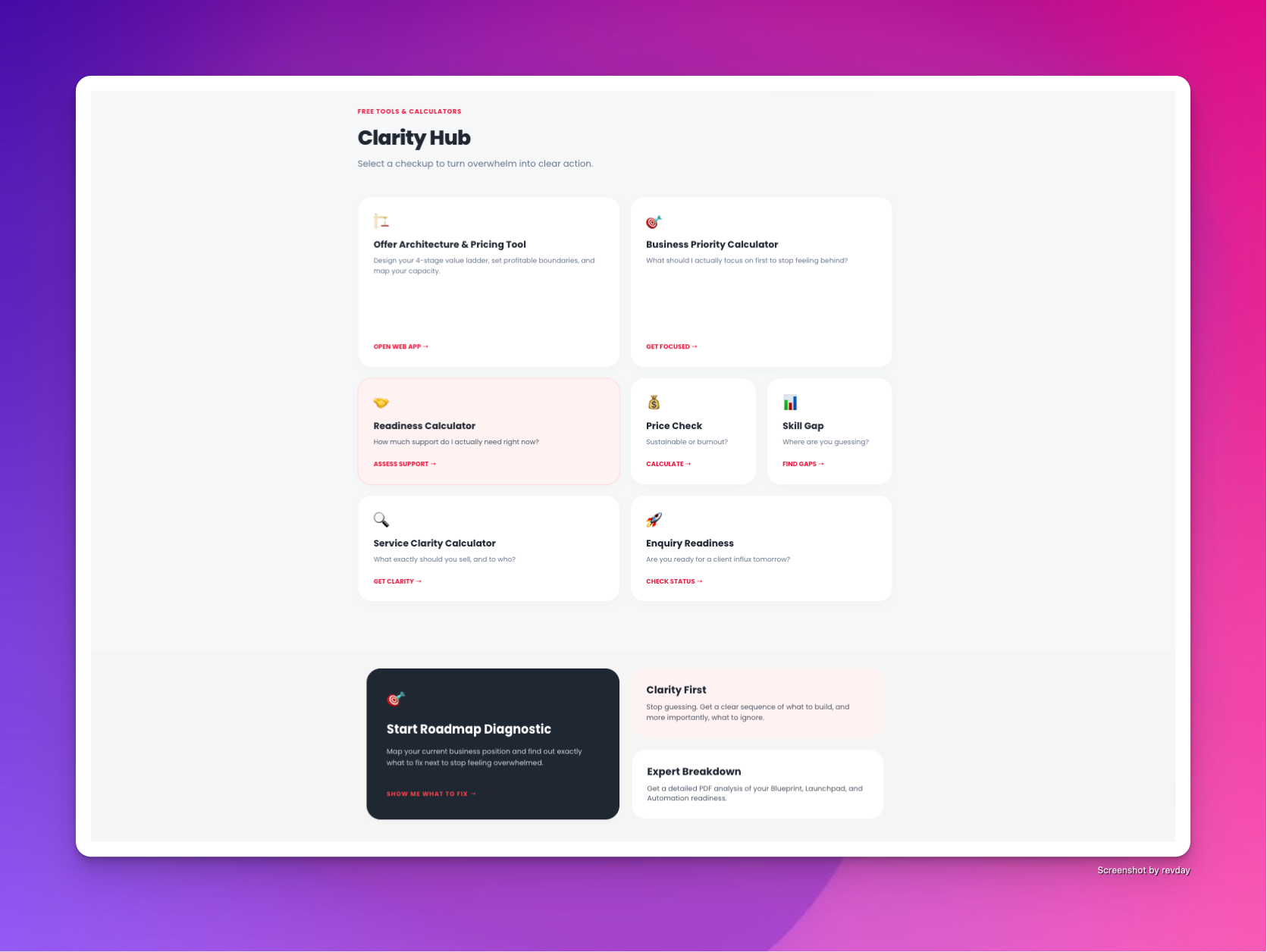
If your current backend is a messy web of disconnected tools, unwritten rules, and manual follow-ups, it’s time to stop chasing frontend vanity metrics and fix your operational plumbing.
At revday, our Stage 2: BLAST implementation is designed specifically for this moment. We don't just hand you a software login; we physically architect your CRM, build your capture pages, structure your sales process, and automate your onboarding so you can finally handle volume without the chaos.
Ready to build a business that can actually handle growth?