How to Close High-Value Clients Without Sounding Desperate
You have run a perfect discovery call. You asked the right questions, diagnosed the core problem, and clearly presented your solution. Then, you reveal the price. Suddenly, the prospect hesitates, the silence stretches out, and panic sets in.
For many service founders, the final ten minutes of a sales conversation are terrifying.
When you quote a large commercial project or pitch a premium consulting retainer, the stakes are high. If you lack the right psychological framework for this crucial moment, you will instinctively revert to either aggressive sales tactics or defensive backpedalling. Both reactions will kill the deal.
Here is how to execute the end of a sales call, handle complex objections, and close high-value clients with quiet confidence.
The Myth of the "Hard Close"
If you spend time looking up sales advice, you will inevitably find gurus preaching about the "hard close". They will tell you to use manipulative psychological tricks, trial closes, and high-pressure rebuttals to force a prospect into saying yes.
This approach is catastrophic for professional service businesses.
High-value clients are sophisticated buyers. Whether they are a homeowner funding a massive renovation or a CEO hiring an agency, they do not want to be backed into a corner. When you apply pressure, they immediately pull away. Closing a premium contract is never about forcing a decision. It is about facilitating an empowered choice based on the diagnostic framework you established earlier in the call.
The Previous Step: If you have not built a structured conversation framework yet, start here: Why Word-for-Word Sales Scripts Kill Premium Deals
The Psychology of the Founder (Detached Confidence)
The fastest way to lose a premium deal is to project "commission breath".
If a prospect senses that you need their money to pay your rent or hit a monthly revenue target, your perceived value immediately plummets. They stop viewing you as an expert authority and start viewing you as a desperate vendor.
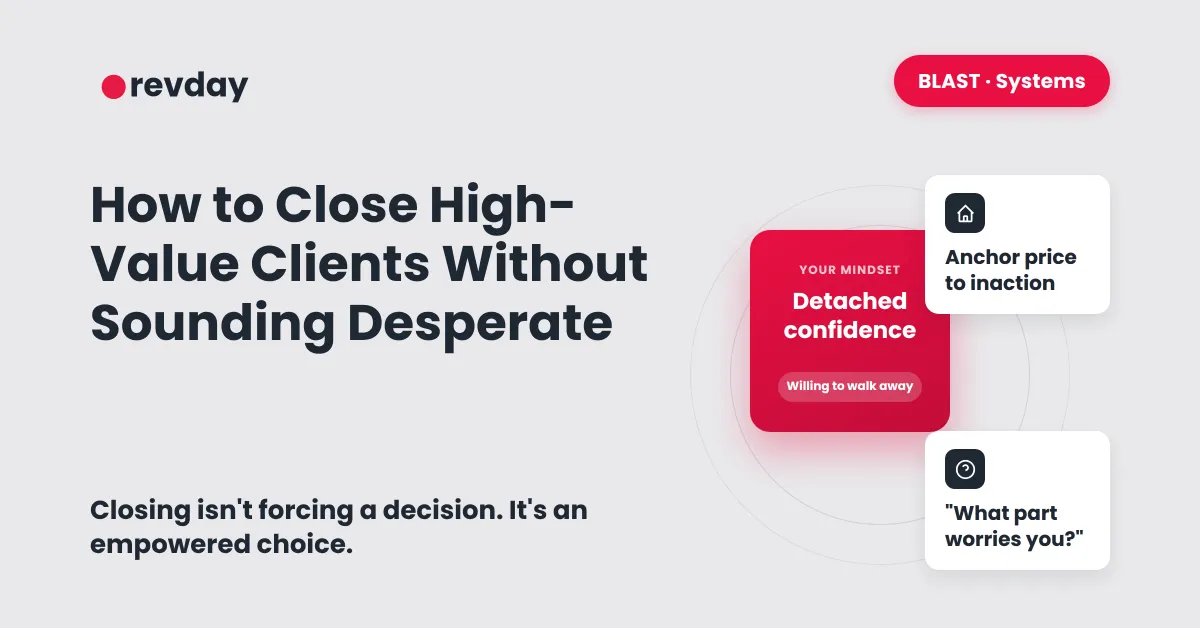
To maintain your status, you must cultivate detached confidence. You must enter every sales conversation completely unattached to the outcome, while remaining highly invested in the prospect's success. Your mindset should be simple: you are entirely willing to walk away if it is not a perfect fit. This quiet confidence is magnetic to high-value buyers.
How to Handle the "Your Price Is Too High" Objection
Price is the single most common objection in the service industry. When a prospect says your service is too expensive, your first instinct will be to defend your pricing, explain your overhead costs, or nervously offer a discount.
You must never do any of these things.
Instead of defending your price, you must gently guide the prospect back to the problem. Reframe the conversation around the deep diagnosis you uncovered earlier. If you established that their broken processes are costing their business $100,000 a year in lost revenue, a $15,000 implementation package is not expensive at all. It is a highly profitable investment. Acknowledge their concern, but anchor the price firmly to the cost of inaction.
Navigating the "I Need to Think About It" Smokescreen
When a prospect tells you they need to think about it, they are rarely going away to sit in a quiet room and ponder your proposal. This phrase is almost always a polite smokescreen. It means they are either too uncomfortable to say no directly, or they have a specific concern they have not voiced yet.
Do not push them for an immediate answer, but do not let them off the hook completely.
The most professional way to handle this is to agree with them and lower the pressure. You can say something like, "I completely understand, this is a big decision and you should absolutely take your time. Just so I know, what part of the proposal are you going to be thinking about the most? Is it the timeline, or the investment?" This gentle probe often brings the real objection out into the open so you can actually address it.
The Critical Transition (Closing to Onboarding)
Getting a verbal "yes" on a Zoom call or at a site visit is only half the battle. The deal is not truly closed until the invoice is paid and the client feels secure in their decision.
The moment they agree to move forward, you must lead them seamlessly into the next phase. Any friction, delay, or confusion after the verbal agreement will trigger immediate buyer's remorse. Your backend systems must instantly deliver the contract, process the payment, and welcome them into your ecosystem.
The Next Step: Ensure your new clients never experience buyer's remorse by mastering the handoff: Client Onboarding Basics: Securing the First 30 Days
The BLAST Approach to Closing Deals
Mastering the human element of sales is impossible if you are constantly stressed about your broken administrative processes. You cannot project quiet confidence if you are worried about how you are going to manually type up the contract after the call ends.
At revday, our Stage 2: BLAST implementation removes that friction completely. We build the automated pipelines and CRM systems that handle the heavy lifting, allowing you to focus 100 percent of your energy on the person in front of you.
Stop losing high-value deals at the finish line.