Why Word-for-Word Sales Scripts Kill Premium Deals
If you search for advice on how to build an initial sales process, you will usually find aggressive, outdated scripts written by massive software companies. They push tactics like "always be closing" and provide word-for-word templates designed for high-volume telemarketing.
If you run a premium service business, using one of these scripts is the fastest way to lose a deal.
Whether you are quoting a large commercial build, consulting for a corporate team, or onboarding a patient for a 12-week clinical program, your prospects are looking for an expert. They are not looking for a rehearsed pitch.
Here is exactly why traditional sales scripts fail and the diagnostic framework you should use instead to land high-value clients.
The Problem with Traditional "Sales Scripts"
High-value clients can smell a rehearsed pitch from a mile away. When you jump on a discovery call and start reading from a rigid script, three terrible things happen instantly.
First, you lose your status. You stop sounding like a peer or an authority figure and immediately sound like a vendor begging for a transaction. Second, you stop listening. Because you are focused on what your next line is supposed to be, you miss the critical nuances in what the prospect is actually telling you.
Finally, a rigid script assumes every client has the exact same problem. Premium clients want tailored solutions. They need to feel understood before they will ever hand over their money.
A Framework, Not a Script (The Diagnostic Approach)
To maintain absolute authority on a sales call, you must stop pitching and start diagnosing.
Think about how a specialist doctor operates. A surgeon does not walk into a consultation room and read a script about how great their scalpels are. They ask highly structured, diagnostic questions until the exact nature of the problem becomes completely obvious to both the doctor and the patient.
Service professionals must do the exact same thing. You do not need a script. You need a structured conversation framework.
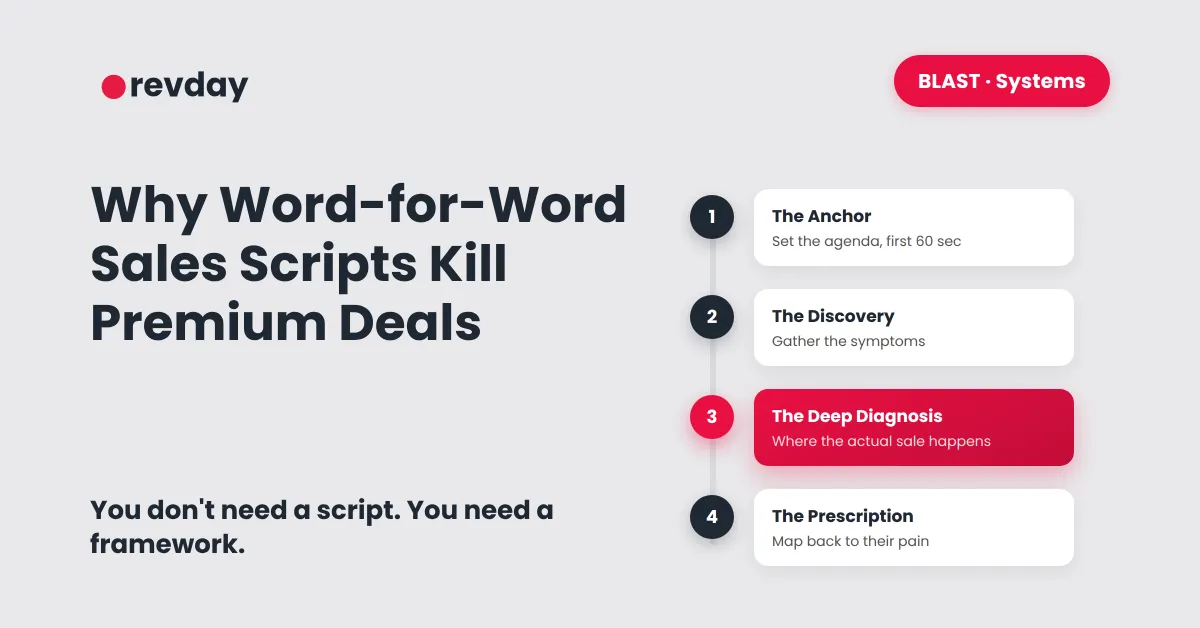
The 4-Part Architecture of a High-Converting Call
A diagnostic sales call moves fluidly through four distinct phases. This framework allows you to control the room while making the prospect feel completely heard.
1. The Anchor
You must take control of the call in the first sixty seconds. Set a clear agenda so the prospect knows exactly what is going to happen. Let them know you will be asking questions to see if it is a good fit, and if it is, you will explain how you can help. This removes all pressure and positions you as the prize.
2. The Discovery
This is where you uncover the surface-level problem. Ask them exactly what prompted them to book the call today. Let them speak freely and take careful notes. Your goal here is to gather the symptoms.
3. The Deep Diagnosis
This is where the actual sale happens. Once you know the surface problem, you must ask probing questions to uncover the real cost of that problem. How much time are they losing? How much money is it costing their business? How is it affecting their daily life? By quantifying the pain, the value of your solution becomes undeniable.
4. The Prescription
Once the diagnosis is clear, you present your service as the logical, tailor-made solution. You do not list all your features. You simply map your service directly back to the exact pain points they just gave you in the previous step.
The Next Step: Once you prescribe the solution, you need to confidently navigate the actual close. Learn how here: Sales Call Execution: How to Handle High-Ticket Objections
Systemising the Follow-Up
Even the best diagnostic call will fail if the prospect falls through the cracks afterward.
If a prospect asks you to send them a proposal, what happens next? If you rely on sticky notes to remind yourself to follow up three days later, you are bleeding revenue. The moment that call ends, your backend systems must take over. Your CRM should automatically trigger the proposal, log the deal value, and schedule your follow-up sequence.
The Deep Dive: How to Set Up a CRM for a Service Business
The BLAST Approach to Sales Pipelines
A smooth sales process does not happen by accident. It is the result of deliberate pipeline architecture.
At revday, our Stage 2: BLAST implementation ensures your frontend conversations perfectly match your backend systems. We help you build these exact diagnostic sales frameworks, then we physically integrate them into a CRM pipeline that automates your follow-ups and proposals.
Stop losing high-value deals to messy conversations and broken systems.