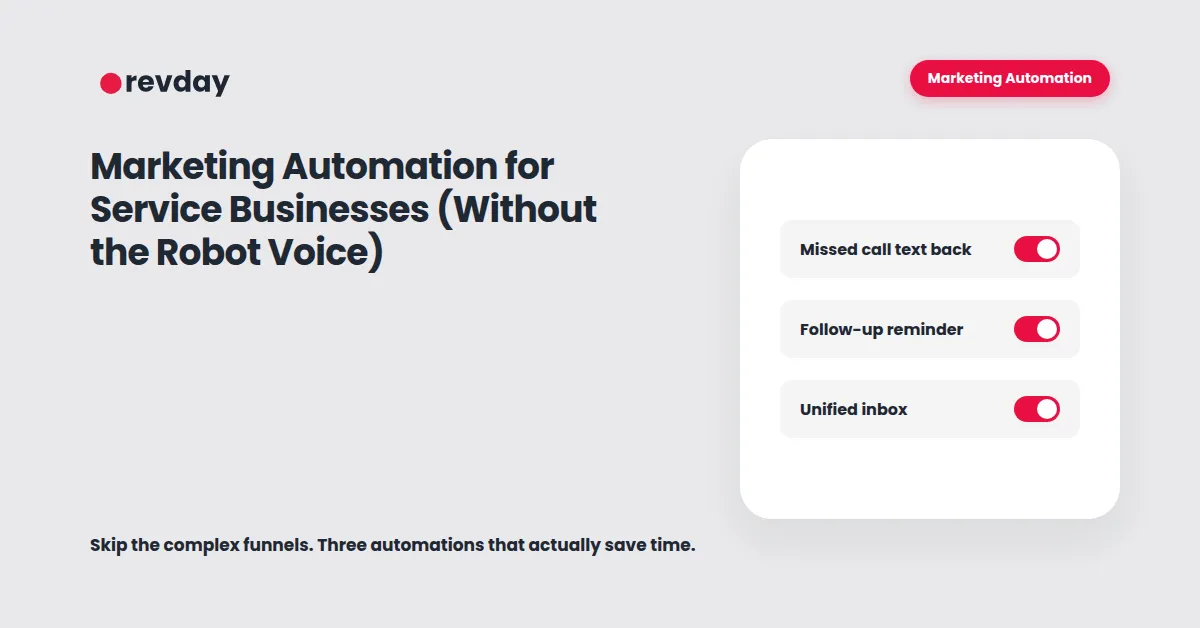
Marketing Automation for Service Businesses (Without the Robot Voice)
Most service business owners hear "marketing automation" and picture something complicated: a 14-step email sequence, a confusing dashboard, a tool that takes a weekend to learn and another month to actually use properly.
That's not what's actually useful here. After looking under the hood of a lot of service businesses, the pattern is consistent: trying to get fancy with automation usually breaks things faster than it fixes them. Real, profitable automation isn't about complex funnels. It's about removing the manual admin that's quietly bottlenecking your follow-up and your onboarding.
A consulting business once lost thousands of dollars simply because the founder was too busy on delivery calls to reply to new web enquiries. Leads were going cold within hours of arriving. The fix wasn't a complex campaign. It was a missed call text back and an automated five-minute SMS follow-up on new form submissions. That one change added two extra closed deals a month, because the business was finally first to respond, without the founder having to lift a finger.
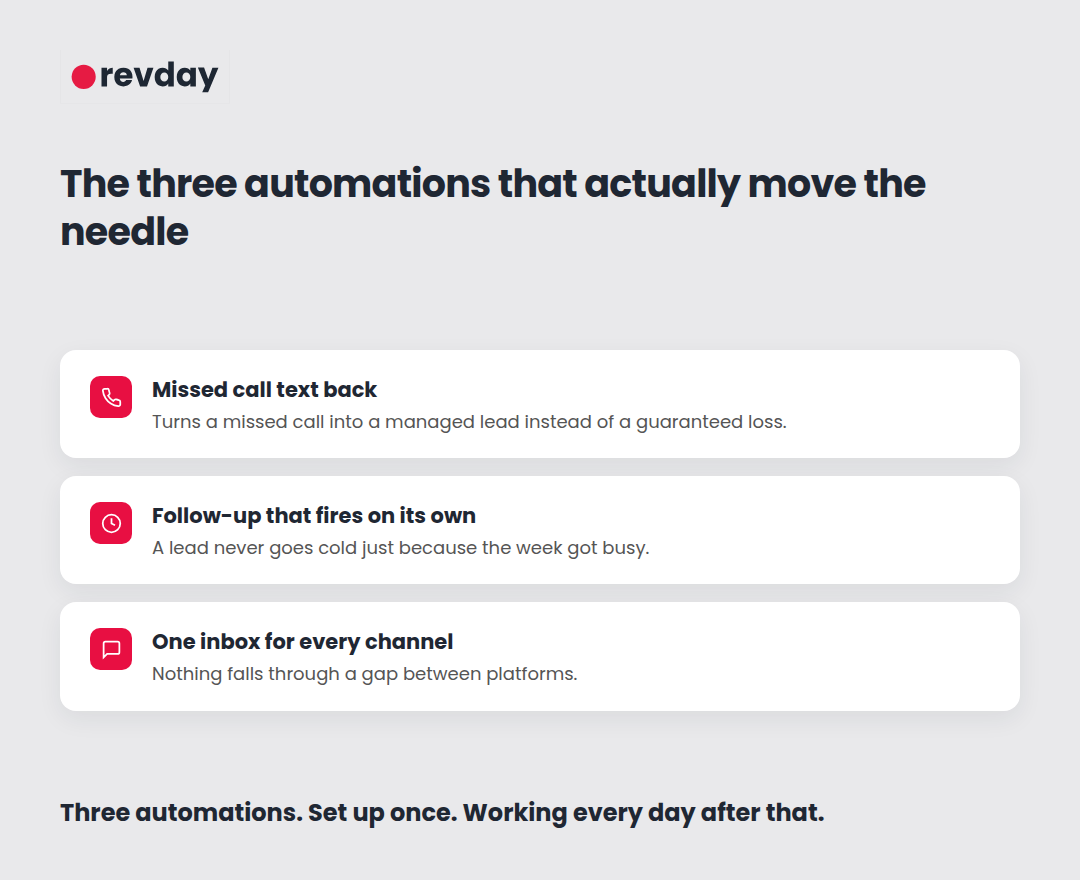
The three automations that actually move the needle
Missed call text back. Every missed call is a potential lead deciding whether to wait for you or call your competitor. An instant automated text acknowledging the call, with a clear path to reply, turns a missed call into a managed lead instead of a guaranteed loss.
Follow-up that fires on its own. Most lost deals aren't lost because the prospect said no. They're lost because nobody followed up at the right moment. A follow-up sequence that runs without manual chasing means a lead never goes cold just because the week got busy.
One inbox for every channel. Email, Facebook, Instagram, SMS, all landing in separate apps means something always gets missed. Bringing every channel into one place means nothing falls through a gap between platforms.
These three cover the vast majority of where service businesses actually lose leads. Everything else is optional until these three are solid.
What to automate, and what to keep human
The goal of automation is to protect the parts of the business that depend on you, not to replace them.
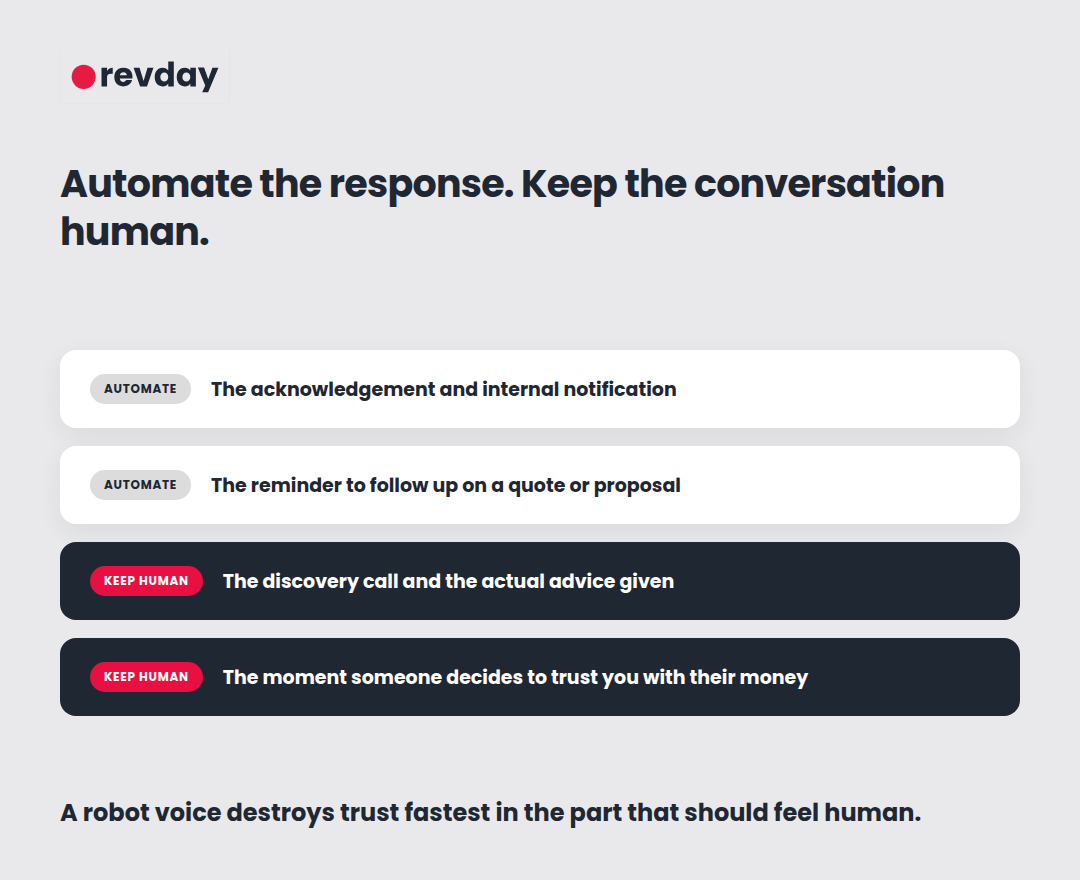
Automate the acknowledgement: the instant text or email that tells someone you've received their enquiry and roughly when they'll hear back. Automate the internal notification, so you know the moment something needs your attention. Automate the reminder to follow up, so a quote or proposal never quietly dies from neglect.
Keep the actual conversation human. The discovery call, the specific advice, the moment someone is deciding whether to trust you with real money, none of that should ever feel automated, because for a service business selling expertise, that's exactly the part a robot voice destroys trust in fastest.
Why this matters more than it looks like it does
None of these three automations are exciting. They don't feel like marketing in the way a clever ad campaign feels like marketing. But they're the difference between a lead that converts because you happened to be free when they called, and a lead that converts regardless of whether you were free, because the business responded before they had time to look elsewhere.
This is also the foundation a repeatable sales process gets built on top of. Without consistent follow-up and a single place to see every enquiry, there's nothing reliable to make repeatable in the first place.
Where to start
Pick one. Not all three at once. If phone leads are your main channel, start with missed call text back. If you're chasing the same five proposals every week, start with follow-up automation. If you're checking four apps a day to see if anyone's messaged you, start with the unified inbox.
Set it up once, let it run for a month, then add the next one. This is exactly the kind of foundational work BLAST is built to put in place properly, rather than bolted on as an afterthought.