How to Get Clients for a New Service Business
You started a service business. You know what you do. You're good at it.
But your calendar is quiet, your inbox is quiet, and every week that passes feels like evidence that maybe this was the wrong call.
Here's what I want you to understand before anything else: getting clients for a new service business is hard for almost everyone at the start. Not because there's something wrong with your offer. Not because you're not good enough. But because most people start by building things, a website, a logo, a pricing page, when they should have started by finding people.
The good news is that once you understand how clients actually find you, the path forward becomes a lot clearer.
Why Getting Your First Clients Feels So Hard
There's a common pattern with new service business owners. They spend the first few months getting everything ready. Website. ABN. Instagram account. Business email.
Then they launch. And nothing happens.
The problem is that they built before they found. They optimised for looking ready instead of for having conversations.
If you're already in this position, doing the work but still not seeing results, it usually comes down to a handful of specific reasons. We cover them in detail in Why You're Not Getting Clients (The Real Reasons), and it's worth reading alongside this one.
Getting clients for a new business is almost always a people problem before it's a marketing problem. The solution in the early days is rarely a better funnel. It's more conversations.
The 3 Ways Clients Find You
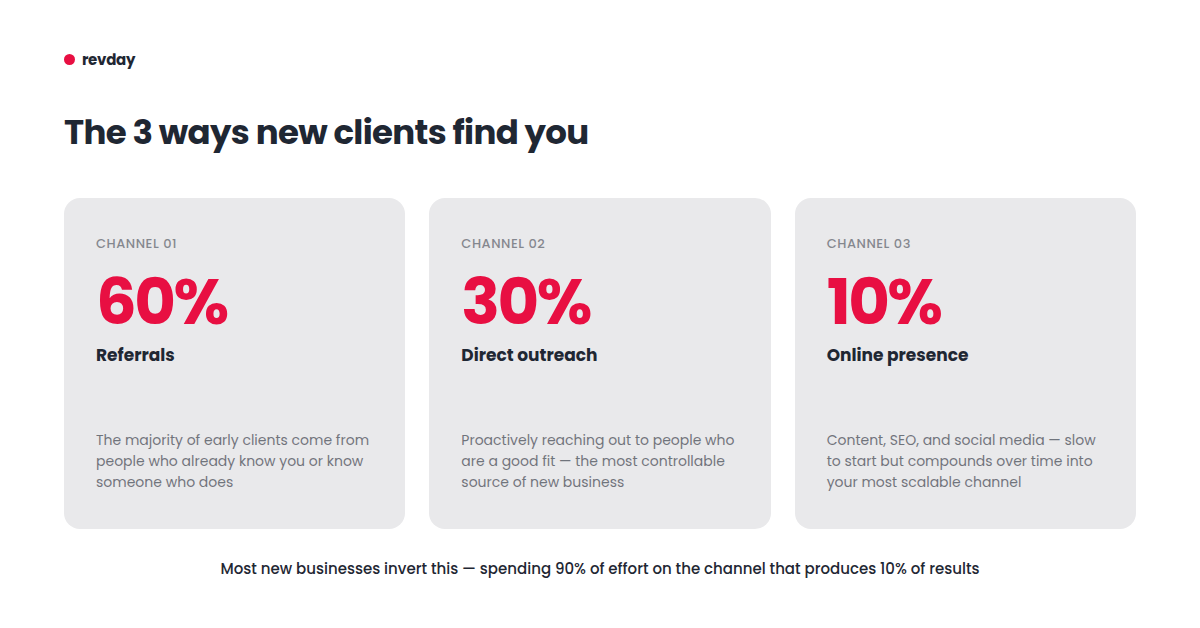
If you want to know how to get clients for a new business, start here. Clients come from three places, and they do not arrive in equal amounts.
Referrals: the fastest route
The majority of early clients for service businesses come through referrals. Someone knows someone who needs what you do, and your name comes up.
This means your single highest-leverage activity when you're starting out is making sure the right people know what you do and who you help. Not in a vague way. In a specific, repeatable way.
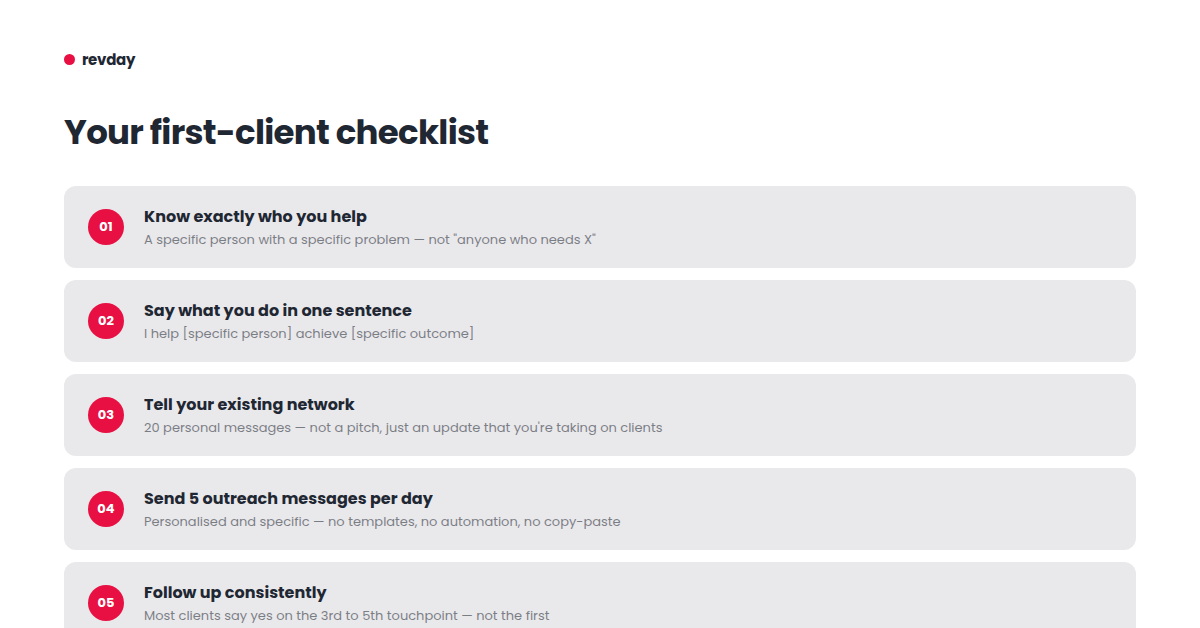
When someone asks what you do, can you say it clearly in one sentence? "I help [specific type of person] do [specific outcome]." If that sentence is fuzzy, referrals become rare because no one knows what to say about you.
Start by making a list of 20 people who could either hire you or refer you. Send each of them a personal message. Not a pitch. Just a genuine update that you're taking on clients and you'd love to hear who might benefit from your help.
Direct outreach: the most controllable route
Referrals are fast but unpredictable. Outreach gives you control.
Direct outreach means proactively reaching out to people who might benefit from your service. LinkedIn is the most effective channel for most service businesses. A simple, personalised message that shows you understand their situation will outperform any automated sequence.
The goal of outreach is not to sell in the first message. The goal is to start a real conversation. From there, you invite them to a discovery call and let the conversation do the work.
Five genuine outreach messages per day, sent consistently for 30 days, will produce results. Most people quit before the results arrive.
Online presence: the slowest but most scalable route
Content, SEO, and social media are long-term plays. They rarely produce clients in month one. But they compound over time in a way that outreach alone cannot.
If you are writing blog posts, showing up on LinkedIn, or posting useful content consistently, you are building something that works while you sleep. It just takes longer to kick in.
The mistake new service business owners make here is investing too much in online presence too early, when they would get faster results from referrals and outreach. Online presence is the third channel to activate, not the first.
What to Do in Your First 30 Days
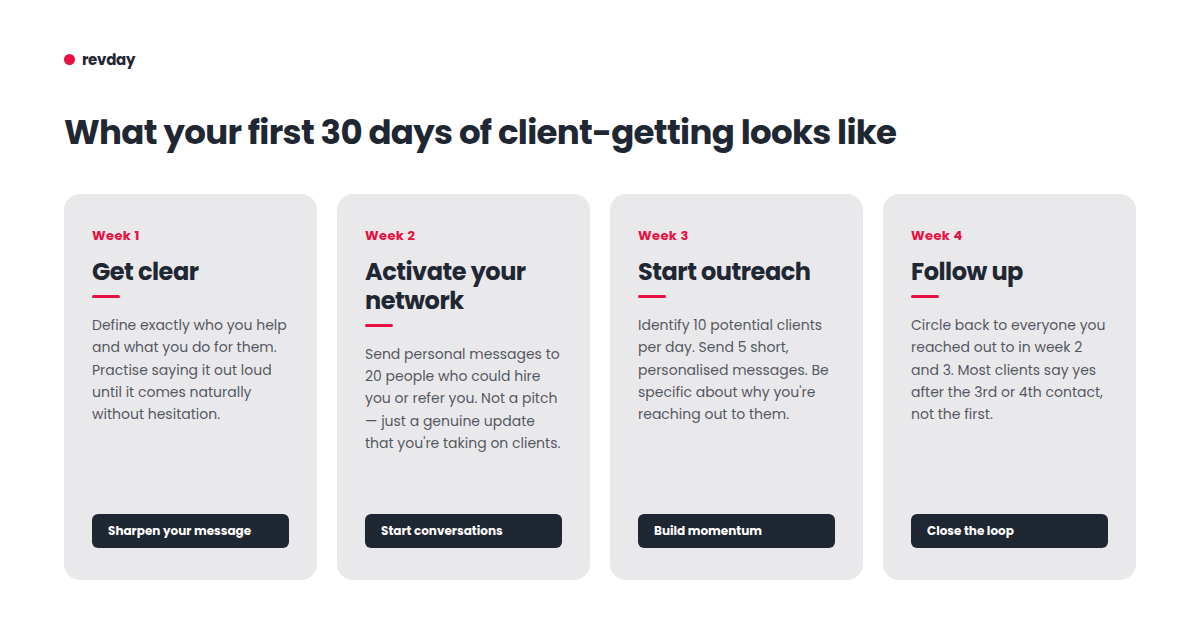
If you're asking how to get clients for a new business, this is the practical answer.
Week one: get clear on who you help and what you do for them. This is not about writing a perfect positioning statement. It is about being able to say it out loud without hesitating. If you find this harder than it sounds, our guide on how to find your ideal client walks through a simple process for getting specific without the overthinking.
Week two: reach out to your existing network. Email, call, or message the 20 people on your list. Let them know you're taking on clients. Ask if they know anyone who might benefit. No pitch. Just a genuine update.
Week three: start proactive outreach. Identify 10 people per day who might be a good fit. Send five of them a short, personalised message. Be specific about why you reached out to them specifically.
Week four: follow up. Most deals happen on the third, fourth, or fifth touchpoint. Following up consistently and professionally is often the difference between a client and a missed opportunity.
That is it. No ads, no funnels, no complicated strategy. Just clear positioning and consistent conversation.
One question we hear a lot at this stage: how long should this take? It genuinely varies — but we've put together an honest answer to how long it takes to get your first client so you have realistic expectations going in.
The Mistake That Keeps People Stuck
The most common reason service business owners struggle to get clients is that they wait until they feel ready.
They wait until the website is perfect. Until the testimonials are in. Until they have more confidence.
But readiness does not come before clients. It comes after them. Your first few clients teach you what you do, who you help best, and how to talk about it. You cannot learn that in advance.
The fastest path to feeling ready is to start having conversations before you feel ready.
If that feels uncomfortable, that is normal. The discomfort is not a sign to wait. It is a sign you are doing something real.
A Note on Pricing
When you are new and clients are scarce, the temptation is to price low. To offer discounts. To take any work that comes in.
This is understandable, but it creates problems.
Low prices attract clients who make decisions on price. These clients are often the hardest to work with and the least likely to refer you to others. They also make it harder to raise your rates later because you have trained yourself and your market to see your work as cheap.
Price for the value you deliver, not for the confidence you have. You can always negotiate from a higher starting point. You cannot easily raise a rate you have already set.
What Comes Next
Once you have a consistent flow of clients coming through organic outreach and referrals, the next question most business owners ask is whether to start running paid ads. It is a reasonable question, but the answer depends on a few specific things being in place first. We cover exactly what those are in When to Start Running Ads for Your Business.
You Do Not Have to Figure This Out Alone
Getting clients for a new service business is not complicated in theory. But it is genuinely hard in practice, especially when you are doing it alone, without a clear structure, and without someone to tell you what to focus on first.
That is exactly what revday is built for. We give you the platform to run your business, build it alongside you, and make sure you know what to do next at every stage.
The best place to start is the Clarity Quiz. In about 5 minutes, it will tell you exactly where you are in your business journey and what you should focus on first.
This post is part of the revday Client Acquisition Series. Next: When to Start Running Ads for Your Business