When to Start Running Ads for Your Service Business
Every service business owner gets to this point. You've got clients. The work is good. You're thinking it's time to scale. Someone tells you to run ads.
So you set up a Meta account, spend $500 in the first week, and end up with three terrible leads who never reply. You blame the platform. You blame the targeting. You blame yourself.
Here's the truth: most service businesses aren't ready for paid ads when they start running them. Running ads too early is the most expensive mistake we see at revday, where we've built and audited paid acquisition systems for service businesses across coaching, consulting, agencies, and trades.
This is the readiness checklist. The criteria that tell you whether ads will actually work for you right now, or whether you'll just be lighting money on fire.
What ads actually do (and don't do)
Ads amplify whatever is already happening in your business. They don't fix what's broken.
If your organic inquiries convert at 30 percent, ads will bring you leads that convert at 30 percent. If your follow-up takes four days, paid leads will get the same four-day follow-up. If your offer is unclear to people who already know you, it'll be even more unclear to strangers who saw a 6-second video on Instagram.
Paid ads are a multiplier. Multiply zero and you still get zero. Multiply a working system and you get scale.
This is why most "ads aren't working for me" stories are actually "my business isn't ready for ads" stories. The platform isn't broken. The foundation underneath is.
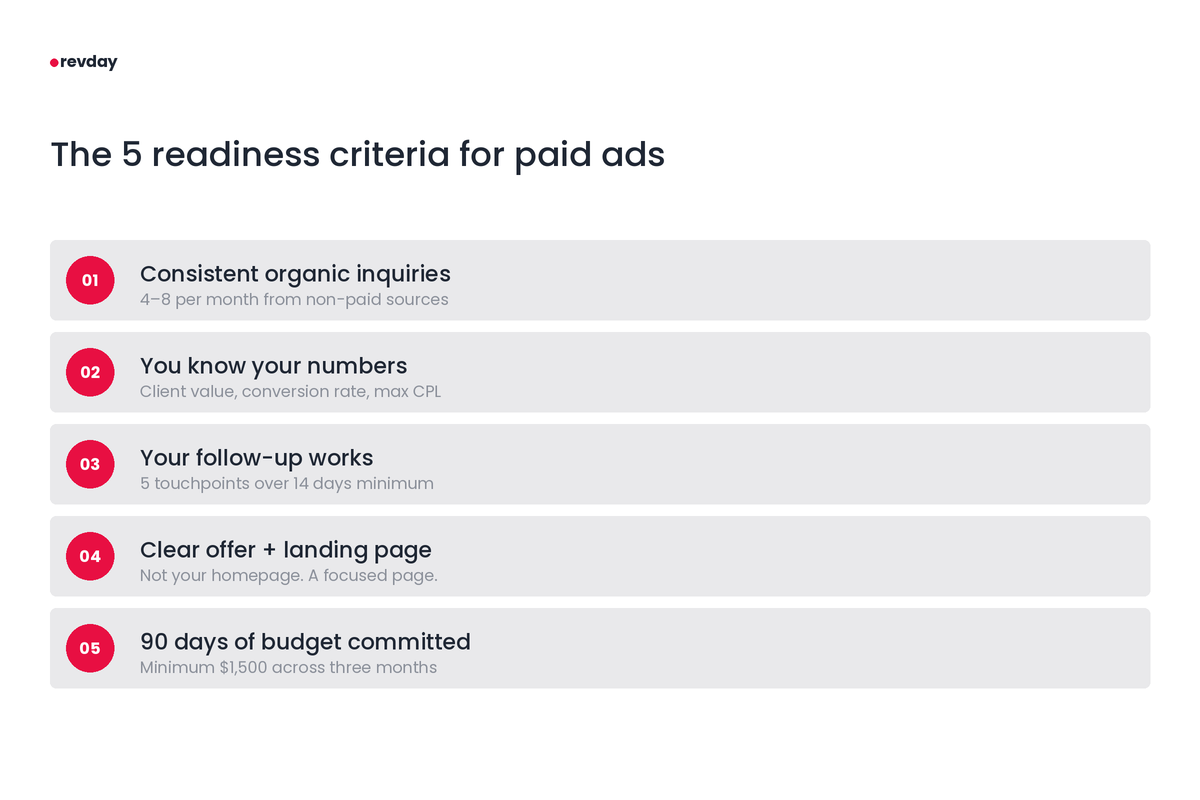
The five readiness criteria
Before you put a single dollar into paid ads, you should be able to say yes to all five of these. If you can't, fix that first.
1. You're getting consistent inquiries from organic channels
You should have 4 to 8 inquiries a month coming in from non-paid sources before you turn on ads. Referrals. Social posts. Email list. Word of mouth. Doesn't matter where, as long as they're coming.
This matters because organic inquiries prove that people want what you sell at the price you charge. If you can't get strangers to inquire about your service for free, paying to put it in front of more strangers won't fix that. It'll just amplify the silence.
We talked about how to build this baseline in the second post in this series, on getting consistent client inquiries on a small budget. Get that running before you read further.
2. You know your numbers
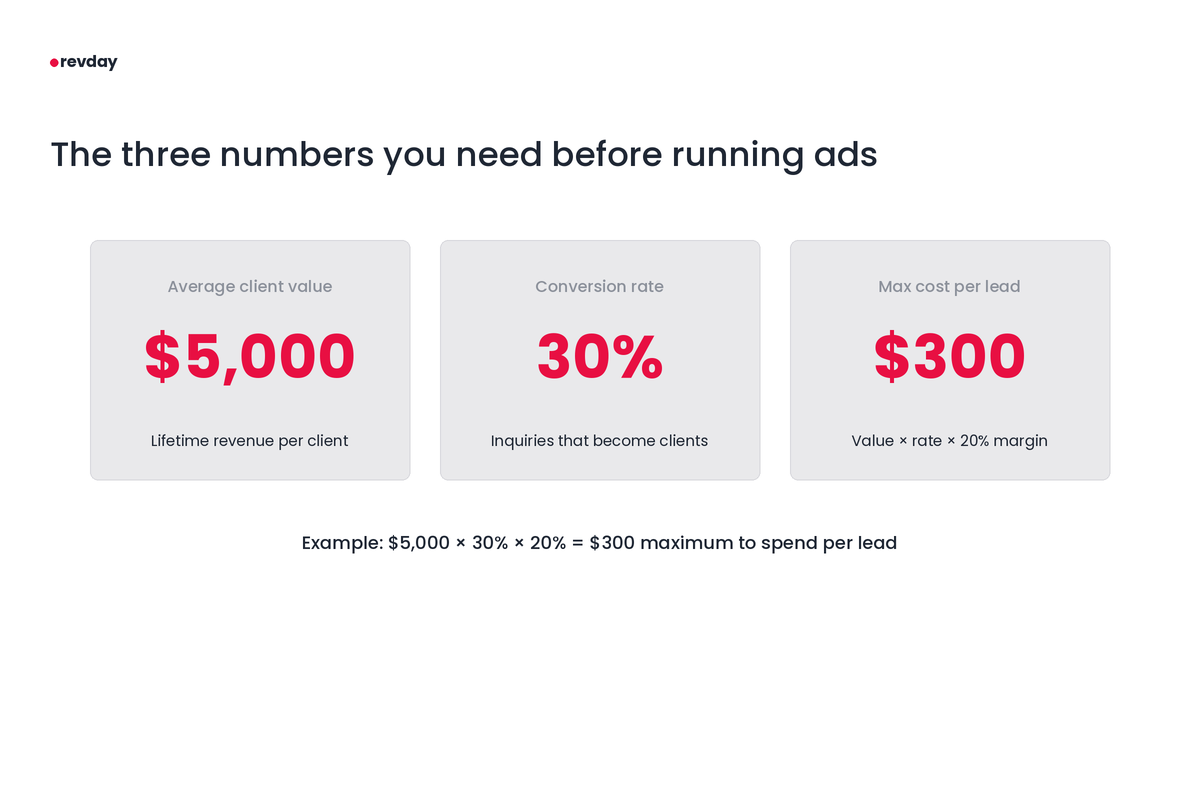
Your average client value. What does a client pay you on average over the lifetime of working together? If you charge $2,000 for a one-off project, that's your number. If you have retainer clients at $1,500/month who stay 8 months, your number is $12,000.
Your inquiry-to-client conversion rate. Out of every 10 people who inquire, how many become clients? If it's 4, you convert at 40 percent. If it's 1, you convert at 10 percent. Most service businesses sit between 20 and 40 percent.
The maximum you can pay per lead. Average client value × conversion rate × profit margin you'll accept. If your average client is worth $5,000, you convert at 30 percent, and you want to spend no more than 20 percent of revenue on acquisition, your maximum cost per lead is roughly $300.
If you don't know these three numbers, you can't measure whether ads are working. You're just guessing.
3. Your follow-up actually works
Paid leads are colder than referrals. They don't know you. They saw an ad, clicked, and gave you their email. They're not ready to hire you. They're ready to think about it.
Most service businesses lose paid leads because they reply once, hear nothing back, and move on. Paid acquisition assumes you'll follow up at least 4 to 6 times before giving up. If you don't have a system for that, your ads will work for the platform and not for you.
Your follow-up should include: an automated welcome email within 5 minutes, a personal email within 24 hours, a follow-up at 3 days, another at 7 days, and a final at 14 days. If that's not in place, set it up before you run ads.
4. You have a clear offer and a landing page
Strangers won't read your homepage and figure out what you do. They'll click an ad, land on a page, and either get it within 5 seconds or leave.
You need a single dedicated landing page for the offer you're running ads to. Not your homepage. Not your services page. A focused page that says exactly what they get, who it's for, how much it costs (or starts at), and what happens when they fill out the form.
If you don't have that page built, the ad has nowhere to send people. Pretty videos and clever copy can't fix a broken destination.
5. You have at least 90 days of budget committed
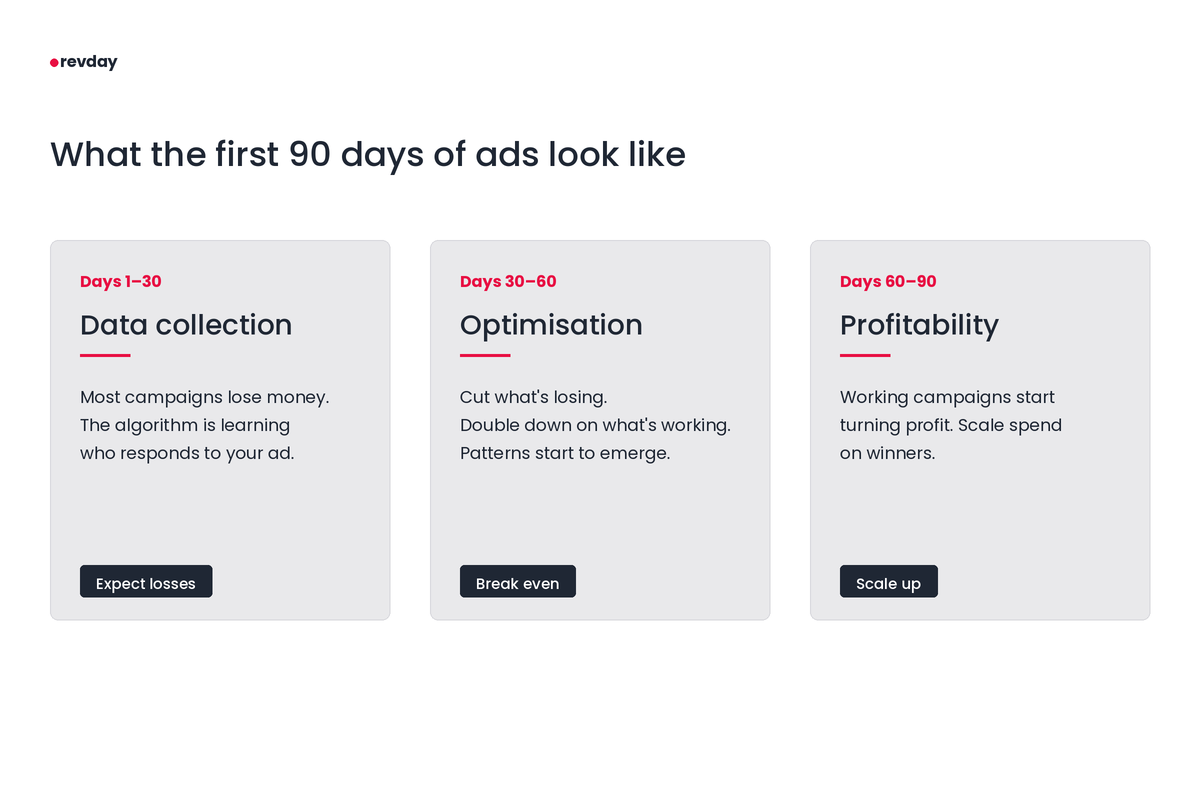
Ads need time to calibrate. The platform's algorithm needs to learn who responds to your ad. You need to learn which audiences, creatives, and messages actually work.
The first 30 days will look bad. The second 30 days will look slightly less bad. By day 90, if you've been testing and adjusting, you should have a campaign that works at a predictable cost.
If you can only commit $500 for a single month, don't run ads. The data you'll get is too thin to make decisions from. Service businesses we work with at revday start with a minimum of $1,500 across three months ($500/month) and scale up as the data proves out. Less than that and you're spending money to learn nothing.
🧭 Not sure if you actually meet these five criteria, or which one is the bottleneck? Take the Clarity Quiz to find out where to focus first.
The two ad platforms worth starting with
Once you meet the criteria, two platforms are worth your attention. Everything else can wait.
Meta (Facebook and Instagram) for cold awareness and retargeting. Works best when you're educating people who don't know they need you yet. You're paying to interrupt them with something useful. Good for service businesses with a strong content angle, a clear pain point you can speak to, or a high-value lead magnet.
Typical cost per lead for service businesses: $30 to $150 depending on industry and offer.
Google Ads for high-intent search traffic. Works best when people are actively searching for what you sell. Local service businesses (consultants, coaches, agencies in specific niches) usually start here. The leads are warmer because they're searching, but the cost per click is higher because everyone bids on the same keywords.
Typical cost per lead for service businesses: $50 to $300 depending on competition.
LinkedIn ads, YouTube ads, and TikTok ads are all valid platforms, but they're harder to start with and require either bigger budgets or more sophisticated content. Skip them until you've made Meta or Google work first.
What to test first
Don't try to scale on day one. Your job in the first 30 days is to find out what doesn't work.
Start with one offer. Not your full service catalog. The single offer most likely to convert a cold stranger. Usually that's your entry-level service, a free consultation, or a low-commitment first step.
Run two ad creatives, three messages. Six total combinations. Same offer, different angles. One angle that leads with the problem. One with the result. One with proof (a case study or testimonial). See which combinations get clicks at a reasonable cost.
Drive everything to the same landing page. You're testing ad performance, not page performance. Keep the destination constant so you can compare.
Measure cost per lead and cost per booked call. Not impressions. Not clicks. Not engagement. The two numbers that actually matter are how much you pay to get a lead and how much you pay to get them on a call with you.
After 30 days, kill what's losing money and double down on what's working. Then test the next variation.
Why ads fail for service businesses (the patterns)
After looking at dozens of ad accounts for service businesses, the failures fall into the same patterns.
Running ads to your homepage. Homepages are built for warm traffic that already knows you. Cold traffic from ads needs a dedicated page.
Bidding for sale on the first touch. Service businesses with $3,000+ price points can't expect strangers to buy from a single ad. Bid for a lead, an opt-in, or a call. Then convert that lead over the next few weeks.
No retargeting. 95 percent of people who click your ad won't fill out the form on the first visit. If you're not retargeting them on Facebook, Instagram, and the display network for the next 14 to 30 days, you're paying full price and capturing 5 percent of the value.
Killing campaigns too early. Most service business ads start showing results in week 3, not week 1. If you panic and turn it off at day 10, you'll never see whether it would have worked.
Spending without tracking. If you don't have the Meta Pixel installed, conversions configured, and UTM tags on every ad, you can't tell what's working. You're just hoping. Hope is not a strategy.
When to bring in help
Running ads yourself is doable. We've seen plenty of service business owners get to a working campaign on their own. It usually takes 6 to 12 months of testing and a few thousand dollars of tuition spend.
The shortcut is to either:
Pay an experienced media buyer or agency to run them for you, usually $1,500 to $3,000 a month plus ad spend. Worth it if your average client value is over $5,000 and you don't want to learn the platforms yourself.
Get coached through it by someone who's run ads for businesses like yours, while you handle execution. Usually cheaper, builds the skill in your business, but takes more of your time.
Use a programme that bundles both with the right tools and tracking already set up. This is what CSA at revday does for businesses past 6 clients ready to scale paid acquisition.
The wrong move is hiring a generic agency that runs ads for any business in any industry. The right ad strategy for a high-ticket B2B consultant is different from the right strategy for a local service business. Specificity matters.
How revday handles paid ads for service businesses
For service businesses ready to scale past organic, CSA is the programme that builds and runs paid acquisition with you. Not a course on how to run ads. Coaching plus the platform set up so the pixel, the landing pages, the follow-up sequences, and the CRM all talk to each other. That's the part most people get wrong, and the part that makes ads actually work.
If you're earlier in the journey and not yet hitting the readiness criteria, BLAST is the stage that gets you there. Most service businesses need 3 to 6 months of organic baseline building before paid ads make sense, and BLAST handles that part.
The Clarity Quiz tells you which stage you're at right now and whether paid ads should be on the table this quarter or six months from now.
Frequently asked questions
How much should I spend on my first ad campaign? The minimum to learn anything useful is $500/month across at least 90 days. So $1,500 committed before you start. Less than that and the data is too thin to make real decisions from. Service businesses at revday typically start at $1,000 to $1,500 per month and scale up once the campaign is profitable.
Which platform should I start with: Meta or Google? Meta if your clients don't know they need you yet and you have a strong content or education angle. Google if your clients actively search for what you sell. Local service businesses usually start with Google. Coaches, consultants, and high-ticket service providers usually start with Meta. Test the one that fits your audience and ignore the other one until the first works.
How long until I see results? First 30 days: data collection. Most campaigns lose money. Day 30-60: optimisation. You start seeing patterns and cutting losers. Day 60-90: this is where a working campaign starts to show profit. If you're still losing money at day 90, the offer or the audience is wrong, not the ad.
Can I run ads with a small budget under $500? Technically yes. Practically no. With less than $500/month, the algorithm doesn't get enough data to optimise, you can't run enough variations to find what works, and you'll likely conclude ads "don't work" when really you didn't give them enough fuel. Wait until you have at least $1,500 committed across three months.
Do I need a marketing degree or course to run ads? No. You need three things: a working business with proven demand, $1,500+ to commit, and 4 to 6 hours a week to manage the campaign for 90 days. After that, you can decide whether to keep running them yourself, hire it out, or use a programme that bundles it.
What's the biggest mistake service businesses make with paid ads? Running them before the foundation is ready. The five readiness criteria in this post are non-negotiable. We've seen businesses spend $20,000 on ads with zero clients to show for it because they skipped the foundation. The foundation is what makes ads work. The ads themselves are the easy part.
Up next in this series
This post covered when to start running ads. The other two posts in this series cover what to do before you're ready.
How to get your first 5 clients without paid ads. If you're starting from zero, this is where to begin. Paid ads can wait.
How to get consistent client inquiries on a small budget. The 5-to-20-client stage where you build the organic baseline ads will eventually scale.
Ready to figure out where to start?
Paid ads are one tool. They're not always the right tool for where you are right now. The Clarity Quiz tells you whether you're ready for ads, whether you should focus on organic first, or whether the bottleneck is somewhere else entirely.