How to Get Your First 5 Clients Without Paid Ads
You already know five people who need what you do. You probably know ten. The problem isn't your network. The problem is you haven't told them you're available yet.
Most advice about getting your first clients assumes you've got a budget to spend on ads, time to build a content engine, or months to wait for SEO to kick in. If you're bootstrapping a service business from zero, you don't have any of those things. What you do have is people who already trust you, problems you already know how to solve, and about two weeks before the doubt starts winning.
This is the playbook for landing your first five paying clients when you can't spend money and can't afford to wait.
Why the first five are different
Your first five clients aren't about building a scalable system. They're about proving the thing works and getting cash flowing before the anxiety eats you alive.
The tactics that will get you to 50 clients don't work at zero. Paid ads need budget. Content marketing needs time. A polished website needs both. At zero clients, none of that moves the needle fast enough to matter.
What does work: going direct to the people who already know you can do the work.
The warm circle (clients 1 and 2)
Start with the people closest to you. Not because it's easy. Because it's fast.
Former colleagues and managers. If you left a job to start this business, the people you worked with know what you're good at. Reach out to three of them this week. Not with a sales pitch. With a "hey, I just launched this, thought you'd want to know" message. Include what you're doing and who it's for. Half of them will ignore it. One will respond. That's your first conversation.
People who've asked for help before. Scroll back through your messages from the past year. Look for anyone who's asked you for advice, an introduction, or a quick favour in your area. They've already shown they value what you know. Tell them you're now doing it professionally and ask if they'd like to work together properly.
The "would you pay for this" test. If someone in your circle has a problem you can solve, offer to fix it for them at a reduced rate in exchange for being your first case study. This is not free work. This is paid work at a discount steep enough that saying yes is easy. Charge something, even if it's 50 percent off your eventual rate. Free projects don't get taken seriously.
You're not looking for 50 people here. You're looking for two. Two people who will pay you money to solve a real problem. Once you have two, the next three get easier.
The referral ask (client 3)
![Referral request script in a quote card: "Now that we've wrapped this up, I'd love to help a couple more businesses like yours get the same result. Do you know anyone dealing with [the same problem you just solved for them]?](https://assets.cdn.filesafe.space/nEVZhTSOV8O07l1C1YTn/media/69ff2d69a7b9e0385a27e018.png "Referral request script in a quote card: \"Now that we've wrapped this up, I'd love to help a couple more businesses like yours get the same result. Do you know anyone dealing with [the same problem you just solved for them]?")
After you've delivered for your first two clients, ask them who else needs this.
Most people skip this step because asking for referrals feels awkward. That awkwardness costs you months. Here's the script that works:
"Now that we've wrapped this up, I'd love to help a couple more businesses like yours get the same result. Do you know anyone dealing with [the same problem you just solved for them]?"
Notice what that's not asking. It's not asking them to sell on your behalf. It's not asking them to put their reputation on the line. It's asking if they know anyone with the same problem. That's an easy yes.
When they give you a name, ask if they're comfortable making an introduction or if you should mention their name when you reach out. Most will offer to introduce you. That warm intro is client three.
The adjacent network (client 4)
Your adjacent network is people one step removed from your direct circle. Friends of friends. Colleagues of former colleagues. Members of the same groups, communities, or associations.
These are people who don't know you well enough to hire you on trust alone, but they know someone who does. That one-step connection cuts the trust-building time in half.
LinkedIn second-degree connections. Filter your LinkedIn connections by industry or role that matches your ideal client. Look at their connections. You're looking for people they're connected to who fit your target. Send a note to your mutual connection asking if they'd be comfortable introducing you. Most will.
Industry groups and communities. If there's a Slack group, Facebook group, subreddit, or association for your industry, you're probably already in it. If you're not, join one this week. Don't post a "hire me" message. Spend three days answering questions, being helpful, and showing you know what you're talking about. Then send a direct message to someone whose question you answered, offering to help them properly.
Partnerships with non-competing services. Find three people who serve the same clients you do but in a different way. If you do marketing, talk to web designers. If you do bookkeeping, talk to accountants. If you do copywriting, talk to brand strategists. Offer to refer clients to them in exchange for the same. Most service businesses at your stage are desperate for referral partners and will say yes immediately.
Client four usually comes from one of these three.
The public signal (client 5)
By the time you've landed four clients, you've done the work multiple times. You know what the result looks like. You know what the common obstacles are. You know how to talk about it in a way that resonates.
Now you can make a public signal that you're open for business.
A single post that says what you do and who it's for. Not a long manifesto. Not a brand story. A clear, direct statement. "I help [type of business] with [specific problem]. If that's you, let's talk." Post it on LinkedIn. Post it in the communities you're in. Tag a few people who might know someone who needs it.
A case study from one of your first four. Write up what you did for one of your clients, what the result was, and how long it took. Keep it under 500 words. Include a testimonial if they'll give you one. Post it publicly. This isn't content marketing. This is proof that the thing you said you'd do, you actually did.
An offer with a deadline. "I'm taking on two more clients this month at [rate]. If you've been thinking about [problem], now's the time." The deadline creates urgency. The number creates scarcity. Neither is fake. You genuinely only have capacity for a couple more right now. That constraint makes the offer real.
Client five comes from one of these signals reaching someone who's been watching but hasn't acted yet.
What to do once you've got five
Five paying clients is the threshold that changes everything. You're no longer proving the concept. You're running a business.
At five clients, the question shifts from "how do I get clients" to "how do I get consistent clients without burning out." That's a different problem with different tactics. We cover that in the second post in this series, on getting consistent client inquiries on a small budget.
For now, your only job is getting to five. Not 50. Not a waitlist. Five paying clients who've hired you to solve a problem and paid you money to do it.
Once you've got five, you'll know whether the business model works, whether you can actually deliver, and whether people will pay what you need to charge. You can't know any of those things at zero.
🧭 Not sure if client acquisition is the right place to start, or if there's a bigger bottleneck elsewhere? Take the Clarity Quiz to find out which part of your business will give you the biggest return when you fix it.
The mistakes that slow you down
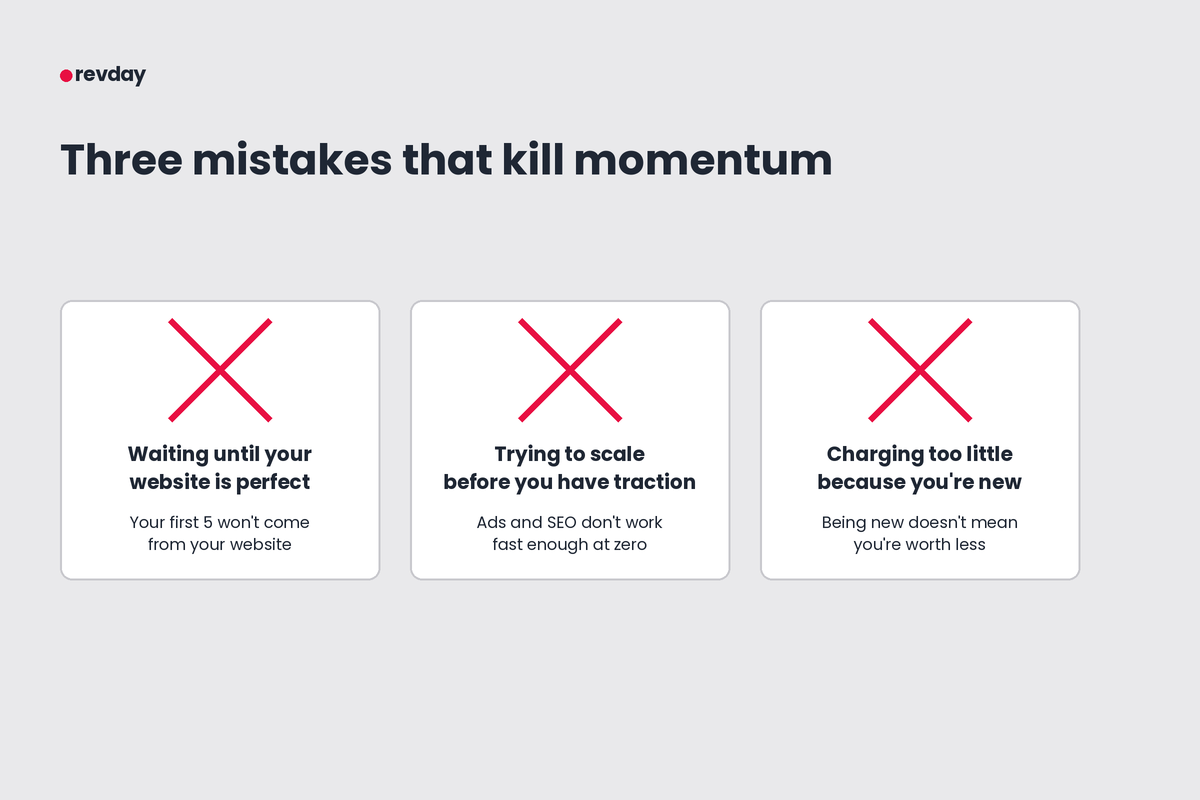
Three things kill momentum when you're trying to land your first five clients.
Waiting until your website is perfect. Your first five clients will not come from your website. They'll come from conversations. You don't need a portfolio. You don't need case studies. You don't need a logo. You need to be able to explain what you do and who it's for in a two-minute conversation. That's it.
Trying to scale before you have traction. Paid ads, SEO, content marketing, and email funnels are all tools for scaling something that already works. At zero clients, none of them work fast enough to matter. We cover when to actually start running ads in the third post in this series.
Charging too little because you're new. Being new doesn't mean you're worth less. It means you haven't proven it to strangers yet. Your warm circle already knows you can do the work. Charge them a real rate. If you undercharge, two things happen: you attract clients who don't value what you do, and you burn out trying to make rent on $500 projects. Neither helps you get to five.
How revday handles this for 0-to-5-client businesses
For service businesses with zero clients trying to get to five, BLAST is the programme that builds this with you. Not a course. Not a template. Coaching plus the all-in-one platform set up properly so the booking flow, follow-up, and client communication actually work while you're focused on landing clients.
The things that matter at zero clients are different from the things that matter at five, and different again from what matters at 20. BLAST focuses on the zero-to-five stage, which is where most service businesses either gain traction or stall out.
If you're past five clients and looking at how to systematise and scale what's working, CSA is the next stage.
The Clarity Quiz takes three minutes and tells you which stage you're actually at and what the highest-impact fix is for your specific situation.
Frequently asked questions
How long does it actually take to get five clients? If you work the warm circle hard, two to four weeks. Most people take longer because they're also trying to build a website, set up social media, and figure out their brand at the same time. Focus only on conversations with people who might hire you, and it goes faster.
What if I don't have a network? Everyone has a network. You know former colleagues, classmates, neighbours, people from past jobs, people you've worked with on projects, and people in online communities you're part of. If you genuinely know fewer than 20 people, join two industry groups this week and start helping people in them. Your network is whoever you've had a conversation with in the past two years.
Should I offer a discount to my first few clients? A small discount to make saying yes easier is fine. Fifty percent off to remove all friction for your first two is fine. Free is not fine. Free work doesn't get taken seriously, doesn't get finished, and doesn't turn into referrals. Charge something, even if it's low.
What if people say no? Most will. At zero clients, you're asking people to take a risk on you. Some will say yes because they trust you. Some will say no because the timing's wrong. Some will say no because they don't need it. Keep asking. You only need five yesses.
Do I need a portfolio or case studies first? No. Your first two clients hire you on trust and past relationship, not on proof. After you've delivered for them, you have proof. Use that to land the next three.
Up next in this series
This post covered getting your first five paying clients. The next two tackle what happens after.
How to get consistent client inquiries on a small budget. Once you've got five clients, the question becomes how to keep the pipeline full without spending all your time on it.
When to start running ads for your service business. Ads work. But not at zero clients. This post covers when you're actually ready and what to test first.
Ready to figure out where to start?
Getting your first five clients is one path. It's not the only bottleneck in a service business. The Clarity Quiz takes a few minutes and gives you an honest read on whether client acquisition is the highest-impact fix for you right now, or if there's something else that would move the needle faster.