Get Consistent Client Inquiries on a Small Budget | revday
You've landed your first handful of clients. The work is good. The money is real. But every month feels like starting from scratch because you still don't know where the next client is coming from.
Most advice about getting consistent inquiries assumes you've either got a big ad budget or unlimited time to "build your brand." If you're running a service business with 5 to 20 clients, you've got neither. You've got maybe four hours a week for marketing, $200 a month to spend, and a pipeline that goes from full to empty in two weeks.
This is how you fix that. Not with ads. Not with a full-time content schedule. With a system that runs in the background and brings inquiries to you while you're doing the work.
What consistent actually means
Consistent doesn't mean five inquiries every single week. It means you're not starting from zero every month.
At the 5-to-20-client stage, consistent looks like this: you get 2 to 4 inquiries a month from people who already know what you do, have a real budget, and aren't shopping for the cheapest option. That's enough to keep the pipeline moving, replace clients who churn, and grow when you're ready.
The goal isn't a flood of leads. The goal is predictability. You should be able to look at next month and have a decent idea of how many conversations you'll have. That's what consistent means.
The three channels that work on $200 a month
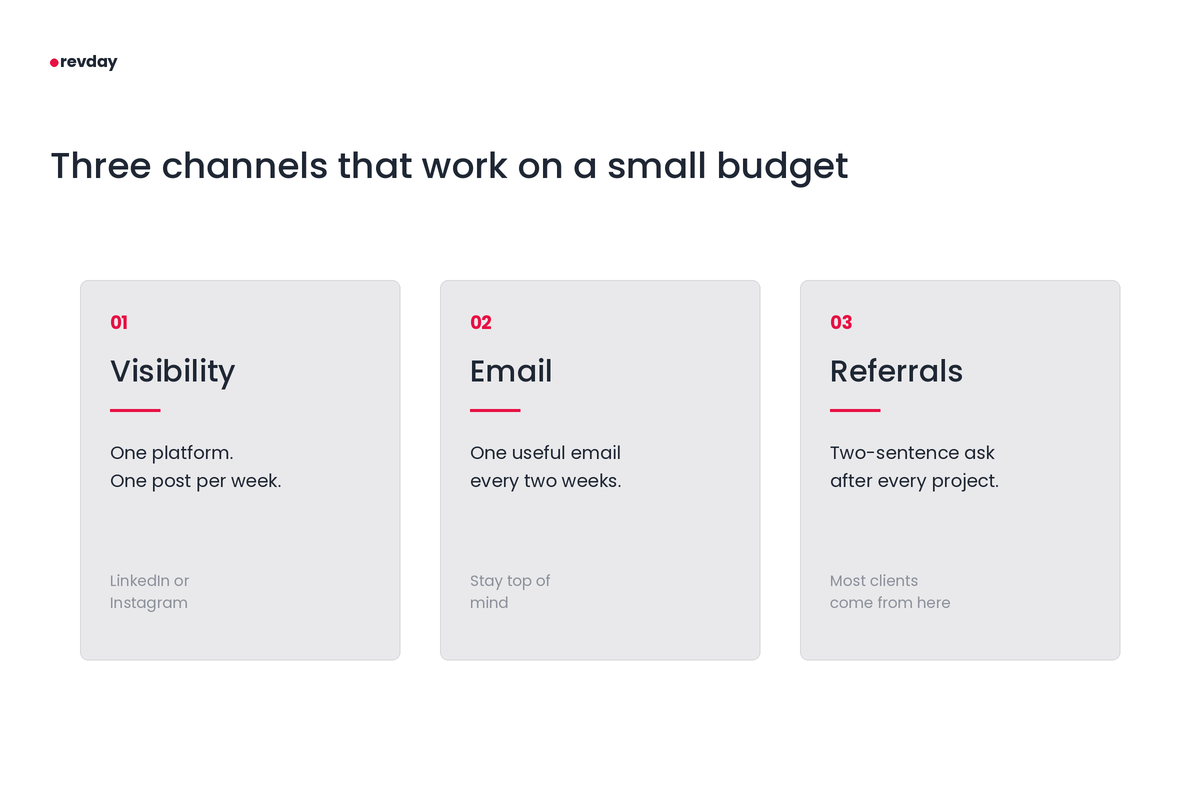
You can't be everywhere. You don't need to be. At this stage, three channels handled well will beat ten channels handled badly.
One platform for visibility. Pick the platform where your ideal clients actually spend time. If you work with other business owners, that's LinkedIn. If you work with creatives or local businesses, Instagram works. If you work with corporate teams, LinkedIn again.
Post once a week. Not motivational quotes. Not behind-the-scenes selfies. Content that shows you know how to solve the problem your clients are paying you to fix. A quick tip. A mistake people make. A question you just answered for a client. 300 words. No fancy graphics. Just useful.
The goal isn't to go viral. The goal is to stay visible to the people who already know you exist and the people one connection away from hiring you.
One email to your list every two weeks. If you don't have an email list yet, start one this week. Put a signup form on your website. Offer something small and useful in exchange. A checklist. A template. A short guide. Something they can use today.
Every two weeks, send an email. Same format as the social posts. Useful. Short. No hard sell. The occasional "I've got two spots open this month" mention is fine. The rest of the time, you're just reminding them you're still here and still helpful.
Email is how you stay top of mind with people who aren't ready to hire you yet but will be in three months.
One passive referral system. Most service businesses get 30 to 50 percent of their clients through referrals. The ones who get more are the ones who actually ask for them.
Set up a simple system: when you finish a project, send a two-sentence message. "Thanks for working with me. If you know anyone dealing with [problem you solve], feel free to send them my way."
That's it. No formal referral program. No affiliate fees. No awkward scripts. Just a reminder that you're still taking clients and they're allowed to tell people about you.
Most referrals happen because the person who hired you remembered you existed at the exact moment someone asked them for a recommendation. Your job is to make sure they remember.
🧭 Already doing these three things but still not seeing consistent inquiries? The bottleneck might not be marketing. Take the Clarity Quiz to find out what's actually slowing you down.
The $200 budget breakdown
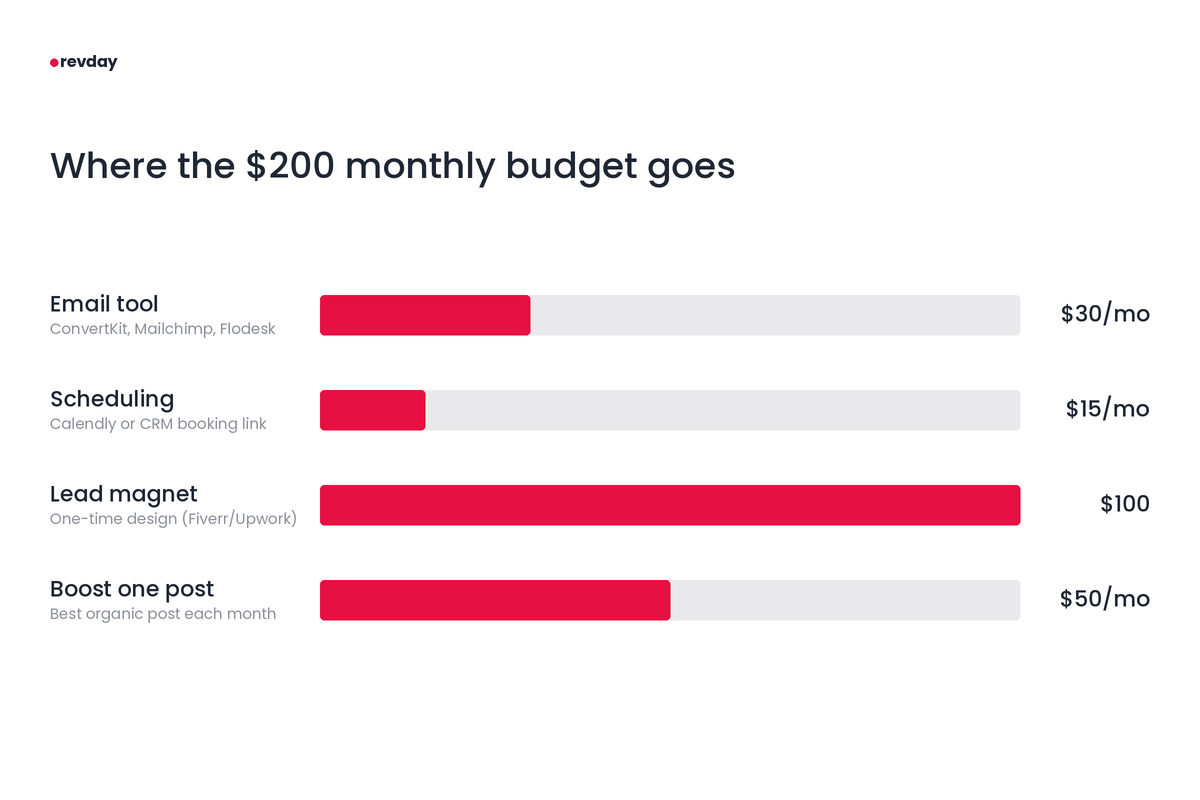
You don't need a big budget. You need to spend what you have in the right place.
Here's where the $200 goes:
Email tool: $30 per month. ConvertKit, Mailchimp, or Flodesk. Pick one. The free tiers work fine until you hit 500 subscribers. After that, you're paying $30 to $40 a month. Worth it. Email converts better than anything else you'll spend money on.
Scheduling tool: $15 per month. Calendly or a booking link inside your CRM. Anything that lets people book a time with you without the back-and-forth. Cuts friction. Converts more inquiries into actual calls.
Lead magnet or opt-in asset: $100 one time, then $0. Pay someone on Fiverr or Upwork to design a simple PDF template, checklist, or guide you can give away in exchange for an email address. You build it once and use it for the next year.
Boost one post per month: $50. Pick your best-performing organic post from the month and put $50 behind it. Target people in your area or industry. Not a huge reach. Just enough to get it in front of 500 to 1,000 people who fit your client profile.
The rest of your time is free. The system doesn't need paid tools to work. It just needs you showing up consistently on the channels that matter.
What to post when you don't know what to post
The hardest part of staying consistent isn't time. It's knowing what to say.
Here's the cheat sheet:
Answer the question someone asked you this week. A client asked you something. A prospect asked you something. That question is content. Write the answer. Post it. Someone else is wondering the same thing.
Share a mistake you see people make. Your clients come to you with the same problem over and over. That problem is content. "A lot of people think X will work, but it won't because Y. Here's what does."
Show the process, not the result. Nobody cares about your finished project. They care about how you got there. Walk through one decision you made. One thing you tried that didn't work. One shortcut that saved time. That's the stuff people remember.
Repurpose one thing three ways. You wrote an email last week. That email can become a LinkedIn post, an Instagram caption, and a Facebook update. Same idea. Slightly different wording. Three pieces of content from one piece of thinking.
If you're stuck, go back to the last five questions a client asked you. Turn each one into a post. That's five weeks of content.
The follow-up most people skip
Getting the inquiry is half the job. Converting it is the other half.
Most inquiries die because there's no follow-up. Someone fills out your contact form. You reply once. They don't respond. You assume they went with someone else. End of story.
Wrong move. Most people don't hire the first person they talk to. They talk to three, get busy, forget to reply, and eventually hire whoever follows up.
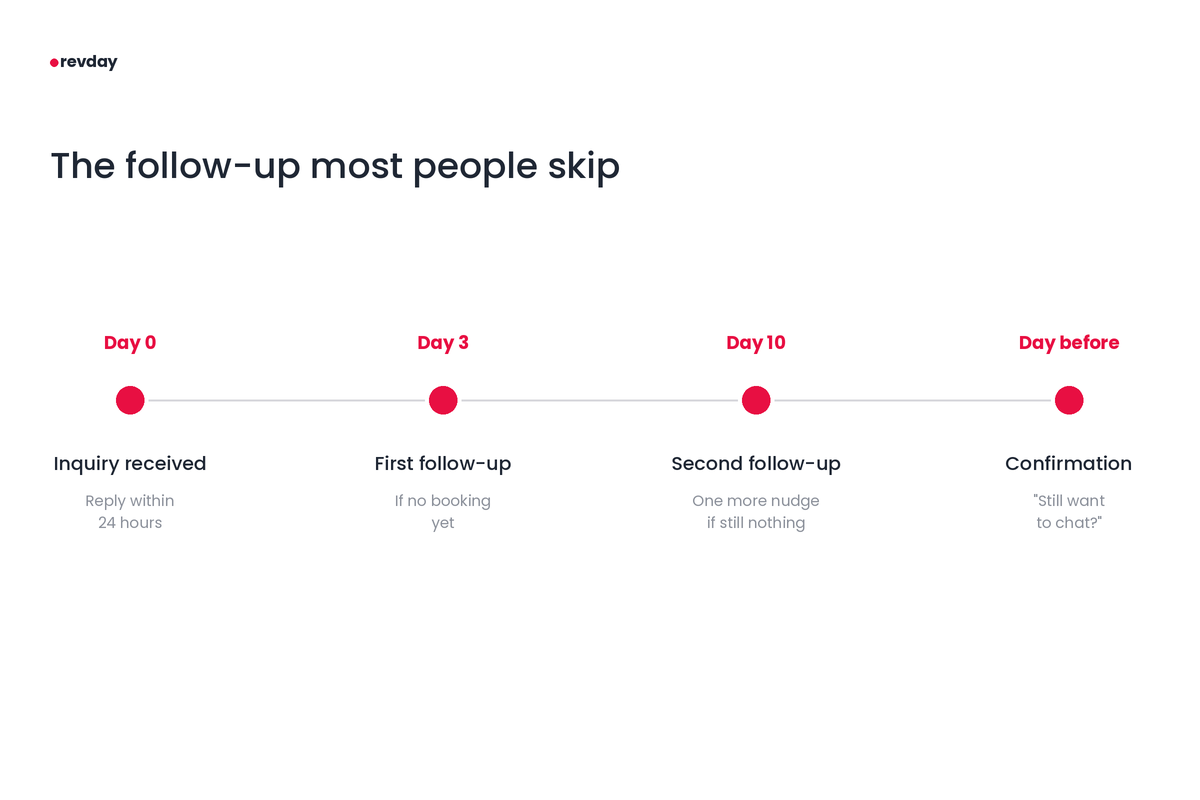
Here's the system: when someone inquires, reply within 24 hours. Book a time to talk. If they don't book, follow up three days later. If they still don't book, follow up one week after that. If they ghost after booking, send a quick "still want to chat?" message the day before.
You're not being pushy. You're being professional. Half the people who don't reply the first time will reply the second or third time. The ones who wanted to hire you but got distracted will thank you for following up.
The inquiries you already have are worth more than the new ones you're chasing. Don't let them die from lack of follow-up.
When you're ready to scale past this
Once you're getting 5 to 10 inquiries a month without paid ads, you've built a system that works. At that point, the question shifts from "how do I get inquiries" to "how do I handle more inquiries without doubling my workload."
That's when paid ads start making sense. Not before. Running ads when you don't have a working system is just expensive noise. Running ads when you've already got consistent organic inquiries is how you go from 10 a month to 30. We cover that in the third post in this series, on when to actually start running ads.
For now, the goal is predictability. Get the system working. Get the inquiries flowing. Prove to yourself that you can fill the pipeline without spending all your time on marketing.
How revday handles this for 5-to-20-client businesses
For service businesses at the 5-to-20-client stage, BLAST is the programme that builds this system with you. Email sequences. Social templates. Referral prompts. Booking automations. All set up inside the platform so it actually runs without you babysitting it.
The bottleneck at this stage isn't knowing what to do. It's having the time and the tools to do it consistently. BLAST handles the setup so you can focus on the client work that's paying you now while the system brings in the clients who'll pay you next month.
If you're past 20 clients and looking at how to scale without burning out, CSA is the next stage. The Clarity Quiz tells you which stage fits where you're actually at.
Frequently asked questions
How long does it take to see consistent inquiries? If you start the three-channel system this week, expect to see the first inquiry from it in 30 to 45 days. Consistency takes three months to prove out. Most people quit at six weeks because they don't see instant results. The ones who stick with it are the ones who end up with predictable pipelines.
What if I don't have an email list yet? Start one today. Put a signup form on your website. Offer something small and useful in exchange. It doesn't need to be fancy. A one-page checklist works. You'll get your first 50 subscribers from people who already know you. After that, the opt-in grows it.
Do I really need to spend $200 a month? No. You can run this system for free if you use free tools and don't boost posts. The $200 just makes it faster. Email tools have free tiers. You can schedule manually. You can skip the boosted posts. The system works either way. The budget speeds it up.
What if my industry doesn't use LinkedIn or Instagram? Then go where your industry does use. If your clients are on Facebook groups, that's your platform. If they're on Reddit or industry forums, that's where you show up. The channel doesn't matter. The consistency does.
How do I know if this is working? Track two numbers: inquiries per month and where they came from. If you're getting 2 to 4 a month and at least half are coming from the three channels you're focused on, it's working. If you're getting zero after three months, the content or the targeting is off. Adjust and try again.
Up next in this series
This post covered building a system that brings consistent inquiries without a big budget or burning out. The other two posts in this series cover the stages before and after.
How to get your first 5 clients without paid ads. If you're still at zero or working on landing your first handful, start here.
When to start running ads for your service business. Once you've got consistent inquiries from organic channels, ads let you scale past 10 a month. This post covers when you're actually ready and what to test first.
Ready to figure out where to start?
Consistent inquiries solve one problem. They don't solve all of them. The Clarity Quiz tells you whether client acquisition is your highest-impact fix right now, or if there's a bigger bottleneck somewhere else in the business.