How Long Does It Take To Get Your First Client? (Honest Answer)
You've been at this for a few weeks, maybe a few months. The website is up. You've sent some messages. You've had one or two conversations that felt promising and then went quiet. You're starting to wonder if everyone else got their first client by now, and you're the one doing it wrong.
So you Google this question, and you get back what you always get back. One article promises five clients in 30 days. Another shrugs and says "it depends." Neither tells you anything useful, and you close the tab feeling worse than when you opened it.
Here's the actual answer.
For a service business starting from scratch and putting in real effort, the honest range to your first paying client is two weeks to two months. Most people land somewhere in week three or four. If you're going content-only with no outreach and no warm network, the range stretches to four to six months.
That's the headline. The rest of this post explains what makes the difference between week three and month six, and gives you a way to know whether you're on track or genuinely stuck.
The realistic range
Here are the timelines I see most often for service businesses that are actually working at it, by approach.
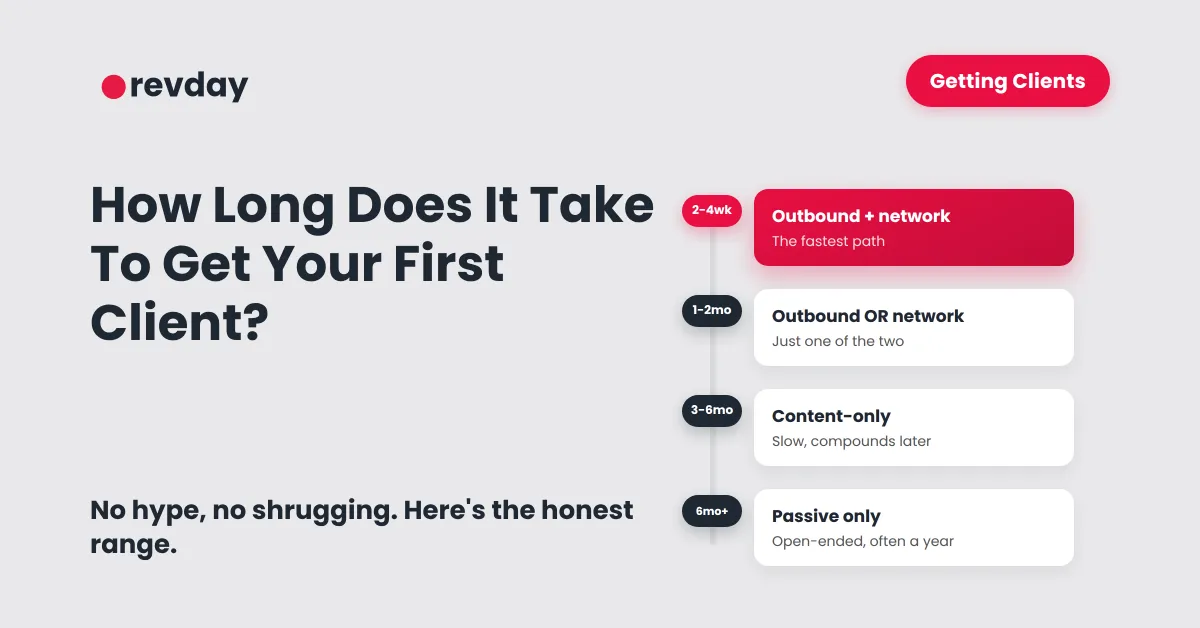
Two to four weeks: outbound plus warm network
Fastest path. You're doing direct outreach (cold email, LinkedIn DMs, calls) and you're also tapping the people you already know. You can usually generate a paying client within three weeks, sometimes sooner. The first one often comes from your network, not your cold outreach. The cold outreach starts producing more reliably from week four onwards.
This works because you're combining two channels that pay out fast. Network is high-trust. Outbound is high-volume. Together they cover both speed and quantity.
One to two months: outbound only or network only
If you only have one of those two going, the timeline roughly doubles. Outbound on its own takes around six to eight weeks before the first paid client lands, mostly because the first month is spent learning what message works for the audience you're targeting. Network on its own can be fast for the first client and then slow for the next two while you wait for word to spread.
Three to six months: content-only or referrals-only
If you've decided you're going to "build an audience" or "let referrals come" and that's your whole strategy, expect three to six months before paid work shows up. Sometimes longer. Content takes time to find an audience. Referrals take time to compound from a small starting base.
These channels are not bad channels. They're just slow. They work brilliantly in year two of a business and feel like watching paint dry in month two.
Over six months: passive only
If you've launched a website, posted on social a couple of times, told a few friends, and are otherwise waiting for the universe to deliver, the timeline is open-ended. I've seen owners go a full year without a paying client at this level of effort. The website will not save you. The market is not waiting for you to be ready.
What actually speeds it up
Five things move the timeline meaningfully. None of them are clever.
Doing outbound from day one. The single biggest accelerator. Most new service businesses sit in build mode (logo, website, brand) for months before talking to a single potential client. The ones who get their first client fastest are the ones who started conversations on day three.
Talking to people who already know you. Past colleagues, old clients from a previous role, friends who run businesses in adjacent spaces. These conversations don't have to be sales calls. "I've started doing X, here's who I help, do you know anyone who might be a fit?" produces leads faster than any cold channel because trust is already there.
Charging less the first time around. The first paying client doesn't need to be at your final price. Underpriced first projects exist for a reason. They get you a case study, a testimonial, and a reference, all of which make the next sale much easier. Charging full rate from day one is admirable and also why some businesses spend six months at zero revenue.
Having one obvious offer instead of five vague ones. If your website lists six services, none of them get bought. The owners who land their first client fastest have one thing on the menu, priced clearly, with the outcome named.
Being willing to be uncomfortable. Cold outreach feels weird. Asking your network for introductions feels weird. Putting your prices on the website feels weird. Doing the weird thing produces the client. Avoiding the weird thing produces another month of nothing happening.
What slows it down (often invisibly)
On the other side, here are the patterns I see most often in owners who are five months in with no clients yet. Almost all of them are doing one of these without realising.
Polishing the website for six weeks before talking to anyone. The website doesn't get you clients. Conversations get you clients. The website just stops the wrong people from emailing you. If yours is 80% finished, that's enough to start outreach. Don't wait.
Waiting for things to feel ready. They won't. Owners who feel ready usually got there by doing the uncomfortable thing 50 times until it stopped feeling uncomfortable. Readiness is the result of action, not the precursor to it.
Spreading effort across five channels. Two posts on LinkedIn, three cold emails, half a podcast pitch, an Instagram story, a blog post in Notion that never got published. Each of those efforts gets so little sustained attention that none of them produce anything. Better to do two channels well than five badly.
Hiding inside business setup tasks. Logo, brand colours, business name, ABN, website hosting, choosing a CRM, picking a calendar booking tool. All of these feel like progress. None of them are progress towards a paying client. They're admin theatre.
Quitting the channel two weeks before it would have worked. This is the saddest one and the most common. Most service business channels need around 90 days of consistent effort before they reliably produce. Most owners give up at week six. Week six is exactly when it's about to start working.
If a few of those sound familiar, here's the deeper diagnostic on why clients aren't coming in.
What "normal" actually looks like
If you're working at this consistently (five to ten hours a week on pipeline activities, not website tweaks), here's roughly what the path looks like.
Weeks 1-2: setup, first conversations with your network, first cold outreach messages going out. No clients yet. This is normal.
Weeks 3-4: first proposals being sent. Possibly a verbal yes from a warm contact. First cold reply that isn't a polite no. Still might not have a signed client.
Weeks 5-8: first paid client signs. This is the most common landing window I see.
Months 3-6: a small handful of clients (2-5 typically), inconsistent income, you're learning what works in your market and adjusting.
Months 6-12: starting to feel something close to consistent. Pipeline review every Friday is producing clients on a schedule. You can predict roughly what next month looks like.
If you're at week six and you've had two conversations and one polite pass, you're not behind. That's exactly normal. If you're at month four and you've had zero conversations, that's a different problem, and it's almost always a volume problem (you're doing too little) or a clarity problem (your message isn't landing).
When to actually worry
Honestly? Three months in with zero conversations is a real signal. Not three months with no clients. Three months with no actual conversations.
If you haven't had a single back-and-forth with a potential client in 90 days of effort, the issue isn't the market. It's almost certainly one of three things.
First, you're not doing enough volume. Sending two cold emails a week and posting twice on LinkedIn isn't a marketing effort. It's a hobby. Pipeline activity at the start of a service business should look closer to one to two hours a day, every weekday, for the first 90 days.
Second, your message isn't landing. People are seeing it and skipping past. The fix is to test more specific positioning until something gets a reply rate above 5%.
Third, you're targeting the wrong people. Sending great messages to people who can't or won't buy is invisible work. Check that the people on your outreach list actually have the budget, authority, and timing to hire someone like you.
Fix one of those three and the conversations start. Once you have conversations, clients are a matter of time.
Where to focus first
If you're in the early window (weeks one to eight) and clients haven't come yet, the answer is almost always to keep going and do more of what you've already started. The work you've done in the last four weeks will produce clients in the next four. That's how the curve works for most owners.
If you're past month three with no real conversations, the answer is to step back and look at the strategy, not the tactics.
Not sure which side of that line you're on? The Clarity Quiz takes about three minutes and tells you which stage you're actually at, plus what to focus on next.
Or have a look at the Clarity Hub at revday.io/tools, which has free tools (no signup needed) for working through bits of this on your own.