The Minimum Viable Setup for a New Service Business
If you look for advice on how to set up the infrastructure for a new service business, you will find a landscape dominated by software vendors and official government portals.
Major platforms actively promote CRM suites, marketing automation flows, and all-in-one website builders, while official government guidance focuses heavily on registrations, digital strategy, and business planning.
This advice is not necessarily wrong, but it confuses what helps a business scale with what a founder needs to simply start and sell. Current setup advice encourages founders to build a more polished brand and a more complex tech stack than is necessary to win early service clients.
The goal of your initial setup is to start credibly, not comprehensively. You need practical infrastructure that allows you to look professional, book meetings, and take payment without burning your Minimum Viable Runway on premature tools.
The Complex Setup Trap
It is incredibly common for new founders to spend their first month configuring software. They build a complex sales pipeline in a CRM, connect it to an email automation tool, and spend weeks tweaking the colours on a website.
This is one of the most common setup traps that keeps founders playing business before they actually go to market.
A CRM is designed to help you manage hundreds of leads and automate follow-ups at scale. If you currently have zero clients and three prospects, a spreadsheet will often do the job perfectly well for free. Complex tech stacks are for scaling a business. At this stage, your setup should be intentionally constrained: it should be simple enough to assemble in a single day, not a project that drags on for weeks.
Building a "Credibility Footprint"
You do not need a tech stack yet. You need a Credibility Footprint.
You are not trying to look like a multinational corporation. You are simply trying to prove to a premium B2B buyer that you are a competent, professional operator. A Credibility Footprint only needs to answer three questions for the buyer:
Are you a real person with a clear offer?
Do you operate professionally?
Can I easily schedule time with you and pay you?
Anything that does not directly answer those three questions should be delayed.
The 4-Part Minimum Viable Stack
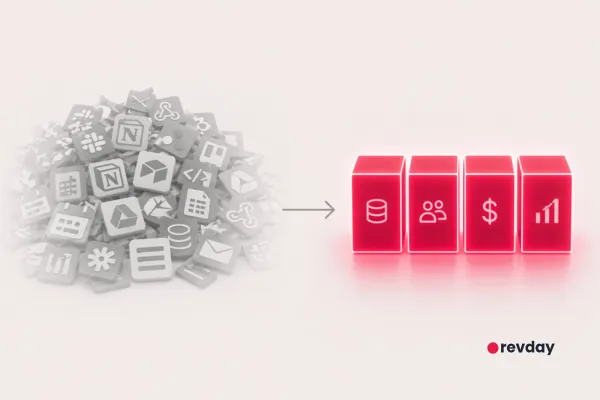
To build your Credibility Footprint, you only need four basic functions. While many founders piece these together using multiple different subscriptions, a consolidated platform like revday allows you to manage your entire footprint in one place.
Professional Communication: Buy a custom domain and set up a professional email address (e.g., using Google Workspace). Sending a proposal from a generic Gmail or Hotmail account immediately damages your premium positioning.
The One-Page Presence: You do not need a multi-page website with a blog. You need a clear LinkedIn profile and a simple, single-page site (which you can build and host directly inside revday) that clearly states your Minimum Viable Offer (MVO).
Frictionless Scheduling: Stop the back-and-forth email chains. Use an integrated calendar (like the one built into revday) so prospects can book directly into your diary. This makes you look organised and respects the buyer’s time.
Simple Payments: You need a professional way to collect money. Connect a Stripe account to your platform so you can generate invoices and accept payments the moment a client says "yes."
The Tools You Must Ignore For Now
To protect your time and your capital, put these four items on a strict "Do Not Buy" list until you have validated your service and secured your first few clients:
Expensive CRM Suites: A free tool or a simple spreadsheet is perfectly fine for managing your first ten conversations. Do not pay for enterprise software before you have enterprise problems.
Complex Project Management Software: Shared documents and a simple checklist are enough early on. You do not need a massive Kanban board to manage yourself.
Marketing Automation: You do not need automated email sequences until you have a reliable flow of inbound traffic.
Over-Engineered Branding: Your business name set cleanly in a standard font looks significantly more professional than a cheap, confusing custom logo. Do not spend thousands on brand guidelines until the market has validated your premium pricing.
Next Step: Taking the Offer to Market
With your Minimum Viable Setup complete, you have enough in place to sell professionally. You know who you help, what you offer, how the model works, and how to show up credibly in the market. The AIM foundations are in place.
Now the real work begins. It is time to stop planning, enter the market, and start generating pipeline.
Explore the next phase: The Foundational Systems Every Service Business Needs Before Scaling