How to Avoid Playing Business and Start Building One
If you are at the earliest stages of starting a service business, it is easy to feel like you are making massive progress while actually standing still.
You might have a domain name registered, a logo half-finished, and a CRM trial started. You have probably drafted several sections of your website and spent hours tweaking your Notion workspace. But if you are honest with yourself, you still have no clear offer, no real customer conversations, and no evidence that the market wants what you are selling.
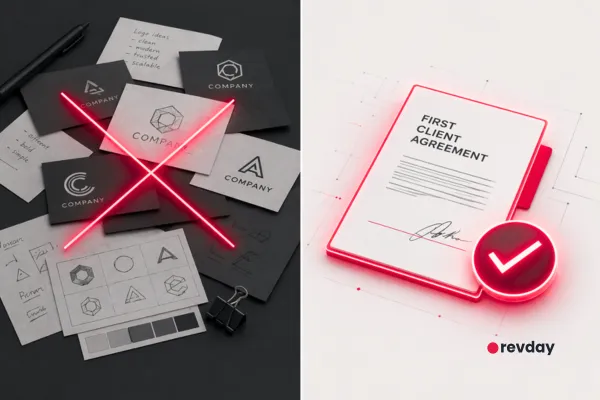
This is "Playing Business." It is doing work that makes the business look real before the market has proven it is real.
You are not behind because you haven’t registered enough things; you are behind because the market still hasn't confirmed that your service is worth paying for. To move forward, you must shift your focus from cosmetic comfort to commercial learning.
What “Playing Business” Actually Looks Like
"Playing Business" is often a form of productive procrastination. It feels like work, but it doesn't reduce market uncertainty. None of these activities are automatically wrong, but they are wrong when they happen before proof.
Common examples of playing business include:
Spending hours choosing brand colours before you have priced your offer.
Building a multi-page website before you have spoken to a single potential buyer.
Opening multiple software accounts before you have decided on your niche.
Researching competitors endlessly without making any contact with the market.
Changing business names instead of testing demand for a solution.
Why Founders Get Pulled Into Administrative Progress
Most startup advice from big-box platforms tells you to start with a business plan, registration, and branding. This is because administrative tasks feel safe. They are finite, they create visible completion, and, most importantly, they protect you from rejection.
According to psychological research into analysis paralysis, overthinking grows when variables are vague and undefined. When the core of your business (your offer and audience) is still a theory, your brain defaults to easier sub-decisions, like choosing a font, to feel productive without the risk of testing whether people actually care.
The Only Work That Counts Early: Commercial Proof
In the AIM Framework, the goal is not administrative setup; it is evidence. Until the market shows real buying intent, you do not have a proven business—you have a theory.
To move past the theory stage, you need three forms of early proof:
Problem Proof: Potential clients clearly recognise and articulate the issue you aim to solve.
Offer Proof: They understand your proposed solution and express a clear desire for it.
Payment Proof: Someone is willing to commit money, a deposit, a pilot fee, or a clear letter of intent to buy.
Active Work vs. Passive Work
To stop playing business, you must ruthlessly prioritise Active Work over Passive Work.
Active Work (Commercial Learning): Speaking to potential buyers, testing your problem statement, shaping your offer, testing price reactions, and sending outreach to secure a first pilot client.
Passive Work (Cosmetic Comfort): Designing logos, printing business cards, shopping for software, and registering every possible legal structure before you know what actually matters.
What You Actually Need Before You Spend on Setup
Most founders spend money far too early. Before you invest in paid tools, professional branding, or legal build-out, aim to have these five things:
A specific audience you can describe in detail.
A painful problem they are motivated to solve.
A simple, packaged offer that promises a transformation.
A rough price range based on real market feedback.
A way to contact prospects and take payment once they say yes.
The 7-Day Exit Plan Out of “Playing Business”
If you have been hiding in administrative tasks, use this 7-day checklist to force yourself back into commercial reality:
Day 1: Choose one specific audience to focus on.
Day 2: Write down the specific, painful problem you think they want solved.
Day 3: Draft a simple, one-page offer.
Day 4: Choose a starting price hypothesis.
Day 5: Contact 10 relevant people in your target audience.
Day 6: Run 2–3 validation conversations.
Day 7: Refine your entire business idea based on what you heard.
Ready to stop overthinking and start choosing your market?
Read the next guide: How to Identify a Premium ICP