Inbound Lead Management for Service Businesses: Stop Losing Leads
You are not short on ways people can contact your business. They can call, text, email, fill out a form on your website, book a time, reply to a post, send an Instagram DM, message your Facebook page, or come through a referral.
That sounds great on paper—until every lead lands somewhere different.
If you are opening four different apps on your phone every morning just to check for new enquiries, you are actively burning money. The missing piece for your service business is not "more leads." It is a better way to catch, organise, and follow up with the leads that are already trying to give you money.
Welcome to the revday way. Let's fix your inbound chaos.
What is Inbound Lead Architecture?
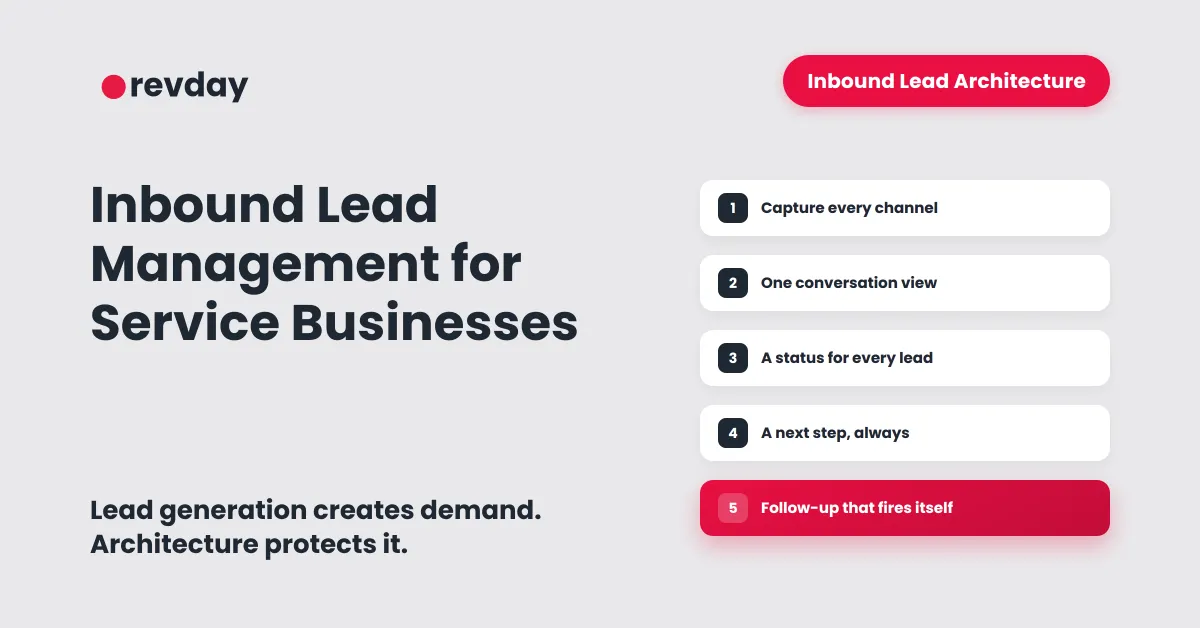
Inbound Lead Architecture is the operational structure that captures every single enquiry, keeps the conversation visible in one place, assigns the lead a status, determines the next step, and makes follow-up happen without relying on your memory.
Lead generation creates demand. Inbound Lead Architecture protects it. If you build a massive lead generation engine without this architecture in place, you are just pouring water into a bucket with no bottom.
The Real Problem is Not Lead Generation. It is Lead Leakage.
Founders often think they have a marketing problem when they actually have a tracking problem. Leads rarely get lost after you've had a great sales call; they get lost in the gap between the first message and the CRM.
When we audited the systems of a local trades founder recently, we found $14,000 worth of unquoted work sitting in a Facebook Messenger inbox that he hadn't checked in 12 days. The leads were there. The architecture was not.
If your enquiries are scattered, your replies are slow, and you have no clear rhythm for following up, your leads will go to the competitor who texts back in five minutes.
Are you bleeding leads right now without realising it? Take our 2-minute Clarity Quiz to find where your leads are leaking and diagnose your exact bottleneck.
Where Inbound Leads Come From in a Service Business
Service businesses do not just deal with neat, tidy "demo requests" like software companies do. You deal with a messy reality across multiple channels.
Phone Calls and Missed Calls
A missed call is not an admin issue; it is a high-intent inbound lead event. If you are on a job site, that missed call needs to instantly trigger an automated text back, log a callback task, and assign an owner.
Read the deep dive: Automating Callbacks and Phone Administration so Leads Never Go Cold.
Website Forms and Quote Requests
Standard "Contact Us" forms are dead. Your website should use smart forms that not only capture information but automatically route the lead to the correct pipeline stage based on what they asked for.
Read the deep dive: High-Converting Lead Forms & Link Trees for Service Businesses.
Instagram and Facebook DMs
Social DMs are not just "engagement." Once someone asks about your service, they are a lead. If you treat your social inbox like a marketing tool rather than a sales channel, you will lose them.
Read the deep dive: Consolidating Facebook, Instagram, and Web Chat into One Inbox.
Email, SMS, and Referrals
Even warm referrals go cold if you rely on scrolling through your iMessages to remember who to follow up with. Every email and text needs to feed into the same central hub.
The 6 Layers of a Clean Inbound Lead System
Stop leads falling through the cracks by building these six non-negotiable layers into your business:
Capture: Every enquiry, regardless of the channel, needs one unified place to land.
Conversation: Every message string (text, email, DM) should be visible in one context view.
Contact Record: Every person gets a profile with their name, number, and lead source.
Status: Every lead must have a stage (e.g., "New Lead," "Quote Sent," "Ghosted").
Next Step: Every lead requires an action (a call, a quote, a booking, or a nurture path).
Follow-up: Every open lead needs a scheduled reminder or an automated sequence.
A CRM is Not the Architecture
A CRM is just a database. It is the container, not the architecture itself.
If you buy a fancy CRM but your capture path is broken (meaning leads are still sitting in your Instagram DMs), your CRM will just become an expensive, empty dashboard. A unified inbox alone doesn't fix it either, unless every conversation in that inbox is tied to a specific pipeline status and next step. The architecture is the operating model that tells the software what to do.
What to Centralise First
Do not try to connect every single app you own on day one. Start by centralising the channels that produce the highest value, or the ones you are most likely to miss.
The revday "Centralise First" Priority List:
Missed calls (Highest intent, highest loss rate).
Website forms and quote requests.
Booking calendar requests.
Instagram and Facebook DMs.
Email and SMS.
Manual referral entry.
Before you start routing these leads, you need to know exactly what you are selling them. Use our free Offer Architecture Tool to map your offer and next step before you automate anything.
The Simple Follow-Up Rhythm for Inbound Leads
Service founders often hate following up because they don't want to sound pushy. But a structured follow-up rhythm isn't pushy; it's professional.
The baseline rhythm:
Same-day response: Immediate acknowledgment of the enquiry (can be automated).
24-hour check-in: If they haven't booked or replied, a quick manual text or call.
3-day follow-up: Providing an asset or answering a common FAQ related to their problem.
7-day close-the-loop: "Hey, haven't heard back, assuming you got this sorted! Let me know if you still need help." (This gets a massive reply rate).
30-day re-engagement: Drop them into your long-term nurture loop.
What Not to Automate Too Early
AI and automation are incredibly powerful, but do not automate scattered inbound chaos.
Do not automate if your offer and pricing are still unclear.
Do not automate poor qualification (don't auto-book bad fits onto your calendar).
Do not try to build workflows for every rare edge case.
Do not automate before you know the exact next step the client should take.
Clarify your offer path before automating so you don't scale a broken system.
What a Good Inbound Lead Architecture Looks Like in Practice
Here is how this works when the architecture is actually installed:
For a Coach or Consultant: A lead sends a DM on Instagram with a specific keyword. The system captures it, sends an automated qualifying question, and once answered, automatically provides a link to book a discovery call. If they don't book within 2 hours, the system follows up.
For a Trade or Local Service: You miss a call while under a sink. The system instantly texts the caller: "Hey, it's [Name]. On a job right now, how can I help?" A task is created on your dashboard reminding you to call them back when you finish.
For a Health or Wellness Provider: A website enquiry comes in. They are sent a booking link. If they book, they get a reminder sequence. If they no-show, they are automatically dropped into a "re-booking" pipeline stage.
When to Get Help Building This Properly
You know you need this if you are currently getting enquiries but losing track of them. If you are relying on your memory to follow up, missing calls, replying late, or paying for marketing but failing to capture the data cleanly, your architecture is broken.
You can spend the next three months trying to wire all these platforms together yourself, or you can have it running perfectly by next week.
Stop letting revenue slip through the cracks. Book a call to map your inbound system and get help centralising your inbound leads today.
FAQs
What is inbound lead management?
Inbound lead management is the process of capturing, tracking, qualifying, and following up with people who contact your business first. It turns raw enquiries from forms, calls, DMs, email, and bookings into clear, tracked next steps.
What is inbound lead architecture?
It is the specific operational structure that ensures every enquiry has one place to land, one owner, one status, and one next action. The goal is not to remember more, but to remove the need to remember.
What is the difference between inbound lead generation and inbound lead management?
Lead generation is the act of attracting attention and getting someone to raise their hand. Lead management is what happens the second after they raise their hand to ensure they actually become a paying client.
What is a lead management system used for?
A lead management system helps a business collect, track, qualify, and convert leads through clear records, reminders, automation, and reporting. For service businesses, its most important job is making sure every single enquiry has a status and a next step.
Do small businesses need lead management?
Yes. Small businesses need lead management because every missed enquiry can cost real revenue, especially when the founder is handling sales, delivery, and administration all at the same time.
How do you stop leads falling through the cracks?
Stop leads falling through the cracks by giving every enquiry a unified inbox, assigning it a pipeline status, and triggering an automated or scheduled follow-up sequence.
What should happen after an inbound lead comes in?
After an inbound lead comes in, it should be captured, acknowledged, qualified, assigned, followed up, and moved to the right next step. That next step may be a call, a quote, a booking, a payment link, or a nurture sequence.
Should I automate inbound lead follow-up?
Yes, but only the baseline touches. You should automate the immediate acknowledgement and the long-term "check-ins," while keeping the high-value, specific conversations strictly human.