Why Charging by the Hour Caps Your Income
A consultant I spoke with used to track her time in six-minute increments, the same way her old law firm job had trained her to. Every call, every email, every half-finished thought in the shower about a client's problem got mentally logged against an hourly rate. She was good at the work. She was still capped at whatever number of hours fit in a week, because that was the only unit she was selling.
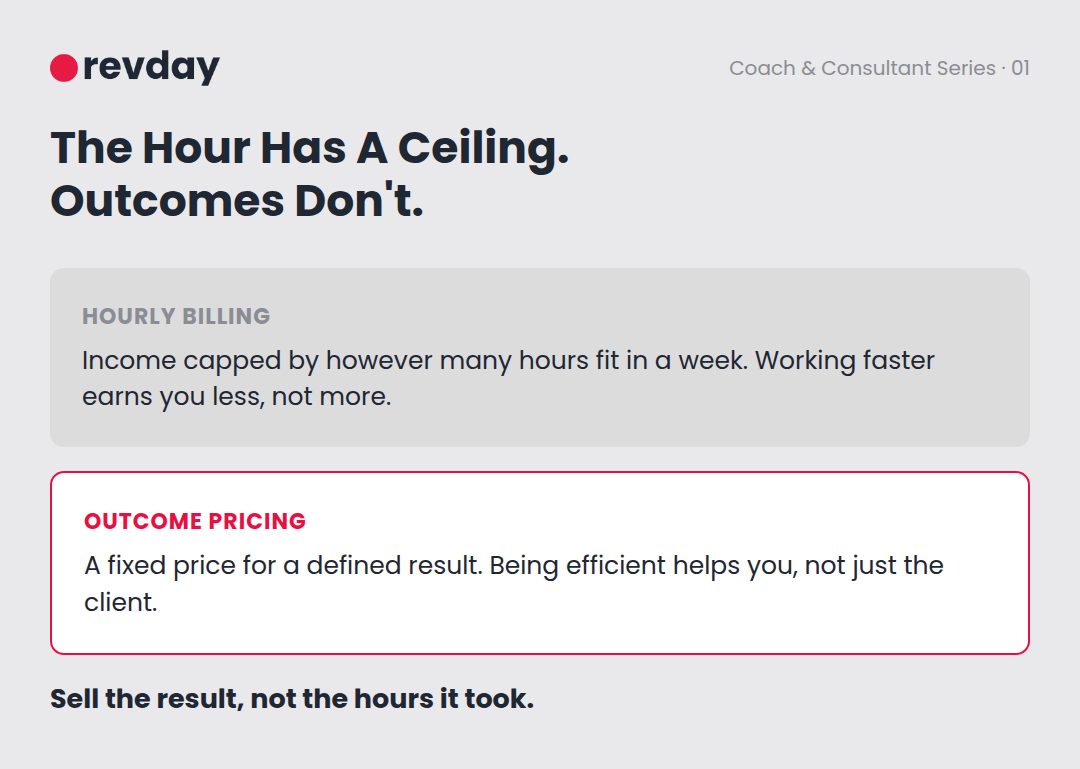
Charging by the hour feels safe. It matches effort to payment, and it's easy to explain to a client. It also means your income has a hard ceiling built into the maths: hours in a week times your rate, minus admin, minus the calls that go long, minus the week you get sick. There's no version of hourly billing where working smarter earns you more, only working longer.
The Hour Is the Wrong Thing to Sell
Clients aren't actually buying your time. They're buying a result, a decision made with more confidence, a problem that stops taking up space in their head. When the invoice is built around hours, the incentive gets twisted: efficiency for the client (you solving their problem faster) directly reduces your income. That's a strange position for skilled advice-based work to be in.
Pricing for the outcome instead of the hour removes that conflict. A fixed price for a defined result rewards you for being good at the work, not for how long the work takes. It also gives the client a number they can say yes to before the meter starts running, shortening the entire sales conversation, the same conversation the pillar post on getting clients as a coach or consultant walks through in more depth.
A Single Price Point Isn't the Fix Either
Some coaches hear "stop charging hourly" and swap one flat rate for another; a single package, take it or leave it. That solves the ceiling problem partway, but it caps who can say yes. A prospect who isn't ready for your core price has nowhere to go, and a client who's outgrown it has nowhere to go either.
A four-tier structure fixes both ends: a low-friction entry point for someone who wants a real result before committing further, a core offer that carries most of your income, and a premium tier for clients who want direct access to you specifically. Priced this way, growth doesn't mean raising your one rate and hoping fewer people say no. It means moving clients through a ladder that already exists. If you want to see this in your own numbers before committing to anything, revday's free pricing tool builds that four-tier structure from your actual costs and hours, and hands you a break-even rate at the end.
How This Actually Gets Built
Building that ladder from scratch, working out what belongs at each tier and what each one should cost, is exactly what gets structured inside BLAST. It's not a pricing worksheet you fill in once, it's built with you against your actual client base and adjusted as you learn what converts.
Two problems this post leaves open: what to actually put inside each tier when you're staring at a blank page (how to stop quoting from a blank page and build your offer once), and why income can still feel inconsistent even once the tiers exist (why your income is inconsistent even with real clients).

